Who’s Ready For Multi-Agents? Get Your Business AI-Ready
Quick answer
A business is ready for multiple AI agents when its workflows are clear, authoritative knowledge is governed, permissions are enforceable, handoffs can be observed, and accountable owners can evaluate the complete outcome.
Key takeaways
Agent readiness is an operating-model question, not a model-access question.
Shared evidence and identity controls prevent a new generation of silos.
Start with one coordinated workflow and explicit human checkpoints.
Measure end-to-end outcomes before increasing autonomy or agent count.
For organizations exploring multi-agent AI readiness, the central design question is not whether AI can produce an output. It is whether that output can be verified, governed, and used responsibly. Speed and fluency are useful, but they are not sufficient when an answer informs policy, customer communication, research, or an operational decision. The system must work from trusted evidence, show how that evidence shaped the output, respect the user’s permissions, and involve an accountable person when consequences rise.
Nouswise approaches this problem as a trust-first AI research and knowledge platform. It helps enterprises and public institutions organize curated internal knowledge and approved public content, ask source-grounded questions, preserve citations and traceability, and turn verified findings into reusable outputs. The following framework applies that perspective to the topic.
Multi-agent systems amplify the organization they enter
Specialized agents can divide complex work into retrieval, analysis, drafting, verification, and coordination. But they also magnify unclear ownership, inconsistent data, and fragmented permissions. If the underlying workflow is poorly understood, adding agents may make it faster without making it better.
Readiness begins with operational clarity. Teams should know what result matters, which steps require judgment, which sources govern the work, and who owns the final decision. Only then is it useful to decide how many agents participate.
Readiness check 1 Workflows and outcomes
Choose a workflow with stable stages, repeat demand, and a measurable outcome. Document the inputs, exceptions, handoffs, and approval points. An agent should have a job description as clear as a new team member’s: purpose, boundaries, expected output, and escalation route.
If teams disagree about the process, resolve that first. Multi-agent orchestration depends on clean contracts between roles. Ambiguous handoffs create hidden errors that can survive into a polished final response.

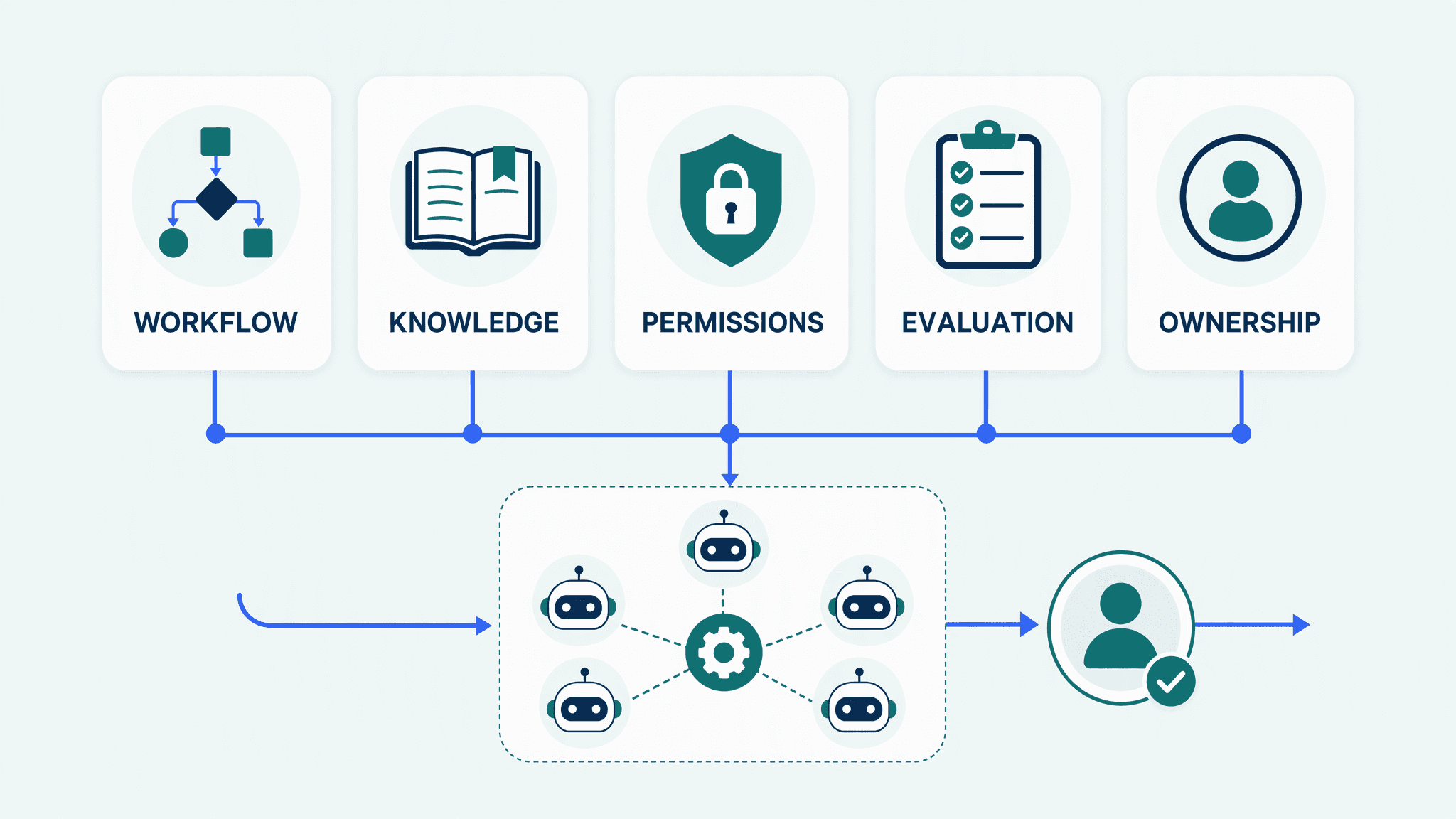
Multi-agent readiness depends on workflows, knowledge, permissions, and evaluation—not model capability alone.
Readiness check 2 Knowledge and data
Agents need a common evidence base with current versions, source owners, and machine-readable structure. They also need a way to distinguish approved internal material from exploratory notes and public web content. Without those distinctions, specialization simply produces multiple interpretations of uncertain facts.
Nouswise can provide a governed knowledge foundation for agentic research. Specialized roles can work over curated collections while citations and provenance remain attached to the output. This reduces duplication and makes cross-agent reasoning easier to audit.
Readiness check 3 Permissions and oversight
Map access at the user, agent, source, tool, and action levels. A retrieval agent may read a policy library but not a confidential personnel folder. A drafting agent may prepare a response but not send it. An approval agent should not replace the authorized human for a consequential decision.
Use least privilege, explicit action gates, and durable logs. When a workflow crosses departments, define who investigates failures and who can change instructions, source access, or tool permissions.

Scale from one bounded workflow only after evidence, controls, and adoption prove stable.
Readiness check 4 Evaluation and adoption
Create test cases for the complete workflow, including no-answer situations, conflicting evidence, broken integrations, and handoff failures. Measure factual support, citation accuracy, policy compliance, completion rate, human review effort, and user trust.
Launch with a small group that understands the work and can provide precise feedback. A business is AI-ready when it can learn from the system responsibly—not when it can deploy the largest number of agents.
Frequently asked questions
What are multi-AI agents?
They are multiple specialized AI agents that coordinate across distinct roles or stages to complete a larger workflow.
How do I know if my business is ready?
You need a clear workflow, governed knowledge, enforceable permissions, observable handoffs, evaluation data, and accountable owners.
Should every department have its own agent?
Not automatically. Create an agent only when specialization improves quality, access control, or workflow clarity.
Why is a shared knowledge layer important?
It gives agents a consistent evidence boundary and preserves citations and provenance as work moves between roles.
How Nouswise helps
Nouswise is an autonomous, AI thinking partner for enterprises that turns scattered information into source-grounded insights, action, and reusable organizational knowledge.
What Nouswise adds to your team
Semi-automated (human-in-the-loop) or fully automated workflows — delegate data collection, research, analysis, and follow-up actions to configurable AI agents.
Multimodal content and artifact generation — create text, spreadsheets, diagrams, slide decks, code, audio, and video from a single prompt or workflow.
Source-traceable answers in 70+ languages — every statement links back to its original source for fast verification, auditability, and compliance.
Support for unlimited, heterogeneous data inputs — work across Excel, Word, PDFs, images, diagrams, databases, audio, video, live webpages, and proprietary file types.
Curated knowledge libraries with citations — preserve organizational context and make trusted knowledge reusable across teams and projects.
Enterprise-grade security and deployment controls — could run on-premises or in a private cloud with permissions, redaction, and complete audit trails.
Agentic search-and-act execution — connect retrieval, reasoning, decision-making, and tool use so insights can immediately trigger action.
Next step: Select one bounded, evidence-rich workflow and evaluate it with real questions before expanding scope or autonomy.
Suggested internal links
Written by:

René Kobelt
Business Development
Share with friends: