Regulatory Change Management: From New Rule to Approved Internal Guidance

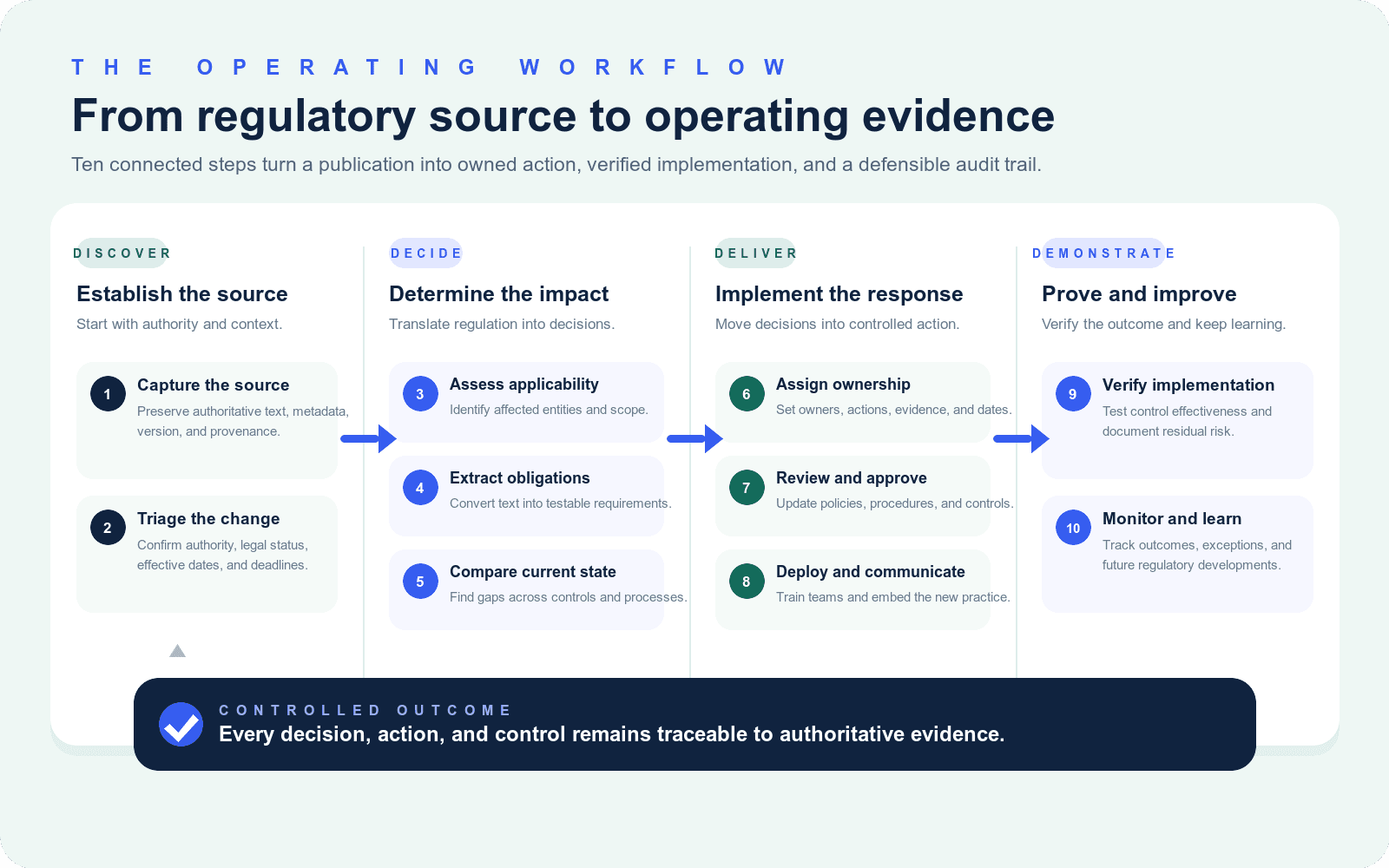
Finding a new regulatory publication is not the same as managing regulatory change. The difficult work begins after discovery: determining authority and scope, resolving ambiguity, identifying affected products and processes, assigning accountable owners and proving that the required change occurred.
A dependable process must connect every internal action to evidence. Teams should be able to move in both directions:
from a new source to the obligations, controls and owners it affects; and
from an internal policy or decision back to the authoritative source and reasoning behind it.
This guide provides a ten-step regulatory change management process for doing that consistently. It complements Nouswise’s articles on open-banking policy intelligence and the PSD3 and Payment Services Regulation research process.
Key takeaways
Use approved primary sources and preserve publication, effective and supersession dates.
Separate discovery, applicability, interpretation and implementation; they require different evidence and owners.
Translate text into atomic obligations before assigning actions.
Preserve a decision trail for non-applicability and “no change required” conclusions.
AI can accelerate search, comparison and drafting, but accountable professionals must approve consequential interpretations.
Measure cycle time and overdue actions without sacrificing legal quality or evidence.
Why monitoring alone is not enough
Regulatory monitoring answers: “What changed?” Regulatory change management answers five additional questions:
Does the change apply to us?
What exactly must or should change?
Which policies, controls, systems, products and communications are affected?
Who is accountable, and by when?
What evidence demonstrates implementation?
A news alert or summary cannot answer all five. It may omit definitions, territorial scope, transitional provisions or later corrections. The workflow must retain the primary material and the organization’s reasoning.

Step 1: Capture the authoritative source
Define an approved source universe for each jurisdiction and topic. It may include:
official journals and legislation portals;
regulator and supervisory-authority publications;
binding technical standards;
decisions and enforcement notices;
consultations and policy statements;
recognized standards bodies; and
approved internal legal interpretations.
For every item, capture:
source URL or controlled file;
issuing authority;
document type and legal status;
publication date;
application or effective date;
jurisdiction and affected entity type;
language and official translation status; and
relationship to earlier material.
Secondary commentary can accelerate discovery and interpretation, but it should not silently replace the primary source.
Step 2: Triage authority, status and deadlines
Triage determines the path and urgency.
Classify the item as, for example:
binding law or regulation;
final supervisory guidance;
consultation or draft;
enforcement or judicial development;
market or technical standard;
explanatory material; or
duplicate or non-relevant publication.
Record important dates separately. Publication, entry into force, application, transition and reporting deadlines are not interchangeable.
Assign an initial priority based on authority, deadline, affected operations, customer or market impact, potential harm and uncertainty. Do not use a risk score to hide a hard legal deadline.
Step 3: Assess applicability
Applicability is a reasoned decision, not a checkbox.
Evaluate:
legal entity and license;
jurisdiction and cross-border activity;
product, service and customer type;
transaction or revenue thresholds;
operational role: provider, distributor, processor, deployer or another defined role;
effective and transitional dates; and
exemptions or proportionality provisions.
Document the conclusion, reviewer and evidence. A “not applicable” decision may deserve as much explanation as an applicable one, because it determines whether the workflow stops.
If facts are missing, create a request for the business owner rather than allowing the research team to guess.
Step 4: Translate the change into obligations
Break the source into atomic obligation statements. Each should answer:
Who must act?
What must they do or avoid?
When must it happen?
Under what conditions?
What evidence demonstrates completion?
Keep the source passage attached. Distinguish:
explicit requirements;
supervisory expectations;
permissions or options;
definitions and scope conditions;
transitional provisions; and
internal interpretation.
Do not convert every paragraph into an action. Definitions and contextual provisions may instead govern how other obligations are interpreted.
Step 5: Compare obligations with the current state
Map each obligation to the current control environment:
policy and procedure;
process owner;
system behavior;
product term or customer communication;
data field or report;
training material;
control and test; and
existing evidence.
Classify the gap:
no change required;
documentation clarification;
control enhancement;
process redesign;
system or data change;
customer remediation; or
further legal interpretation needed.
Record the rationale. A gap analysis should make it clear why an existing control is sufficient or why a change is necessary.
Step 6: Assign owners, actions and evidence
Every action needs an accountable owner, target date and completion evidence.
Role | Typical responsibility |
|---|---|
Regulatory intelligence | Capture and classify the source |
Legal or regulatory affairs | Interpret authority, scope and ambiguity |
Compliance | Translate obligations and define oversight |
Business or product owner | Implement operational change |
Technology or data owner | Implement system, integration and reporting changes |
Risk or control function | Challenge, test and record residual risk |
Governance committee | Resolve material disagreements and approve high-impact decisions |
Accountability should not be diluted across a long distribution list. Use a RACI or equivalent model, but name one accountable owner for each decision and action.
Step 7: Update and approve internal guidance
Drafting should preserve traceability.
For every material policy change:
link the draft to the triggering source and obligation;
distinguish mandatory language from internal control choices;
use defined terms consistently;
identify affected documents and owners;
preserve review comments and resolution;
record approvers and approval date; and
assign a review or expiry date.
Avoid copying regulatory language into a policy without explaining the required behavior. Internal guidance should tell the intended user what to do, who decides and where evidence is recorded.
Step 8: Communicate, train and attest
Publication alone does not demonstrate adoption.
Choose communication according to impact:
targeted notice for a small procedural change;
role-specific training for new judgment or workflow requirements;
customer or partner communication where obligations affect them;
formal acknowledgement or attestation where justified; and
updated job aids, forms and system prompts at the point of work.
Track the population, completion, exceptions and follow-up. Training should use realistic scenarios and explain escalation, not merely restate the new policy.
Step 9: Verify implementation
Completion evidence should demonstrate operation, not just intention.
Possible evidence includes:
approved policy and procedure;
configured system control;
test result;
sample transaction review;
training completion;
customer communication;
updated report or data field;
vendor confirmation; and
control-owner attestation supported by evidence.
Independent testing may be appropriate for high-impact changes. If an action is accepted late, partially implemented or subject to a compensating control, record the decision, risk owner and expiry date.
Step 10: Monitor and learn
The process continues after implementation.
Monitor:
corrective publications and FAQs;
supervisory speeches or enforcement that alter interpretation;
missed or reopened actions;
incidents and complaints;
control-test results;
recurring employee questions; and
evidence that the internal guidance is difficult to use.
Feedback can improve both the control and the underlying knowledge. Repeated questions may signal that a policy is ambiguous, not that users need another reminder.
Useful metrics include:
Metric | What it reveals |
|---|---|
Time from publication to triage | Discovery and intake speed |
Time from triage to applicability decision | Research and decision bottlenecks |
Obligations without owners | Accountability gaps |
Actions overdue by impact tier | Delivery risk |
Reopened or reversed decisions | Interpretation or evidence quality |
Time required to retrieve supporting evidence | Audit readiness |
Repeated user questions after publication | Guidance usability |
Metrics should encourage timely, well-supported decisions—not rushed closure.
Where AI can help—and where it should stop
AI can support:
monitoring approved sources;
extracting dates, entities and definitions;
comparing a new publication with earlier versions;
finding related internal policy;
drafting obligation candidates;
assembling evidence-linked briefing material; and
identifying recurring questions and knowledge gaps.
AI should not silently determine legal applicability, approve a consequential interpretation or close an implementation action. These steps require accountable organizational judgment.
The 2026 CHI paper on AVA describes a useful model for bounded research: a curated library of 4,000+ World Bank reports, specialized retrieval and synthesis components, page-linked citations and reasoned abstention when the available evidence cannot support an answer.[ava] In a five-month field evaluation, participants described AVA as a specialized evidence engine. The design lesson for regulatory change is clear: useful AI should make the evidence path and system boundary easier to inspect.
For a buyer-oriented view, see AI Regulatory Research Platforms: A Buyer’s Guide. Nouswise can support curated, source-grounded research, but the organization remains responsible for approval, implementation and legal judgment.
Frequently asked questions
What is the difference between regulatory monitoring and regulatory change management?
Monitoring identifies new or changed material. Change management determines applicability, translates the material into obligations, implements actions and preserves evidence of the result.
What should a regulatory change record contain?
At minimum: authoritative source, status, dates, jurisdiction, applicability decision, obligation statements, affected controls, owners, actions, approvals and implementation evidence.
Can AI determine whether a regulation applies?
AI can help locate and compare relevant provisions, but applicability depends on legal and organizational facts. A qualified, accountable person should approve consequential conclusions.
How should consultations and draft rules be handled?
Track them separately from binding requirements. They can support scenario planning and early preparation, but their draft status and uncertainty must remain visible.
When is a regulatory change complete?
Completion requires more than an approved action plan. The required policy, process, system or communication must be implemented, evidenced and verified at the level appropriate to its impact.
Written by:

Elizabeth Sims
Senior Business Developer
Share with friends: