Verifiable AI vs Enterprise RAG: What Regulated Teams Actually Need

Basic RAG retrieves context; verifiable AI adds governed sources, claim-level evidence, permissions and review.
Enterprise retrieval-augmented generation (RAG) is a technical pattern that retrieves information and supplies it to a generative model. Verifiable AI is an operational outcome in which users can inspect the evidence behind material claims, understand limitations and reproduce the path from question to answer.
The two are not competitors. RAG can be part of a verifiable system. But deploying a vector database and adding citations does not automatically make an AI answer trustworthy enough for regulated work.
What enterprise RAG does
A basic RAG pipeline usually works as follows:
Documents are parsed into smaller units or chunks.
Those chunks are represented for search, often with embeddings.
A user asks a question.
The system retrieves relevant chunks.
A language model creates an answer using the retrieved context.
The original RAG research showed how retrieval can combine external memory with generation. In enterprise systems, the pattern is attractive because organizations can use their own content without retraining a model for every update.
RAG can improve relevance and reduce some unsupported answers. It can also fail at every step.
Why a working RAG demo may fail in production
The wrong passage is retrieved
Semantic similarity is not the same as legal or operational authority. A commentary document may rank above the controlling policy. A general paragraph may rank above a decisive exception.
Document structure is lost
Chunking can separate a rule from its heading, definition, table or footnote. The model sees text but loses the relationship that gives it meaning.
Source status is invisible
A draft, withdrawn policy and current policy may all exist in the same index. Without metadata and governance, retrieval can select the wrong version.
The model exceeds the evidence
Even with useful context, a model may add an unsupported detail, collapse uncertainty or present an inference as a fact.
Citations are decorative
Some systems attach sources after generating the answer or link to documents that mention the subject without supporting the claim. A citation is useful only when it entails the statement beside it.
Access controls do not survive retrieval
An index assembled without permission awareness can expose information across teams. Enterprise search must preserve the authorization model of the underlying content.
What makes an AI answer verifiable?
A verifiable answer has more than a source list.
Claim-level evidence
Important statements are connected to precise passages. Users can move from the claim to the evidence without repeating the research manually.
Source identity and status
The interface shows who issued the source, when it was published, which version is used and whether it is binding, advisory or internal.
Faithful synthesis
The answer does not go materially beyond the retrieved evidence. Where the model draws an inference, the distinction is visible.
Uncertainty and refusal
The system identifies missing or conflicting evidence and can decline to give a definitive conclusion.
Reproducibility
An organization can retain enough context to investigate how an answer was produced: the question, sources, passages, configuration and relevant version information.
Accountable review
The workflow makes clear who verifies the answer and what decisions may be made with it.
Enterprise RAG and verifiable AI compared
Dimension | Basic enterprise RAG | Verifiable AI system |
|---|---|---|
Goal | Provide relevant context to a model | Produce an answer a person can inspect and govern |
Sources | Documents available to retrieval | Approved, classified and versioned evidence |
Citations | May link to retrieved documents | Claims linked to supporting passages |
Permissions | Often added around the application | Enforced through retrieval and output |
Uncertainty | Model may answer regardless | Abstention and conflict are designed behaviors |
Evaluation | General answer quality | Retrieval, entailment, completeness and faithfulness |
Change control | Index and model updates | Controlled source, prompt, model and workflow changes |
Human role | End user consumes answer | Named reviewer validates consequential use |
The difference is not one feature. It is the quality of the complete evidence workflow.
How to evolve an enterprise RAG system
Step 1: govern the corpus
Assign owners, remove obsolete content and add metadata for authority, version, jurisdiction and effective dates.
Step 2: improve retrieval evaluation
Build a benchmark that tests whether the system retrieves controlling provisions and exceptions. Measure performance by question type.
Step 3: bind citations to claims
Require the system to show which passage supports which statement. Test entailment with expert reviewers.
Step 4: design uncertainty
Create behaviors for insufficient, conflicting or out-of-scope evidence. A controlled refusal is often more valuable than a fluent guess.
Step 5: preserve permissions
Ensure document access is checked at query time and that generated answers cannot reveal restricted content indirectly.
Step 6: add operational governance
Control source updates, model changes, prompts, evaluation thresholds, incidents and user feedback.
Step 7: monitor real use
Analyze recurring questions, verification behavior and failure reports. Use that information to improve both the system and the underlying guidance.
A benchmark for accuracy-critical RAG
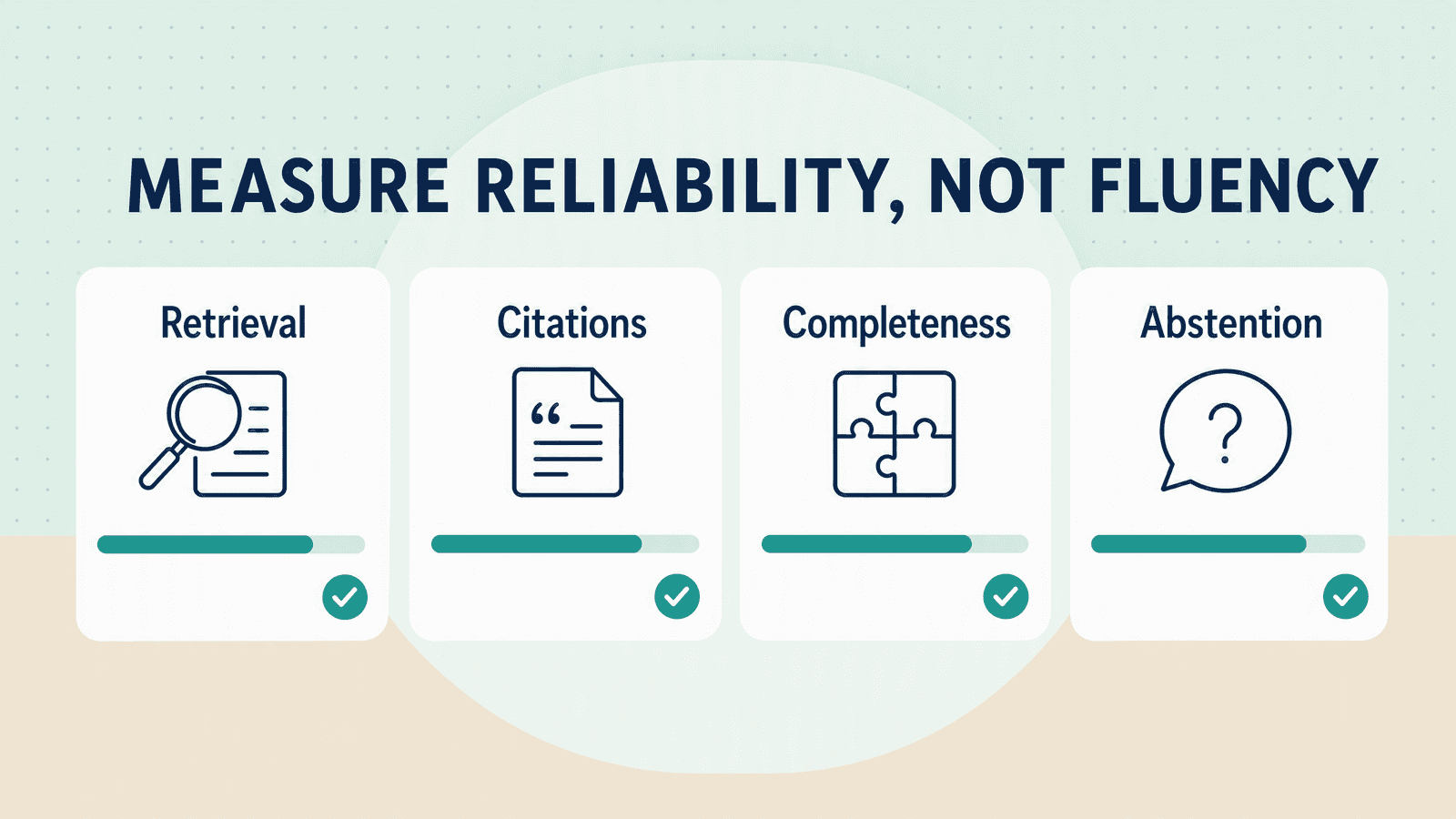
Accuracy-critical evaluation should measure retrieval, citation support, answer completeness and appropriate abstention.
Build a representative set of questions with expert-approved answer elements and evidence. Include:
direct lookup questions;
questions requiring multiple sources;
exceptions and definitions;
conflicting documents;
obsolete terminology;
incorrect assumptions;
questions the corpus cannot answer.
For each response, score:
retrieval relevance;
citation correctness;
material completeness;
unsupported-claim rate;
appropriate uncertainty;
time required for human verification.
Do not hide these dimensions inside one aggregate score. A system with excellent writing and poor citation entailment is not ready for evidence-sensitive work.
How Nouswise goes beyond a basic RAG interface
Nouswise is designed around curated knowledge and evidence-linked research ("knowledge controlled layer"). Teams can create approved libraries, ask questions across those sources and inspect the material behind an answer.
The platform is intended to support an institutional workflow rather than offer an isolated chat box. Organizations can use it to centralize trusted content, make verification easier and understand which questions recur across users. Deployment can be discussed across hosted, dedicated and on-premise models.
No technical architecture removes the need for expert testing or human responsibility. Nouswise’s role is to make the evidence workflow more usable and governable.
Frequently asked questions
Is RAG obsolete?
No. RAG remains a useful technical pattern. The problem is treating it as a complete trust and governance solution. Alternatively, Nouswise's harness AI takes many elements into account that enables it to provide trust and governance.
Does a larger language model make enterprise RAG reliable?
A stronger model may improve synthesis, but it cannot correct an obsolete corpus, missing permissions or consistently poor retrieval. Reliability depends on the whole system.
What is citation entailment?
Citation entailment asks whether the cited passage actually supports the associated claim.
Can verifiable AI guarantee a correct answer?
No. It makes answers easier to inspect and can reduce certain risks. The system needs testing and proportionate human review (human in the loop). Also the reliability of the source itself would be under question if you don't know them.
Final words
Enterprise RAG answers the engineering question: “How can a model use our documents?” Verifiable AI answers the institutional question: “How can a person determine whether this answer deserves to be used?”
Regulated teams need both a capable retrieval architecture and a defensible evidence workflow. Nouswise can help evaluate that workflow with a curated corpus and an expert-reviewed benchmark.
Written by:

Reza Yazdanfar
CEO
Share with friends: