AI Governance for Regulated Organizations: From Policy to Operational Controls

Operational governance connects each AI use case to approved evidence, testing, accountability and continuous monitoring.
AI governance is the system of decision rights, controls and evidence used to ensure that AI is selected, built, deployed and monitored responsibly. For a regulated organization, a policy is only the beginning. Governance becomes real when every use case has an owner, a defined purpose, an approved information boundary, proportionate testing and a clear path for human intervention.
The EU AI Act became generally applicable on 2 August 2026, subject to specific exceptions and timelines. Financial institutions must also consider existing obligations and supervisory expectations covering governance, outsourcing, operational resilience, data, conduct and model risk. The practical challenge is to connect these requirements into one operating model.
What effective AI governance must answer
For every AI use case, an institution should be able to answer:
What is the system intended to do?
Who owns the outcome?
Which users and people may be affected?
What information enters and leaves the system?
Which models, providers and infrastructure are involved?
What could go wrong, and how consequential would it be?
How was the system tested before approval?
Where is human review required?
How will changes, incidents and performance be monitored?
What evidence proves that the controls operate?
If those answers exist only in separate spreadsheets and committee minutes, oversight becomes slow and incomplete. Good governance creates a traceable line from purpose to control to evidence.
Start with the use case, not the model
The same model can support very different risk profiles. Summarizing a public report is not equivalent to recommending whether a customer qualifies for a product.
A useful inventory records:
business purpose;
system and model providers;
users and affected parties;
data and source categories;
outputs and downstream decisions;
degree of automation;
jurisdictions;
accountable business and technical owners;
current approval status.
This use-case view also helps determine whether the organization is acting as a provider, deployer, importer or another defined role under relevant rules.
Create proportionate risk tiers
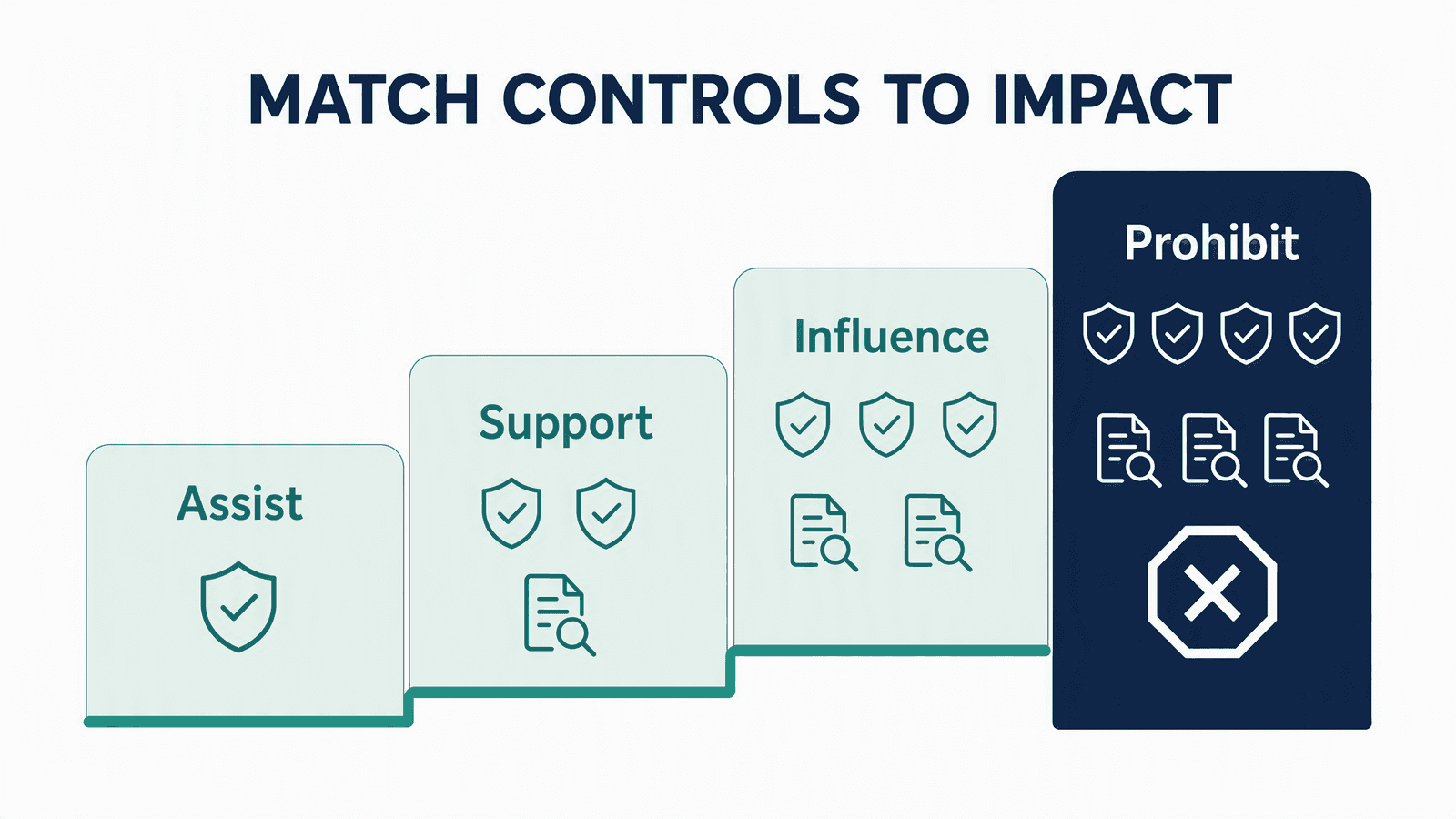
Controls should become stronger as an AI system moves from low-impact assistance toward consequential decisions.
Not every use of AI needs the same process. A practical internal framework might distinguish:
Low-impact assistance
Examples: summarizing public material or improving the structure of a non-sensitive draft. Controls may focus on approved tools, disclosure and basic review.
Controlled professional support
Examples: regulatory research, internal policy Q&A or document comparison. Controls should include approved sources, citations, access restrictions, benchmark testing and professional review.
Decision-influencing systems
Examples: tools that contribute to customer, employee, credit, fraud or compliance decisions. These require stronger validation, oversight, documentation and monitoring.
Prohibited or unacceptable uses
The organization should identify uses that are prohibited by law or internal policy and prevent them through access, procurement and monitoring controls.
Internal tiers do not replace legal classification. They help route use cases through the correct review process.
The seven operational control domains
1. Purpose and accountability
Define the intended use, prohibited uses and accountable owner. Approval should expire or require review when the purpose materially changes.
2. Data and source governance
Document what data the system may process, where it originates and who controls it. For knowledge assistants, distinguish approved authorities from commentary and user-added sources.
3. Model and supplier governance
Record model versions, service dependencies, locations, contractual terms and change-notification arrangements. A product label alone is not an adequate supplier inventory.
4. Evaluation
Test the system against representative tasks and foreseeable misuse. For generated answers, measure unsupported claims, citation quality, completeness, bias where relevant and the ability to abstain.
5. Human oversight
Define who reviews which outputs, what information they receive and how they can override or stop the process. “Human in the loop” is meaningful only if the human has time, competence and authority.
6. Transparency and records
Give users the information necessary to understand the system’s role and limitations. Retain evidence proportionate to the use case, including approvals, tests, changes and incidents.
7. Monitoring and incident response
Track whether the system remains effective after changes to models, prompts, sources or workflows. Establish thresholds for investigation, rollback and notification.
Governance for generative research systems
Generative research tools need several controls that conventional software reviews may miss.
Retrieval quality
The model cannot use evidence it never receives. Test whether retrieval finds controlling provisions, relevant exceptions and updated documents.
Citation entailment
Confirm that a cited passage supports the associated claim. A real citation can still be misleading.
Prompt and instruction changes
System prompts influence how evidence is used and uncertainty is expressed. Treat material prompt changes as controlled configuration changes.
Source lifecycle
Define how documents are approved, versioned, replaced and withdrawn. An obsolete policy inside a well-performing model still creates an obsolete answer.
Adversarial content
Documents may contain instructions intended to manipulate an AI system. Secure ingestion and testing should consider prompt injection and data exfiltration scenarios.
A governance workflow that teams can operate
Stage | Owner | Required evidence |
|---|---|---|
Intake | Business sponsor | Purpose, users, data and expected benefit |
Classification | Risk and legal functions | Risk tier and applicable obligations |
Design | Product and technology | Architecture, source and access model |
Validation | Independent or qualified reviewer | Test set, results and known limitations |
Approval | Accountable authority | Conditions, residual risk and review date |
Operation | Business and technology owners | Monitoring, incidents and user feedback |
Change | Change authority | Impact assessment and regression testing |
Retirement | Business and records owners | Access removal, retention and deletion evidence |
The process should be rigorous but not identical for every tier. Excessive process pushes low-risk experimentation into the shadows; insufficient process exposes the institution to uncontrolled use.
How Nouswise supports governed research
Nouswise is designed for research over curated sources. Organizations can define approved knowledge collections, control who can access them and keep answers connected to supporting material. This makes it easier to test not just the wording of an answer, but the evidence behind it.
Usage patterns can also help content owners see where employees or external stakeholders repeatedly ask for clarification. That turns the research interface into a feedback mechanism for better guidance.
Deployment and integration can be discussed around the organization’s risk requirements, including dedicated and on-premise options. Nouswise should form one controlled component of the institution’s governance framework—not substitute for that framework.
Frequently asked questions
Who should own AI governance?
Governance is usually cross-functional. Business owners remain accountable for outcomes, while legal, risk, compliance, privacy, security, technology and procurement contribute specialist controls.
Does the EU AI Act apply to every AI research assistant as a high-risk system?
No. Classification depends on intended purpose and the circumstances of use. Organizations should assess each use case against the legal definitions and obtain qualified advice where necessary.
How often should an AI system be reevaluated?
Set a periodic review based on risk and trigger additional review after material changes to models, sources, prompts, data, integrations or intended use.
What is the most useful first governance artifact?
A complete use-case inventory with owners is often the best starting point. An organization cannot govern systems it has not identified.
Conclusion
AI governance succeeds when it changes everyday decisions: which sources can be used, which tests must pass, who reviews an output and what happens when the system changes. Principles establish direction; operational controls create accountability.
Nouswise can help organizations pilot a governed, source-grounded research workflow with a defined purpose, approved corpus and measurable evaluation criteria.
Written by:

Elizabeth Sims
Senior Business Developer
Share with friends: