How to Make AI a Trusted Business Partner With Anti-Hallucination Practices
Quick answer
AI becomes a trusted business partner when it is constrained by approved evidence, required to cite that evidence, evaluated against real tasks, and allowed to say when the available sources are insufficient.
Key takeaways
Treat hallucination control as a system design problem, not a prompt-writing trick.
Ground every important answer in an approved, current source set.
Make citations, uncertainty, and review paths visible to the user.
Evaluate retrieval and answer quality with representative business questions.
For organizations exploring AI anti-hallucination practices, the central design question is not whether AI can produce an output. It is whether that output can be verified, governed, and used responsibly. Speed and fluency are useful, but they are not sufficient when an answer informs policy, customer communication, research, or an operational decision. The system must work from trusted evidence, show how that evidence shaped the output, respect the user’s permissions, and involve an accountable person when consequences rise.
Nouswise approaches this problem as a trust-first AI research and knowledge platform. It helps enterprises and public institutions organize curated internal knowledge and approved public content, ask source-grounded questions, preserve citations and traceability, and turn verified findings into reusable outputs. The following framework applies that perspective to the topic.
Why confident answers can still be wrong
A language model is optimized to produce a plausible continuation, not to guarantee that every sentence is supported by evidence. When a question is ambiguous, the source material is incomplete, or retrieval returns the wrong passage, the model can bridge the gap with language that sounds convincing. That is the practical shape of an AI hallucination in business work: fluency without a defensible source trail.
The risk increases when teams ask one assistant to work across policies, contracts, market reports, customer material, and public web content without defining which sources are authoritative. Anti-hallucination practice therefore begins before the prompt. It starts with the knowledge boundary, access rules, document quality, and the decision about what the system should do when evidence is missing.
Build the first defense around trusted sources
Create a curated source library for each business domain. Prefer primary documents, approved policies, final reports, and current versions. Preserve titles, dates, owners, and version information so an answer can be traced to the material that shaped it. Remove duplicates and superseded drafts before they become competing evidence.
Nouswise is designed for this source-first pattern. Teams can organize internal knowledge and approved public content into focused workspaces, ask questions against that evidence, and keep the answer connected to citations. The goal is not to give the model more text; it is to give it the right text and a clear boundary for what counts as support.

Trust starts by narrowing the knowledge boundary: approved sources in, cited answers out.
Make the workflow prefer evidence over completion
A reliable workflow should distinguish between supported facts, reasonable synthesis, and unresolved questions. Require the system to quote or cite the relevant passage for material claims. Ask it to identify conflicting sources, state important assumptions, and abstain when the available evidence cannot answer the question. These controls reduce the pressure to manufacture a complete response.
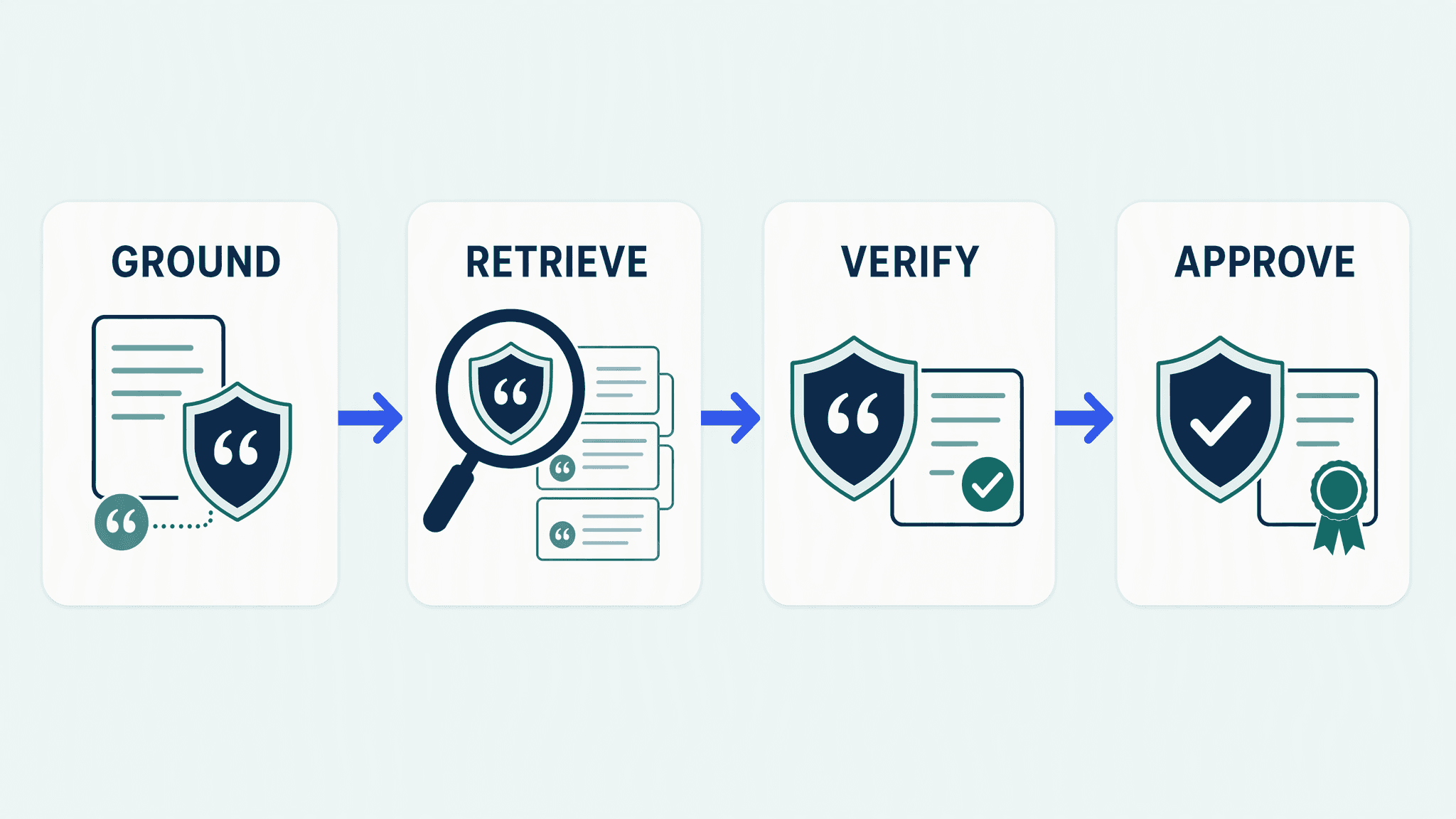
For higher-risk work, break the task into stages: retrieve, compare, synthesize, verify, and approve. This makes failure easier to detect than a single long prompt. A reviewer can inspect whether the right sources were found before spending time polishing the final output.
Test the questions that matter in real work
Generic benchmarks rarely reveal the weaknesses that frustrate employees. Build an evaluation set from recurring questions, known edge cases, outdated terminology, ambiguous requests, and documents with similar names. Score whether the correct source was retrieved, whether the answer is supported, whether citations point to the right passage, and whether the system declines appropriately.
Evaluation should continue after launch. Source libraries change, access rights evolve, and user questions expose new failure modes. A practical RAG scorecard turns these observations into measurable work instead of relying on whether an answer merely feels credible.

Separating retrieval, comparison, synthesis, verification, and approval makes failures easier to detect.
Use human review where consequences are real
Human oversight is not a sign that AI failed. It is a control matched to consequence. Legal interpretations, clinical decisions, public claims, financial approvals, and security actions require accountable owners. The assistant can accelerate discovery and synthesis while the authorized person confirms the decision.
The strongest trust signal is a transparent path from question to evidence to approval. Nouswise supports that pattern by keeping trusted sources, grounded answers, reusable notes, and governed outputs connected. AI earns a larger role as the organization can repeatedly demonstrate that this chain works.
A practical implementation checklist
Name the workflow owner, affected users, and measurable business outcome.
Define the authoritative sources, their owners, versions, freshness rules, and access restrictions.
Separate retrieval, drafting, recommendation, approval, and execution permissions.
Create representative tests for normal cases, ambiguity, conflict, missing evidence, and unsafe requests.
Require citations for material claims and an explicit response when evidence is insufficient.
Log sources, tools, approvals, exceptions, and user feedback so the system can improve.
Frequently asked questions
What is an AI hallucination?
An AI hallucination is a statement that sounds plausible but is unsupported, inaccurate, or fabricated. In enterprise use, the most important test is whether a material claim can be traced to an approved source.
Can prompting eliminate hallucinations?
No. Better prompts help, but reliable performance also depends on source quality, retrieval, permissions, evaluation, and human review.
What should AI do when evidence is missing?
It should clearly state that the available sources are insufficient, explain what is missing, and suggest the next verification step instead of inventing an answer.
How does Nouswise reduce hallucination risk?
Nouswise centers work on curated sources, grounded answers, citations, traceability, and governed reuse so teams can inspect the evidence behind important outputs.
How Nouswise helps
Nouswise is an autonomous, AI thinking partner for enterprises that turns scattered information into source-grounded insights, action, and reusable organizational knowledge.
What Nouswise adds to your team
Semi-automated (human-in-the-loop) or fully automated workflows — delegate data collection, research, analysis, and follow-up actions to configurable AI agents.
Multimodal content and artifact generation — create text, spreadsheets, diagrams, slide decks, code, audio, and video from a single prompt or workflow.
Source-traceable answers in 70+ languages — every statement links back to its original source for fast verification, auditability, and compliance.
Support for unlimited, heterogeneous data inputs — work across Excel, Word, PDFs, images, diagrams, databases, audio, video, live webpages, and proprietary file types.
Curated knowledge libraries with citations — preserve organizational context and make trusted knowledge reusable across teams and projects.
Enterprise-grade security and deployment controls — could run on-premises or in a private cloud with permissions, redaction, and complete audit trails.
Agentic search-and-act execution — connect retrieval, reasoning, decision-making, and tool use so insights can immediately trigger action.
Next step: Select one bounded, evidence-rich workflow and evaluate it with real questions before expanding scope or autonomy.
Suggested internal links
Written by:

Dominique Vincent
Senior Business Developer
Share with friends: