6 Tips to Make Your Employee Agent a Powerhouse (Plus Tools and Use Cases)

Quick answer
A powerful employee agent solves a specific bottleneck, follows the real workflow, retrieves approved knowledge, connects only to necessary tools, is tested with messy questions, and improves through measured feedback.
Key takeaways
Start with a high-friction knowledge task, not a broad ‘assistant for everything.’
Map the human workflow and its approval points before configuring the agent.
Use source-grounded answers and least-privileged integrations.
Test ambiguity, outdated files, permission boundaries, and missing evidence.
For organizations exploring employee AI agent, the central design question is not whether AI can produce an output. It is whether that output can be verified, governed, and used responsibly. Speed and fluency are useful, but they are not sufficient when an answer informs policy, customer communication, research, or an operational decision. The system must work from trusted evidence, show how that evidence shaped the output, respect the user’s permissions, and involve an accountable person when consequences rise.
Nouswise approaches this problem as a trust-first AI research and knowledge platform. It helps enterprises and public institutions organize curated internal knowledge and approved public content, ask source-grounded questions, preserve citations and traceability, and turn verified findings into reusable outputs. The following framework applies that perspective to the topic.
Tip 1. Start with a costly bottleneck:
Choose a problem employees can describe in concrete terms: finding the current policy, preparing a cited research brief, comparing contracts, answering recurring service questions, or locating prior decisions. A narrow use case creates a clear baseline for time, quality, and review effort.
Avoid beginning with ‘answer anything about the company.’ Broad scope hides source gaps and makes success difficult to measure. A good first agent serves a defined team, content set, and decision context.
Tip 2. Map the real employee journey:
Document how the work is completed today, including systems opened, searches attempted, handoffs, approvals, and common exceptions. The agent should remove friction from this journey without erasing the controls that make the outcome safe.
Turn the map into stages with explicit inputs and outputs. For a research brief, those stages may be scope, retrieve, compare, synthesize, cite, and approve. Each stage becomes easier to test and improve.
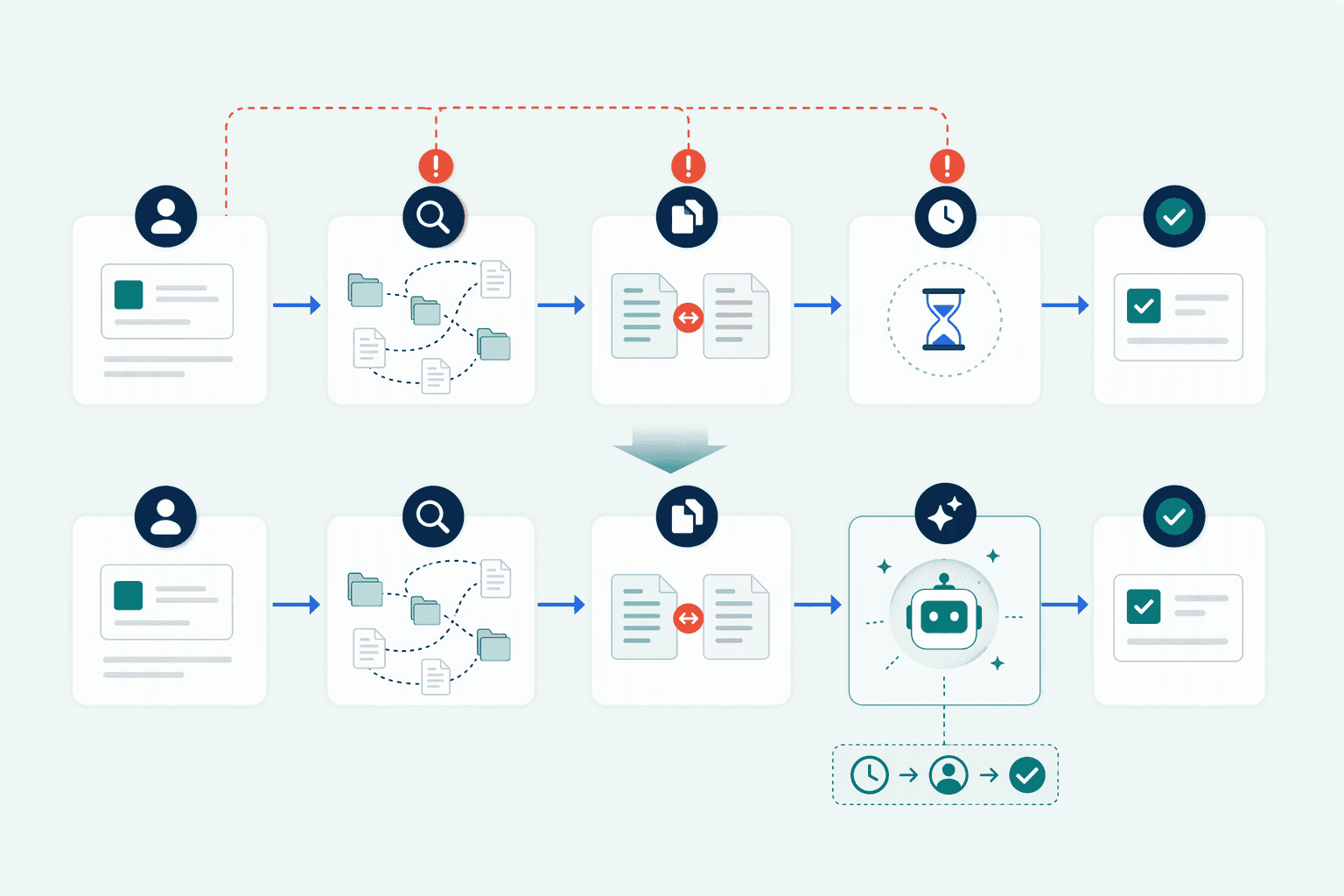
Start where employees repeatedly lose time searching, reconciling, and waiting for answers.
Tip 3. Connect only the tools it needs:
An employee agent may need document repositories, search, ticketing, or communication tools. Give it the minimum access needed for the use case and separate reading, drafting, recommending, and acting. The most useful first integrations are often read-only.
Preserve identity and permission checks across every connection. The agent should never turn a user’s question into a path around existing access controls.
Tip 4. Build on approved business knowledge:
Source quality determines answer quality. Organize current policies, procedures, product information, research, and approved public content with owners and dates. Remove outdated duplicates and make authoritative versions clear.
Nouswise gives employees a grounded way to ask questions across curated sources and keep citations attached to the answer. Reusable notes and outputs help the organization retain what was learned instead of repeating the same research.

A powerful employee agent combines approved knowledge with only the tools and permissions its task requires.
Tip 5. Test the messy reality:
Employees use abbreviations, incomplete requests, old names, and contradictory language. Test those conditions deliberately. Include questions that have no answer, documents with similar titles, sources that disagree, and requests outside the user’s permissions.
Evaluate retrieval accuracy, supportedness, citation correctness, instruction following, and appropriate refusal. Invite users to flag problems in context so the team can connect feedback to the exact question and source set.
Tip 6. Train, measure, and scale:
Employees need to understand what the agent knows, what it does not know, how to inspect sources, and when to escalate. Adoption improves when the first workflow reliably saves time instead of producing flashy but inconsistent answers.
Track task completion, review effort, citation use, unanswered questions, and repeat usage. Expand into adjacent workflows only after the knowledge layer and governance pattern are working. Power comes from dependable reuse, not from unlimited scope.
A practical implementation checklist
Name the workflow owner, affected users, and measurable business outcome.
Define the authoritative sources, their owners, versions, freshness rules, and access restrictions.
Separate retrieval, drafting, recommendation, approval, and execution permissions.
Create representative tests for normal cases, ambiguity, conflict, missing evidence, and unsafe requests.
Require citations for material claims and an explicit response when evidence is insufficient.
Log sources, tools, approvals, exceptions, and user feedback so the system can improve.
Frequently asked questions
What is an employee AI agent?
It is an AI assistant configured to help employees complete internal tasks by retrieving knowledge, using approved tools, and following defined business rules.
What is a good first employee-agent use case?
Choose a frequent, document-heavy, low-risk task such as policy Q&A, research briefing, or locating prior decisions.
How should an employee agent be tested?
Use representative and adversarial questions, including ambiguity, missing evidence, outdated documents, conflicting sources, and permission boundaries.
How does Nouswise support employee agents?
Nouswise supports curated knowledge, grounded questions, citations, traceability, task automation and reusable outputs (artifacts) for internal research and knowledge workflows.
How Nouswise helps
Nouswise is an autonomous, AI thinking partner for enterprises that turns scattered information into source-grounded insights, action, and reusable organizational knowledge.
What Nouswise adds to your team
Semi-automated (human-in-the-loop) or fully automated workflows — delegate data collection, research, analysis, and follow-up actions to configurable AI agents.
Multimodal content and artifact generation — create text, spreadsheets, diagrams, slide decks, code, audio, and video from a single prompt or workflow.
Source-traceable answers in 70+ languages — every statement links back to its original source for fast verification, auditability, and compliance.
Support for unlimited, heterogeneous data inputs — work across Excel, Word, PDFs, images, diagrams, databases, audio, video, live webpages, and proprietary file types.
Curated knowledge libraries with citations — preserve organizational context and make trusted knowledge reusable across teams and projects.
Enterprise-grade security and deployment controls — could run on-premises or in a private cloud with permissions, redaction, and complete audit trails.
Agentic search-and-act execution — connect retrieval, reasoning, decision-making, and tool use so insights can immediately trigger action.
Suggested internal links
Written by:

Trudi Ullrich
Senior Business Developer
Share with friends: