RAG vs Knowledge Graphs vs Agentic Search: Which Architecture Fits Regulated Research?

“Should we use RAG, a knowledge graph or agents?” sounds like an architecture decision. It is usually a problem-definition decision.
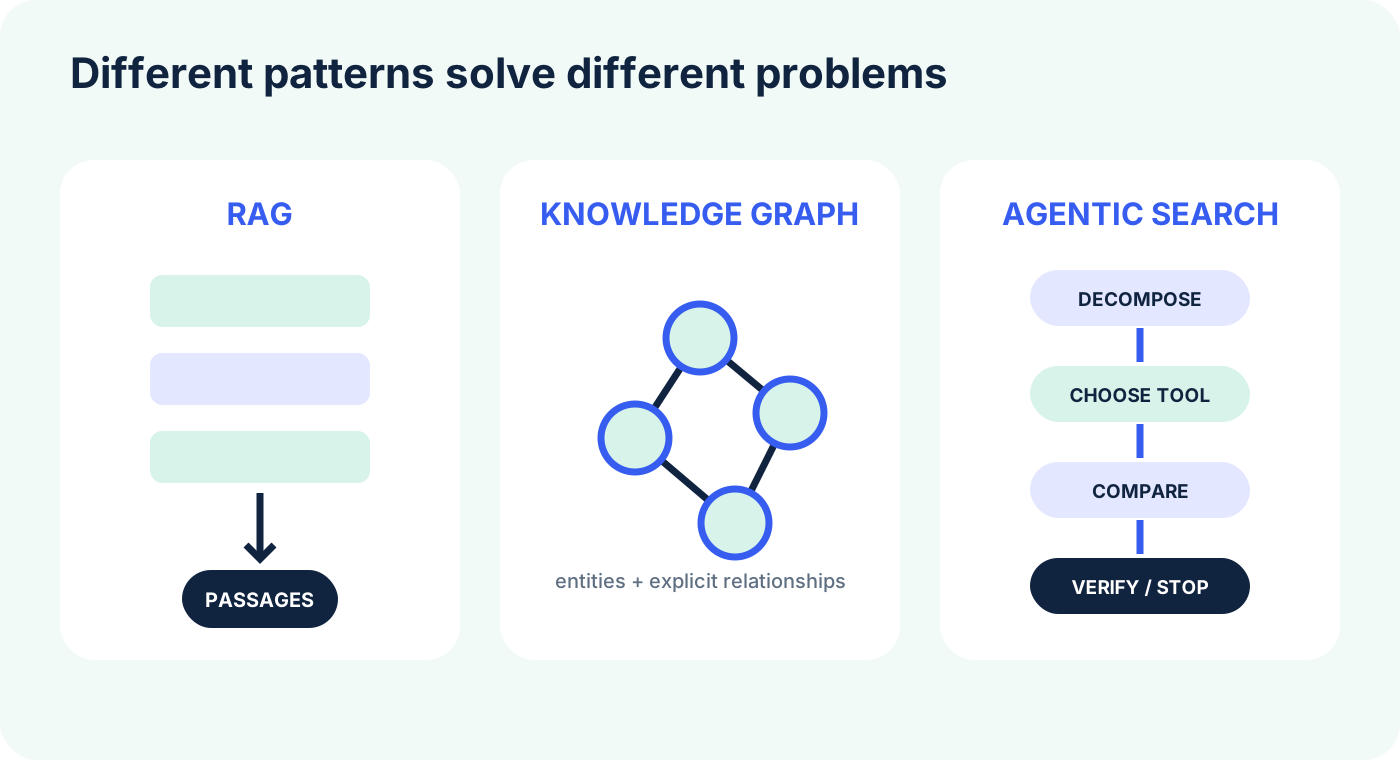
If the main challenge is finding passages across a large document library, retrieval-augmented generation may be enough. If the challenge is understanding explicit relationships—who owns an obligation, which policy implements which rule, or which version supersedes another—a knowledge graph can add structure. If the question requires decomposition, multiple searches, comparisons and checks, an agentic workflow may be useful.
Regulated research adds a further requirement: the answer must remain connected to authoritative evidence and organizational controls. The winning design is therefore not the one with the most fashionable component. It is the one whose behavior can be inspected, tested and governed.
Key takeaways
RAG, knowledge graphs and agentic search are complementary architectural patterns, not direct substitutes.
RAG is usually the simplest starting point for answering questions from documents.
Knowledge graphs are valuable where entities, definitions, ownership and relationships must be explicit.
Agentic search can handle complex, multi-step questions but introduces orchestration, permission and verification risk.
A hybrid system should preserve a traceable path from every material claim to approved evidence.
Add complexity only when a benchmark demonstrates that the simpler design cannot meet the use case.
The three approaches in plain language
Retrieval-augmented generation
RAG retrieves material from an external corpus and provides it to a generative model as context for an answer. It is useful when knowledge changes more frequently than a model’s training and when users need answers based on private or curated documents.
Knowledge graph
A knowledge graph represents entities and the relationships between them. A graph might connect a regulation to its obligations, an obligation to internal controls, controls to owners and owners to evidence. Graphs can support deterministic traversal and make relationships explicit, but they require a data model and ongoing curation.
Agentic search
Agentic search uses one or more model-driven components to plan and execute steps: classify a question, decompose it, choose tools, retrieve across sources, compare evidence and assemble an answer. “Agentic” does not guarantee autonomy or quality; it describes an orchestration pattern. The allowed actions, evidence requirements and stopping conditions still need to be designed.
How standard RAG works
A basic enterprise RAG pipeline typically:
ingests and parses documents;
divides content into retrievable units;
creates searchable representations, often embeddings;
retrieves passages relevant to a question; and
supplies those passages to a language model for synthesis.
The pattern is attractive because an organization can update the corpus without retraining the entire model. It can also preserve links to source documents.
Its weaknesses are equally important:
semantic similarity may not reflect legal authority;
chunking can separate a rule from its definition or exception;
stale and current versions may coexist;
retrieval may miss an important passage;
the model may go beyond the evidence; and
citations may point to documents that do not support the claim.
These are not arguments against RAG. They are reasons to treat RAG as a retrieval-and-synthesis component rather than a complete trust system. See Verifiable AI vs Enterprise RAG for a deeper distinction.
Where knowledge graphs add value
Knowledge graphs are useful when relationships carry meaning that text similarity alone cannot preserve.
Examples include:
a directive is implemented by several national rules;
an internal policy maps to multiple external obligations;
a control has an owner, test frequency and evidence record;
a guidance document supersedes an earlier version;
a definition applies only to a particular entity or product; or
two terms refer to the same institution in different source systems.
A graph can make these relationships queryable and inspectable. It may improve retrieval by expanding a question through connected entities or by limiting search to an applicable jurisdiction and date.
But a graph does not eliminate evidence work. Relationships can be wrong, incomplete or stale. The organization must govern the ontology, provenance, update process and permissions. Graph outputs should link back to the source evidence that justified each relationship.
GraphRAG methods combine graph-derived summaries with language-model retrieval to answer questions that require a global view across a corpus. Research from Microsoft describes one such approach for query-focused summarization over document collections. It is a pattern to evaluate, not a default requirement for every knowledge base.
What makes search agentic
A conventional search sends one query to an index. An agentic search workflow may perform several coordinated actions:
identify the question type;
split a complex question into sub-questions;
choose lexical, semantic, graph or database retrieval;
compare sources or jurisdictions;
search again when evidence is incomplete;
test whether the evidence supports the draft; and
stop, ask for clarification or abstain.
This can improve coverage for complex research. It can also multiply failure paths. An agent might select the wrong tool, broaden the scope, loop unnecessarily, lose authorization context or produce a confident synthesis from uneven evidence.
The response should therefore expose the evidence path, not merely the final prose.
Architecture comparison
Dimension | RAG | Knowledge graph | Agentic search |
|---|---|---|---|
Primary strength | Finding relevant passages | Representing explicit relationships | Executing multi-step research plans |
Best data | Documents and passages | Structured entities and relations | Multiple controlled tools and sources |
Typical output | Evidence-grounded synthesis | Connected facts, paths or constraints | Researched answer assembled across steps |
Main weakness | Retrieval and chunking errors | Modeling and maintenance burden | Orchestration unpredictability and cost |
Explainability | Good when citations are precise | Strong for explicit graph paths | Variable; requires step and evidence logging |
Freshness | Depends on ingestion | Depends on graph updates | Depends on every connected source and tool |
Permission risk | Retrieval must be access-aware | Node and relationship access can be complex | Permissions must survive every tool call |
Operational complexity | Low to medium | Medium to high | Medium to high |
Relative complexity depends on scope, data quality and existing infrastructure. The table should guide discovery, not substitute for a technical assessment.
Accuracy, explainability and freshness
No architecture is accurate by design.
Accuracy
RAG quality depends on parsing, retrieval and faithful generation.
Graph quality depends on correct entities, relationships and provenance.
Agent quality depends on planning, tool selection, intermediate evaluation and stopping rules.
Explainability
RAG can provide direct passages. A graph can show a relationship path. An agent can show its executed steps. None of these is sufficient unless the explanation is understandable and the underlying evidence is available.
Freshness
Define freshness by source type. A daily regulatory feed, a monthly internal procedure and an annual policy review may require different update commitments. Record ingestion time, source publication date, effective date and supersession status where relevant.
Security and permission implications
Security architecture must follow the query through every component.
For RAG, enforce permissions before retrieval and again before output. For graphs, determine whether nodes, edges and inferred relationships inherit source permissions. For agents, pass a constrained identity and authorization context to every tool.
Test:
cross-team and cross-tenant queries;
revoked access;
cached results;
conversation memory;
exports and citations;
inference from restricted evidence;
tool calls outside the approved scope; and
malicious instructions embedded in retrieved documents.
The Nouswise guide to on-premise AI knowledge assistants explains when infrastructure control may be part of the deployment decision. Hosting location alone does not solve identity, retrieval or output authorization.
Choose an architecture by use case
Use case | Likely starting point | Why |
|---|---|---|
Answer questions from a controlled policy library | RAG | Direct passage retrieval is the central need |
Map obligations to controls and owners | Knowledge graph plus source links | Relationships and accountability are explicit |
Compare several regulations across jurisdictions | Constrained agentic search plus RAG | The task benefits from decomposition and repeated retrieval |
Track source versions and supersession | Metadata-rich RAG or graph | Dates and relationships are decisive |
Produce a researched briefing from several repositories | Agentic workflow with governed retrieval | The task spans sources and output stages |
High-volume FAQ with narrow scope | Simple retrieval before agents | Lower complexity is easier to test and operate |
Start with the simplest architecture that can pass the organization’s benchmark. Complexity is justified by measured improvement in a required outcome—not by novelty.
When a hybrid design is appropriate
A hybrid design may combine:
Governed source layer: approved documents, metadata, versions and permissions.
Retrieval layer: lexical, semantic and structured search.
Relationship layer: graph entities and links where relationships matter.
Agent layer: bounded planning and tool use for complex questions.
Evidence layer: claim-to-passage mapping, conflict detection and abstention.
Experience layer: citations, review controls, exports and feedback.
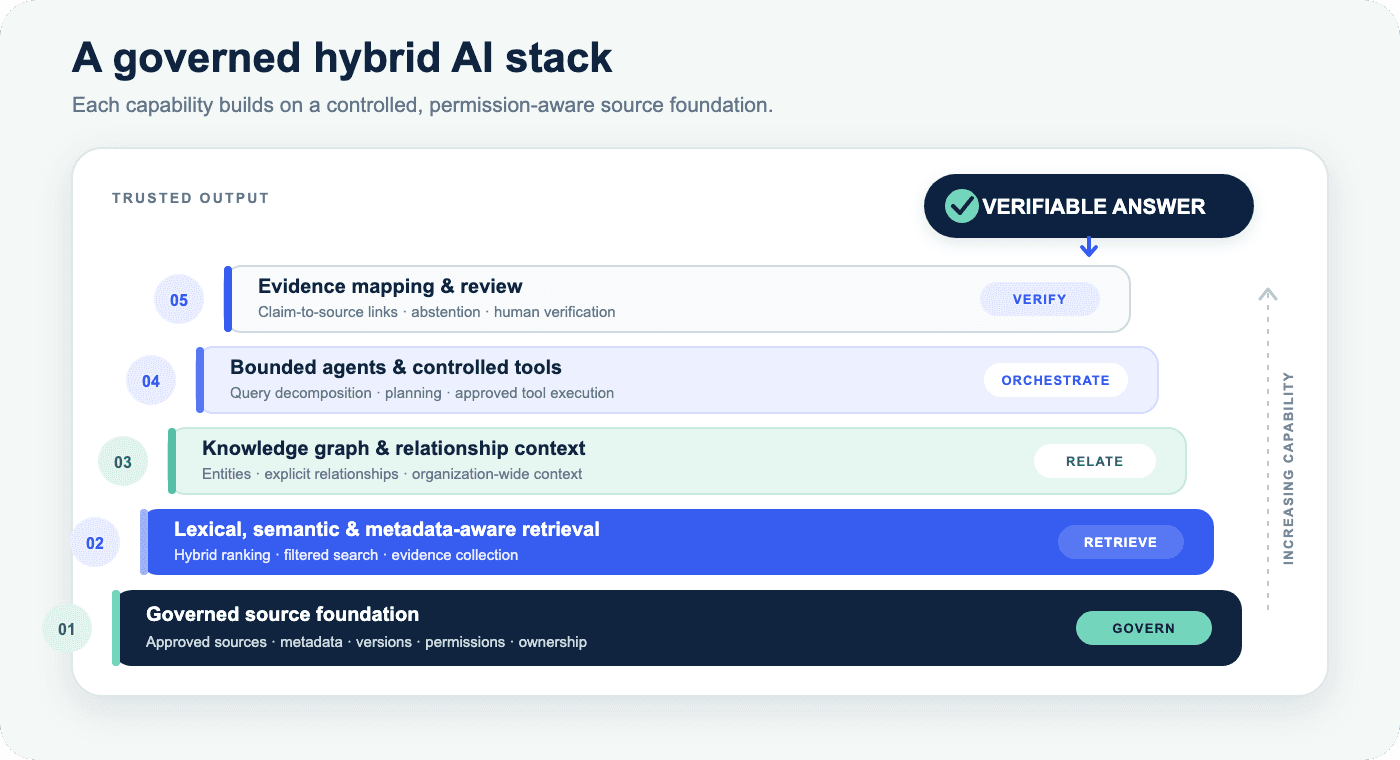
The AVA architecture described in the 2026 CHI paper illustrates this layered approach. It begins with curation and hierarchical indexing of 4,000+ World Bank reports, uses specialized agents for query decomposition, retrieval planning, tree walking and drafting, then performs evidence synthesis and verification before delivering citation-linked answers or reasoned abstention. It also supports multilingual responses and user-controlled preferences.[AVA]
AVA was evaluated over five months with more than 2,200 participants in 116 countries. The study’s importance for architecture is not that every organization should copy its components. It is that source curation, retrieval, verification, refusal and user experience were treated as one sociotechnical system.
A practical decision framework
Before selecting an architecture, answer these questions:
What decisions or tasks will the system support?
Which sources are authoritative, and how often do they change?
Do explicit relationships materially affect the answer?
Does the task require multiple searches, tools or comparisons?
What evidence must a reviewer inspect?
Which users may access each source and derived answer?
What should happen when evidence is missing or contradictory?
Which failure modes are release blockers?
Can the organization maintain the added data model and orchestration?
Does benchmark performance justify the complexity?
Nouswise focuses on research grounded in curated, inspectable information. A sound evaluation should compare architectures using the organization’s own sources and questions, with measurable criteria for evidence quality, access control and human verification.
Frequently asked questions
Is a knowledge graph better than RAG?
Not universally. A graph is valuable when explicit relationships and structured constraints matter. RAG is often simpler for retrieving passages from documents. Many systems combine the two.
Is agentic search the same as agentic RAG?
The terms are used inconsistently. In this article, agentic search means a controlled workflow in which model-driven components plan and execute multiple retrieval or analysis steps. RAG may be one of the tools used by that workflow.
Does GraphRAG eliminate hallucinations?
No. Graph-based retrieval can improve coverage for some questions, but graph construction, summarization and generation can still introduce errors. Outputs require provenance, evaluation and appropriate review.
When should an organization avoid agents?
Avoid unnecessary agents when a direct, deterministic search or bounded RAG pipeline satisfies the task. Agents add value when multi-step planning produces measurable improvement that justifies additional cost, latency and governance.
Can a hybrid architecture be audited?
Yes, if the system records source versions, retrieval results, tool actions, evidence mapping, configuration and reviewer decisions. Auditability must be designed into the workflow.
Written by:

Dominique Vincent
Senior Business Developer
Share with friends: