On-Premise AI Knowledge Assistants: When Regulated Organizations Need Them

The right deployment model depends on information sensitivity, control requirements and operational ownership.
An on-premise AI knowledge assistant runs within infrastructure controlled by the customer rather than as a shared public-cloud service. Organizations commonly consider this model when their source material is highly confidential, data-location requirements are strict, network isolation matters or existing policy restricts external AI processing.
On-premise deployment is not automatically more secure. It offers more control, but the institution also assumes more responsibility for patching, monitoring, capacity, model operations and incident response. The right decision depends on the use case and threat model—not on a slogan.
Three common deployment models
Multi-tenant software as a service
The provider operates the application and serves multiple customers with logical separation. This model is usually the fastest to deploy and easiest to update.
It may be appropriate for public or moderately sensitive sources when contractual, technical and jurisdictional controls meet the institution’s requirements.
Dedicated or private cloud
The application runs in a dedicated environment or customer-controlled cloud account. This can provide stronger isolation and more control over regions, keys, networking and integrations while preserving many cloud operating benefits.
On-premise deployment
The application and relevant data services run in the customer’s data center or controlled infrastructure. Depending on the design, model inference may also run locally or connect to an approved external model endpoint.
“On-premise” should therefore be defined precisely. Hosting the document index locally while sending prompts to an external model is not the same as keeping the full processing chain inside the institution.
When on-premise deployment is justified
Highly sensitive source material
Examples may include confidential supervisory correspondence, privileged legal material, unreleased policy, investigation records or strategically sensitive research.
Network-isolated environments
Some organizations maintain environments with no direct internet connection. The assistant must support controlled updates and local dependencies.
Explicit internal or contractual requirements
A board-approved risk appetite, client contract or public-sector policy may restrict external processing or require specific infrastructure ownership.
Deep integration with internal repositories
An on-premise system may fit an environment where authoritative content already sits behind tightly managed internal controls and cannot be replicated externally.
Jurisdiction and sovereignty considerations
Where data-location or government-access concerns cannot be addressed through a regional or dedicated cloud service, local deployment may be appropriate.
When private cloud may be the better answer
On-premise deployment can introduce cost and operational friction that do not improve the actual risk outcome. A dedicated cloud environment may be preferable when it can provide:
an approved hosting region;
customer-managed encryption keys;
private network connectivity;
contractual restrictions on data use;
clear retention and deletion controls;
dedicated tenancy;
audit evidence and incident commitments.
The objective is to satisfy the control requirement with the least unnecessary complexity.
The architecture questions buyers should ask
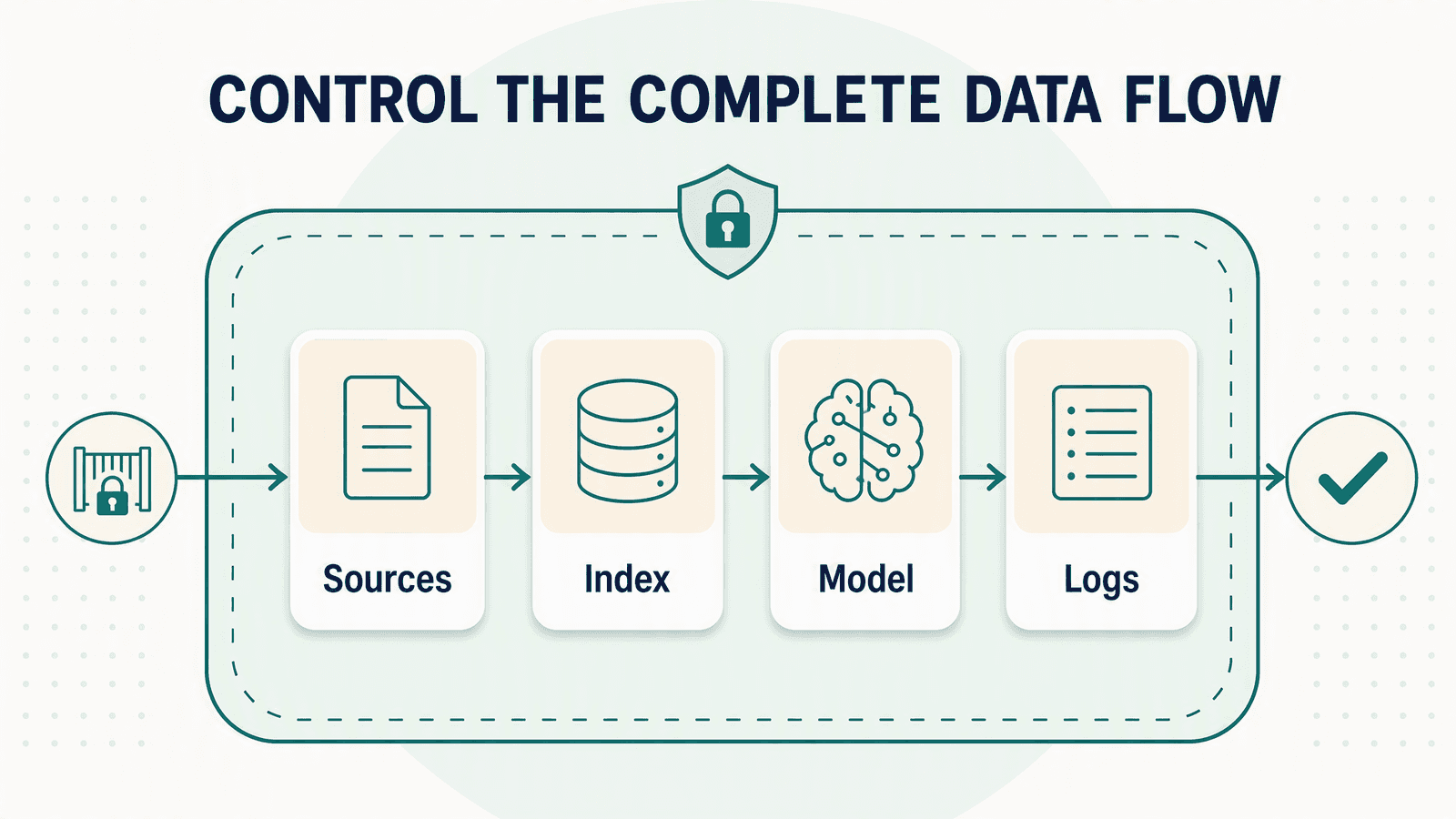
Hosting location is only one control: buyers should trace sources, indexes, model calls and logs across the complete data flow.
Where does every data type go?
Map documents, extracted text, embeddings, prompts, model outputs, logs, backups and support data. “Your data stays private” is not a data-flow diagram.
Which model processes the prompt?
Identify whether inference is local, privately hosted or performed by an external model provider. Record retention and training terms for every service in the chain.
How are identities and permissions enforced?
The assistant should integrate with approved identity systems and preserve document-level or collection-level access controls.
How are components updated?
On-premise software needs a controlled mechanism for security patches, model changes and application upgrades. Air-gapped environments require a specific update process.
What is logged?
Logs can be valuable for audit and incident investigation, but may contain sensitive questions or extracted content. Define access, retention and redaction.
How is deletion verified?
Deleting an original file may not remove derived text, embeddings, caches or backups immediately. The architecture should explain the complete deletion lifecycle.
Cloud versus on-premise comparison
Consideration | SaaS cloud | Dedicated/private cloud | On-premise |
|---|---|---|---|
Initial deployment | Fastest | Moderate | Slowest |
Infrastructure control | Lower | High | Highest |
Operational burden | Provider-led | Shared | Customer-led |
Update speed | Fast | Controlled | Depends on local process |
Custom integration | Moderate | High | High |
Offline capability | Rare | Rare | Possible |
Capacity flexibility | High | High | Depends on owned capacity |
Upfront cost | Lower | Moderate | Higher |
The table describes typical patterns, not guarantees. Actual controls depend on the provider and implementation.
Security is more than hosting location
Deployment is only one layer. A defensible AI knowledge assistant also needs:
source and user permissions;
encryption in transit and at rest;
secrets and key management;
vulnerability and dependency management;
secure document parsing;
audit logging;
backup and recovery;
incident response;
model and prompt-change governance;
testing for data leakage and prompt injection.
For EU financial entities, DORA provides a broader framework for ICT risk management, resilience and third-party risk. The institution should assess an AI assistant within those established processes rather than treating it as an isolated experiment.
How to make the deployment decision
Step 1: classify the use case
Describe the users, data, decision impact and integrations. Avoid selecting infrastructure before defining what the system will do.
Step 2: define non-negotiable controls
Separate legal or policy requirements from preferences. Examples include a mandated region, no external model processing or recovery within a defined period.
Step 3: compare complete architectures
Evaluate data flow, identity, model hosting, logging, support access, updates and recovery—not merely the location of the database.
Step 4: test operational ownership
Ask who will patch the platform, monitor capacity, investigate alerts and validate new releases. Control without an operating model becomes unmanaged risk.
Step 5: pilot with representative content
Use a bounded, appropriately classified source set. Test both answer quality and the operational procedures surrounding it.
How Nouswise supports deployment flexibility
Nouswise is a source-grounded research platform for working with curated organizational knowledge. Depending on the institution’s security, jurisdiction and integration requirements, deployment can be discussed across hosted, dedicated and on-premise models.
The goal is to preserve the core research workflow—approved sources, evidence-linked answers and controlled access—inside an architecture the institution can approve. A discovery process should establish data flows and responsibilities before a pilot begins.
Frequently asked questions
Does on-premise AI require an on-premise language model?
Not necessarily. Some architectures keep documents and retrieval locally while using an approved external model. If the requirement is that no prompt or source content leaves the environment, inference must also be local or otherwise isolated to satisfy that requirement.
Is a private cloud the same as on-premise?
No. A private or dedicated cloud environment is hosted in cloud infrastructure, while on-premise normally means infrastructure controlled within the customer’s own environment. Contracts sometimes use these terms loosely, so define the architecture.
Is on-premise deployment always more expensive?
It commonly has higher implementation and operating costs, but the comparison depends on existing infrastructure, scale, support and risk requirements.
Can an on-premise assistant work in an air-gapped environment?
It can if every required component supports local operation and the organization establishes controlled processes for software, security and model updates.
Conclusion
Choose on-premise AI when the use case genuinely requires local control and the organization is prepared to operate it. Otherwise, a well-designed dedicated cloud environment may offer a better balance of assurance, agility and cost.
Nouswise can help institutions compare these options around a real source set and produce a deployment design suitable for technical and risk review.
Written by:

René Kobelt
Business Development
Share with friends: