Open Banking Policy Intelligence: How to Track Rules, Standards and Market Guidance

Useful Open Banking intelligence connects multiple authorities and market actors without erasing their distinct roles.
Open Banking policy intelligence is the continuous process of monitoring relevant rules, standards and official guidance, deciding what has changed, and connecting that change to products, controls and stakeholder communications.
It is broader than regulatory news. An alert that says a document was published is only the first step. A useful intelligence process identifies the authoritative passage, explains which organizations and services may be affected, records the internal interpretation and routes actions to accountable owners.
Open Banking makes this difficult because the evidence is distributed across legislation, regulators, standard-setting bodies, competition authorities, implementation entities and market guidance.
Why Open Banking research is unusually fragmented
Multiple sources of authority
The legal framework may establish rights and obligations, while technical standards and implementation documents define how access, authentication, consent and interfaces work in practice.
Different national and regional models
The EU framework and the UK Open Banking ecosystem have related objectives but different legal and institutional structures. Global discussions of “Open Banking” can therefore hide important differences.
Policy and technology evolve together
API performance, consent journeys, fraud controls and data access are both policy and engineering questions. A change that looks small in legal text may require substantial product work.
The boundary is expanding
Policy is moving from payment-account access toward broader concepts such as Open Finance and financial-data access. Teams need to track both the current regime and adjacent initiatives without treating proposals as adopted law.
The source layers to monitor
Legislation and binding requirements
Start with adopted legal texts and their implementation dates. In the EU, this includes the existing PSD2 framework and the developing PSD3/PSR package. In the UK, relevant requirements sit across payment-services regulation, competition measures and regulatory rules.
Regulatory and supervisory guidance
Guidelines, opinions, policy statements, consultations and supervisory communications often determine how broad legal requirements are applied in practice.
Technical and implementation standards
API profiles, security specifications, customer-experience guidance and conformance requirements influence real-world implementation. Record who issued the standard and whether compliance is mandatory, expected or voluntary.
Enforcement and complaints evidence
Decisions, enforcement notices, complaint themes and fraud publications reveal where authorities see practical harm or weak controls.
Internal interpretation
Legal advice, policy decisions, risk acceptances and product standards should be connected to the external sources they interpret. Otherwise, the organization accumulates conclusions without retaining their rationale.
From publication alert to operational intelligence
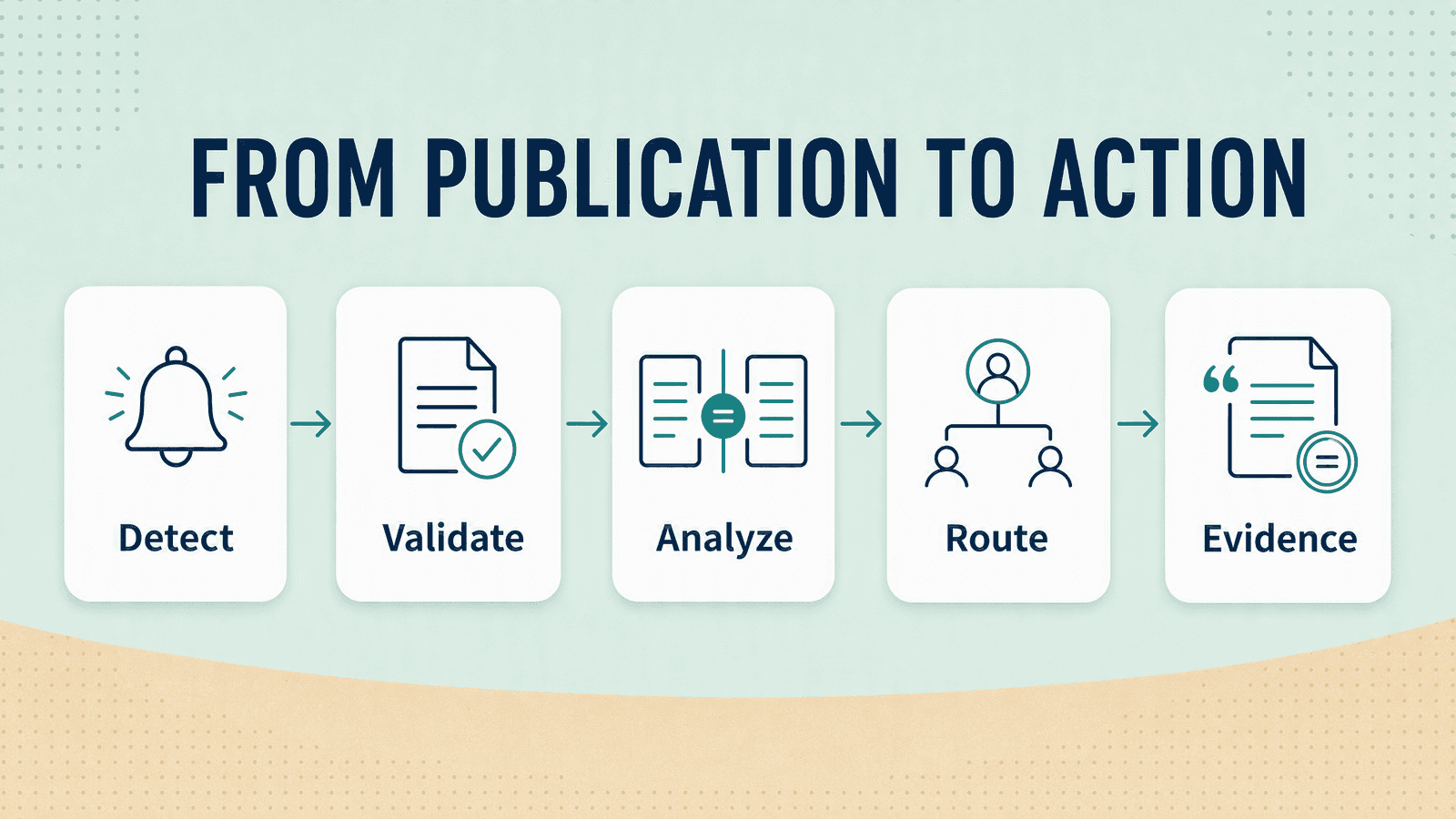
An alert becomes operational intelligence only after validation, analysis, routing and preservation of the evidence.
A mature process has six stages.
Detect: identify a new or changed source.
Validate: confirm authenticity, status, version and effective date.
Classify: label jurisdiction, topic, affected parties and authority level.
Analyze: compare the source with prior rules and internal positions.
Route: assign questions and actions to product, legal, compliance or engineering owners.
Evidence: retain the source, interpretation, decision and implementation record.
The process should also close the loop. When employees or members repeatedly ask the same question, the policy owner should see that demand and decide whether guidance needs improvement.
Questions an Open Banking intelligence system should answer
Access and eligibility
Which providers may access which payment-account data?
What authorization or registration status is required?
When may an account provider deny or limit access?
Consent and customer control
What must the customer understand and approve?
How can the customer view, renew or revoke permission?
How are duration and scope communicated?
Authentication and fraud
When is strong customer authentication required?
Which exemptions or risk-based processes apply?
How are liability and reimbursement allocated?
API performance and obstacles
Which availability, response or contingency requirements apply?
What conduct may constitute an obstacle to third-party access?
How are incidents and performance problems escalated?
Data use and expansion
Which data may be accessed and for which purpose?
How do privacy and data-protection requirements interact with access rights?
Which changes arise from Open Finance proposals?
Every answer should state its jurisdiction and source date. A globally worded answer to a jurisdiction-specific question is a warning sign.
Build a policy-intelligence knowledge graph
Teams do not need to begin with an elaborate graph database. They do need consistent relationships between information.
For each source, capture:
issuing authority;
legal or policy status;
jurisdiction;
publication and application dates;
affected organizations;
topic and product;
provisions changed or interpreted;
related internal policies and controls;
accountable owner;
open questions and decisions.
This structure allows a team to move from “What changed?” to “Which product owner must act, and what evidence supports the decision?”
How AI can help—and where it should stop
Source-grounded AI can reduce the manual work involved in reading and connecting a large policy corpus. It can:
summarize a new publication with citations;
compare current and previous versions;
answer questions across multiple approved sources;
locate where internal guidance addresses an external requirement;
draft stakeholder briefings from verified material;
identify recurring questions and knowledge gaps.
It should not silently assign legal status, resolve a genuine conflict between authorities or approve a product decision. Those steps require accountable professional judgment.
A useful Open Banking pilot
Choose one bounded theme—for example, API access, consent or fraud—and assemble the authoritative sources used by the team. Add approved internal guidance and a small set of implementation documents.
Create 30 questions representing different users:
legal and compliance;
product management;
API operations;
customer support;
policy and external affairs.
Score whether the system retrieves controlling passages, distinguishes EU and UK sources, states relevant dates and avoids treating consultation material as final.
The result should be a documented evidence base for deciding whether to expand—not merely a successful demo.
How Nouswise supports policy intelligence
Nouswise enables organizations to create curated libraries from policy, regulatory and institutional sources. Users can ask questions in natural language, receive source-linked answers and move directly to the supporting evidence.
For an industry body, the same approach can support member questions and reveal where guidance is unclear. For a bank or fintech, it can connect external requirements with approved internal interpretation. For advisers, it can create a repeatable research environment without turning analysis into an unsupported chatbot response.
Frequently asked questions
What is the difference between Open Banking monitoring and policy intelligence?
Monitoring detects publications. Policy intelligence validates their authority, interprets their relevance, routes actions and preserves the evidence behind decisions.
Should EU and UK Open Banking sources be stored together?
They can share a platform, but the system should maintain clear jurisdictional labels and prevent answers from blending requirements without explanation.
Can AI monitor consultations as well as final rules?
Yes, provided every source is labeled by status. A consultation can indicate direction, but it should not be presented as an existing obligation.
How does Open Finance relate to Open Banking?
Open Finance generally extends data-access concepts beyond payment accounts to a wider range of financial data and services. The exact scope depends on the jurisdiction and final applicable rules.
Conclusion
The hard part of Open Banking policy is not finding more documents. It is maintaining a reliable chain from authority to interpretation to implementation. Source-grounded AI can make that chain faster to navigate—if status, jurisdiction and evidence remain visible.
Nouswise can support an Open Banking policy-intelligence pilot using an approved corpus and questions drawn from real stakeholder demand.
Written by:

Reza Yazdanfar
CEO
Share with friends: