AI for Telecom Finance: Investigate Revenue Leakage With Evidence

AI can support telecom finance by assembling the evidence behind a suspected revenue exception and preparing a case that an authorized person can review. The useful output connects validated numbers with contractual terms, source dates, unresolved questions, and a clear decision owner.
A discrepancy on a dashboard is the beginning of an investigation. Before anyone changes a charge, the team needs to establish which service was delivered, which commercial terms applied, whether the records are complete, and who has authority to resolve the issue.
Define the case before asking AI for an explanation
An open-ended request such as “find our revenue leakage” leaves the scope, evidence, and acceptance criteria unclear. A better starting assignment is:
Review this approved set of invoice exceptions for the specified account and period. Compare them with the supplied contract and rate schedule. Cite the provisions used, identify missing evidence, and prepare questions for the revenue-assurance owner. Do not change billing records.
The case should identify the entity, service, period, currency, and record versions. If an extract excludes late-arriving events or adjustments, make that limitation visible. A numerical comparison is meaningful only when its inputs refer to the same scope.
Build a compact evidence pack
For a first pilot, use approved extracts rather than unrestricted production access. Give each item an owner and a clear reason for inclusion.
Evidence | What it establishes | What still needs checking |
|---|---|---|
Validated billing extract | The recorded charge and adjustment history | Completeness and reconciliation status |
Usage or service extract | The supplied operational activity | Timing, duplication, and service mapping |
Signed contract and amendments | Applicable commercial obligations | Effective dates and precedence |
Approved rate schedule | The basis for calculating expected charges | Version, currency, and exceptions |
Control procedure | Required investigation and approval steps | Current approval status |
Keep arithmetic reproducible. Use validated calculations or an approved analytical tool for financial totals. A language model’s narrative explanation should not become the only record of how a material figure was calculated.

A reviewable case preserves the relationship between the figure and the evidence used to interpret it.
Ask for competing explanations
The first plausible explanation can become an anchor. Require the research output to compare alternatives and show what would distinguish them.
Suppose an account’s billed usage appears lower than the validated service extract. Possible explanations include a timing difference, a contract allowance, a mapping error, an incomplete extract, or a genuine omission. The same visible discrepancy can support very different operational responses.
A useful case table contains:
The observed exception.
The candidate explanation.
Supporting and contradictory evidence.
A verification step.
The person who can resolve the question.
This structure also helps a reviewer reject an attractive explanation when the sources do not support it. “Evidence insufficient” is a productive outcome if it identifies the exact missing record.
Separate research from financial authority
An investigation assistant may have permission to read approved sources and draft a brief. That does not imply authority to amend invoices, apply credits, contact customers, or update a commercial agreement.
Set explicit boundaries for the pilot:
The analyst validates the case scope and calculations.
The contract owner resolves disputed commercial interpretation.
The revenue-assurance or finance owner decides the proposed treatment.
The authorized operational team executes any approved change.
A control owner verifies the outcome against the approved case.
These roles may overlap in a small team, but the responsibilities should still be recorded. An integration should enforce the permitted action outside the model’s written instructions.
Design the case brief for a busy reviewer
The first page should contain the question, scope, material evidence, provisional explanation, alternatives, unresolved points, and requested decision. Put detailed extracts and calculation references behind it.
Use explicit labels: verified from supplied records, analyst interpretation, missing evidence, and proposed action. Avoid presenting an estimated exposure as a recovered amount. A potential exception becomes a confirmed issue only after the responsible team completes its verification.
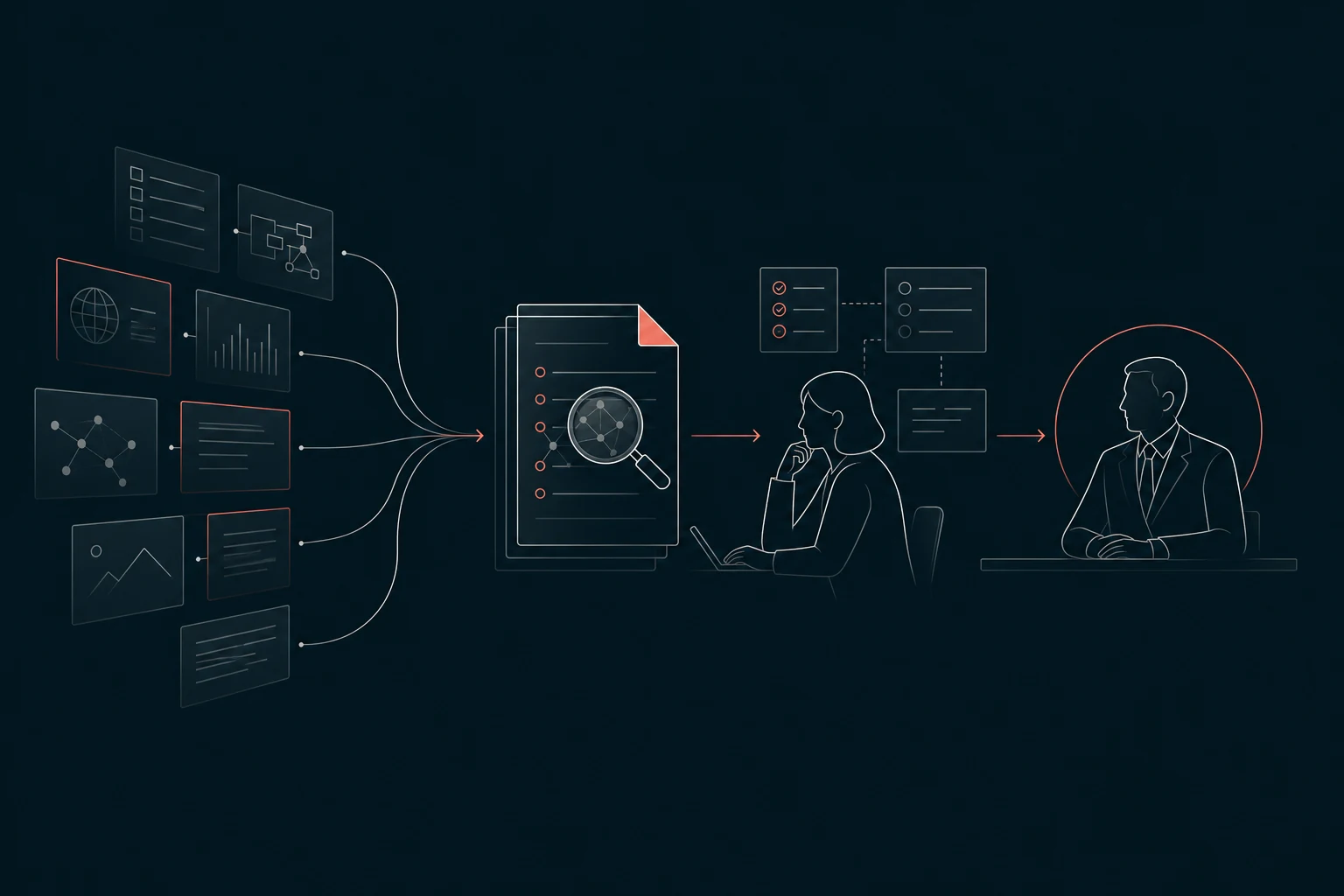
The evidence package supports an accountable decision before an operational change is made.
Where Nouswise can contribute
Nouswise’s source-grounded research approach for financial institutions is relevant to comparing approved policies, contracts, reports, and supporting material. A telecom finance team could evaluate that approach on a bounded case pack.
Ask for a cited exception brief and a list of follow-up evidence requests. Keep the source references attached when turning the result into an internal report or presentation. Confirm supported file formats, calculation tooling, access controls, and integration options in the actual deployment.
This positions Nouswise as part of the investigation workflow. Revenue-assurance engines, ledgers, billing controls, and the organization’s financial approval process continue to have their own responsibilities.
Measure investigation quality and effort
Compare completed cases with the manual process. Track time to a reviewed brief, the proportion of material claims with valid support, reviewer corrections, missing-evidence detection, and the rate of cases that require additional specialist work.
Record false leads as well as useful findings. A workflow that creates many plausible exceptions can increase workload without improving control quality. Measure confirmed outcomes only after the responsible team validates them, using the same definitions as the existing finance process.
Frequently asked questions
Can AI determine that an invoice is wrong?
AI can help compare records and identify possible inconsistencies. A confirmed finding requires reliable inputs, reproducible calculations, correct commercial interpretation, and review by the responsible team.
Does this require giving an AI agent access to the billing platform?
An initial research pilot can use approved extracts and documents. Live access should follow a separate assessment of identity, permissions, logging, data freshness, and operational risk.
What should a Nouswise pilot deliver?
A useful first deliverable is a cited case brief with verified scope, evidence references, competing explanations, unresolved questions, and a proposed review path. It should make the analyst’s work easier to inspect.
Evaluate one real investigation: bring an appropriately approved case pack and a reviewer’s acceptance criteria to a Nouswise enterprise discussion.
Related Nouswise reading
Written by:

Trudi Ullrich
Senior Business Developer
Share with friends: