Source-Grounded AI for Financial Institutions: How Verifiable Answers Work

A verifiable answer links material claims back to the precise evidence used to produce them.
Source-grounded AI is an AI system instructed to answer from a defined collection of evidence rather than relying only on what a model learned during training. For financial institutions, that evidence may include regulations, supervisory statements, policies, procedures, product documents and approved research.
The defining feature is not simply that the system has access to documents. It is that a user can trace important claims back to the passages used to produce them.
Source grounding is particularly valuable in financial services because a correct answer often depends on the exact version, jurisdiction, entity and context of a rule. It can improve reliability and verification speed, but it does not guarantee correctness.
How source-grounded AI works
A typical workflow has six steps.
Ingest: The organization adds approved documents or connects an authorized repository.
Structure: The system extracts text and useful metadata such as title, date, jurisdiction and owner.
Retrieve: When a user asks a question, the system finds the passages most likely to contain the answer.
Generate: A language model explains or compares those passages.
Cite: The response links claims to the underlying material.
Review: The user inspects the evidence and decides how the answer may be used.
The model remains important, but retrieval and provenance determine whether the output fits an accuracy-critical workflow.
Grounded does not mean guaranteed
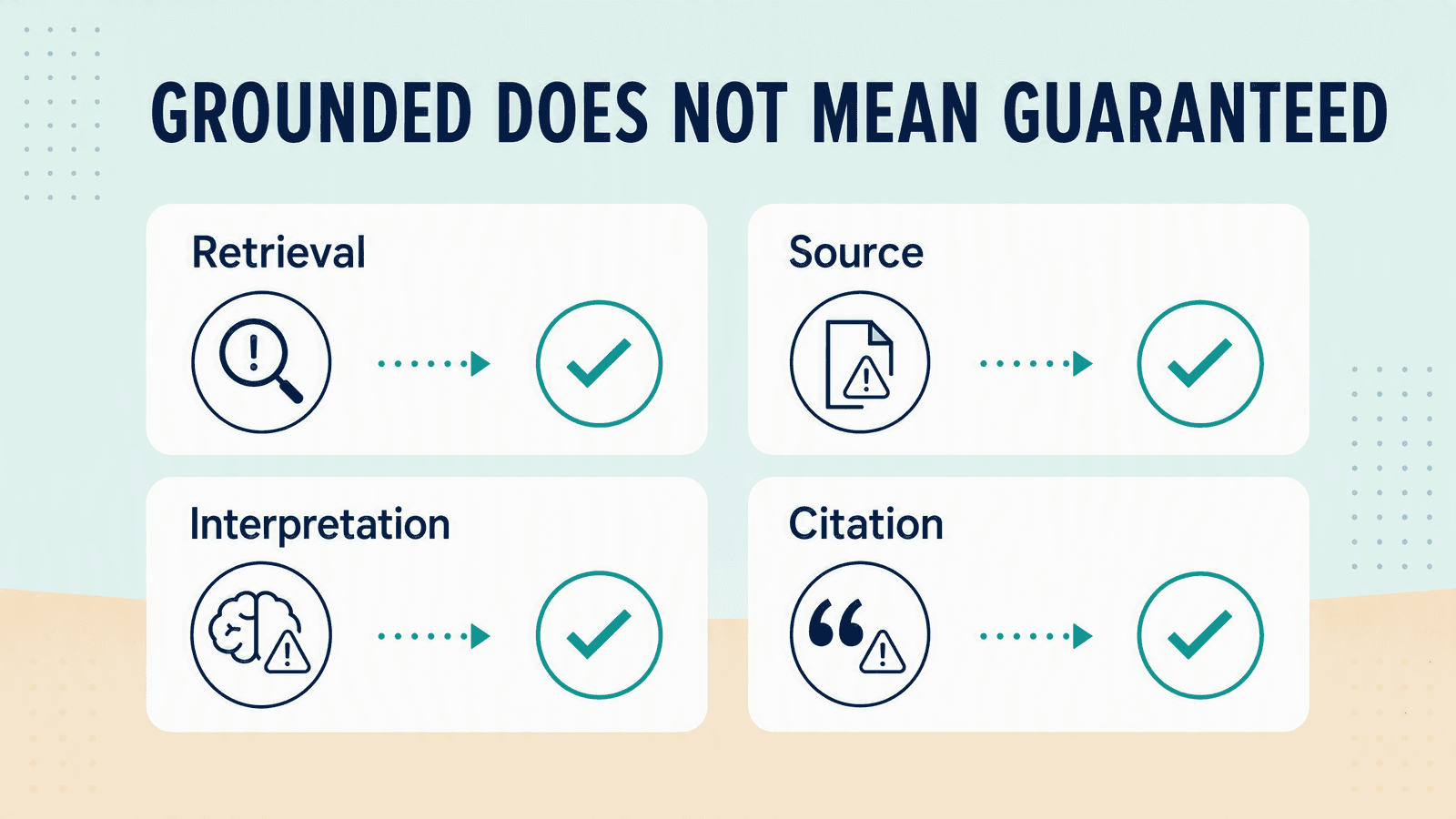
Grounding reduces risk, but teams must still test retrieval, source quality, interpretation and citation accuracy.
Grounding reduces some failure modes. It does not eliminate them.
Retrieval failure
The correct document may be in the library while the system retrieves a less relevant passage. This can happen because of unusual terminology, poor document extraction or an ambiguous question.
Source failure
The system may accurately report a source that is obsolete, incomplete or inappropriate for the entity concerned. Source governance is therefore as important as model quality.
Interpretation failure
A model can cite the right paragraph and still misunderstand an exception, definition or interaction with another provision.
Citation mismatch
A citation may discuss the topic without supporting the exact claim made. Evaluation must test entailment: does the cited passage actually justify the sentence?
Overcompression
A concise answer can omit conditions that matter. In financial regulation, the missing exception may be more important than the general rule.
For these reasons, “grounded” should describe an architecture—not serve as a blanket accuracy claim.
What a verifiable answer should contain
A well-designed answer should make five elements clear:
Conclusion: a direct response to the question.
Authority: the source or sources on which it relies.
Evidence: the specific passages that support material claims.
Scope: relevant jurisdiction, entity, product and date.
Limits: missing information, conflict or uncertainty that affects the conclusion.
For example, a weak answer says: “Strong customer authentication is required.” A more useful answer identifies the governing text, states the relevant scope, notes any exemptions raised by the sources and gives the reviewer direct access to the cited provisions.
Financial-services use cases
Regulatory Q&A
Compliance and legal teams can ask focused questions across an approved rule set and receive a cited research starting point.
Policy-to-regulation mapping
The platform can locate sections of an internal policy that correspond to an external requirement and surface potential gaps for review.
Product and market comparison
Teams can compare requirements across jurisdictions, provided the system keeps the underlying sources and legal contexts separate.
Frontline guidance
Employees can obtain answers from approved procedures rather than searching across shared drives. Permissions should ensure that users see only the material appropriate to their role.
Regulatory change triage
When new guidance appears, AI can summarize it and identify documents that may need attention. Accountable owners still decide what must change.
The minimum control set
Curated sources
Every collection should have an owner and an update process. Where possible, label sources by authority level, jurisdiction, status and effective date.
Permission inheritance
An AI interface must not create a new route around existing access controls. Permissions should follow the underlying content or an equally controlled model.
Evidence-preserving exports
When users copy an answer into a memo or briefing, citations should travel with it. Otherwise the most important control disappears at the point of use.
Audit and feedback
Record enough information to investigate a problematic output and improve the system. Feedback should identify the failure type rather than merely collect thumbs-up or thumbs-down reactions.
Human accountability
Name the person or function responsible for decisions made with the output. AI can support responsibility; it cannot hold it.
How to evaluate grounded answers
Use a benchmark built from real questions and score each answer across separate dimensions.
Dimension | What good looks like |
|---|---|
Retrieval relevance | The controlling or most useful passages are present |
Citation entailment | Each citation supports the associated claim |
Completeness | Material conditions and exceptions are included |
Faithfulness | No substantive claim exceeds the supplied evidence |
Abstention | The system acknowledges when evidence is insufficient |
Usability | A reviewer can reach and understand the source quickly |
A single “accuracy” percentage can hide serious weaknesses. Report the dimensions separately and examine failures by question type.
Source grounding and the EU AI governance context
The EU AI Act uses a risk-based framework and assigns obligations according to the role and use of an AI system. The Act became generally applicable on 2 August 2026, subject to specific exceptions and timelines. Whether a particular research assistant falls into a defined category depends on its intended purpose and deployment.
Regardless of classification, source grounding can support broader governance objectives: traceability, information quality, human oversight and documented limitations. It should sit inside the organization’s full AI-risk process rather than replace it.
How Nouswise supports source-grounded work
Nouswise allows institutions to organize approved material into curated libraries and ask questions across those sources. The resulting answer is designed to keep evidence close to the claim, helping users move quickly from explanation to verification.
The same interface can support research, comparison and recurring internal questions. Analytics can also show which subjects generate repeated demand, giving content owners evidence about where guidance may need clarification.
For sensitive environments, Nouswise can discuss deployment and data controls that fit the institution’s requirements, including on-premise options.
Frequently asked questions
Is source-grounded AI the same as RAG?
Retrieval-augmented generation, or RAG, is a common technical pattern used for grounding. Source-grounded AI is a broader outcome: answers constrained by defined evidence, with usable provenance and governance around the entire process. Source-grounded AI is built natively in Nouswise harness.
Can grounded AI use internal and external sources together?
Yes, but the interface should label them clearly and preserve permissions. It should also distinguish binding authority, external commentary and internal interpretation.
What happens when sources disagree?
The system should surface the conflict and cite both sides rather than silently choosing one. A qualified reviewer determines how the conflict should be resolved.
Can citations themselves be wrong?
No. A Nouswise citation only comes from available sources and never can be made up.
Conclusion
Source-grounded AI is valuable to financial institutions because it changes the unit of trust. Instead of asking users to trust a model’s confidence, it gives them evidence they can inspect. The strongest systems combine that evidence with curated sources, access controls, evaluation and accountable human review.
Nouswise can help teams test this model on a bounded financial-services use case and measure it against an expert-reviewed benchmark.
Written by:

Dominique Vincent
Senior Business Developer
Share with friends: