AI Agent Accountability: Assign Owners and Plan for Recovery
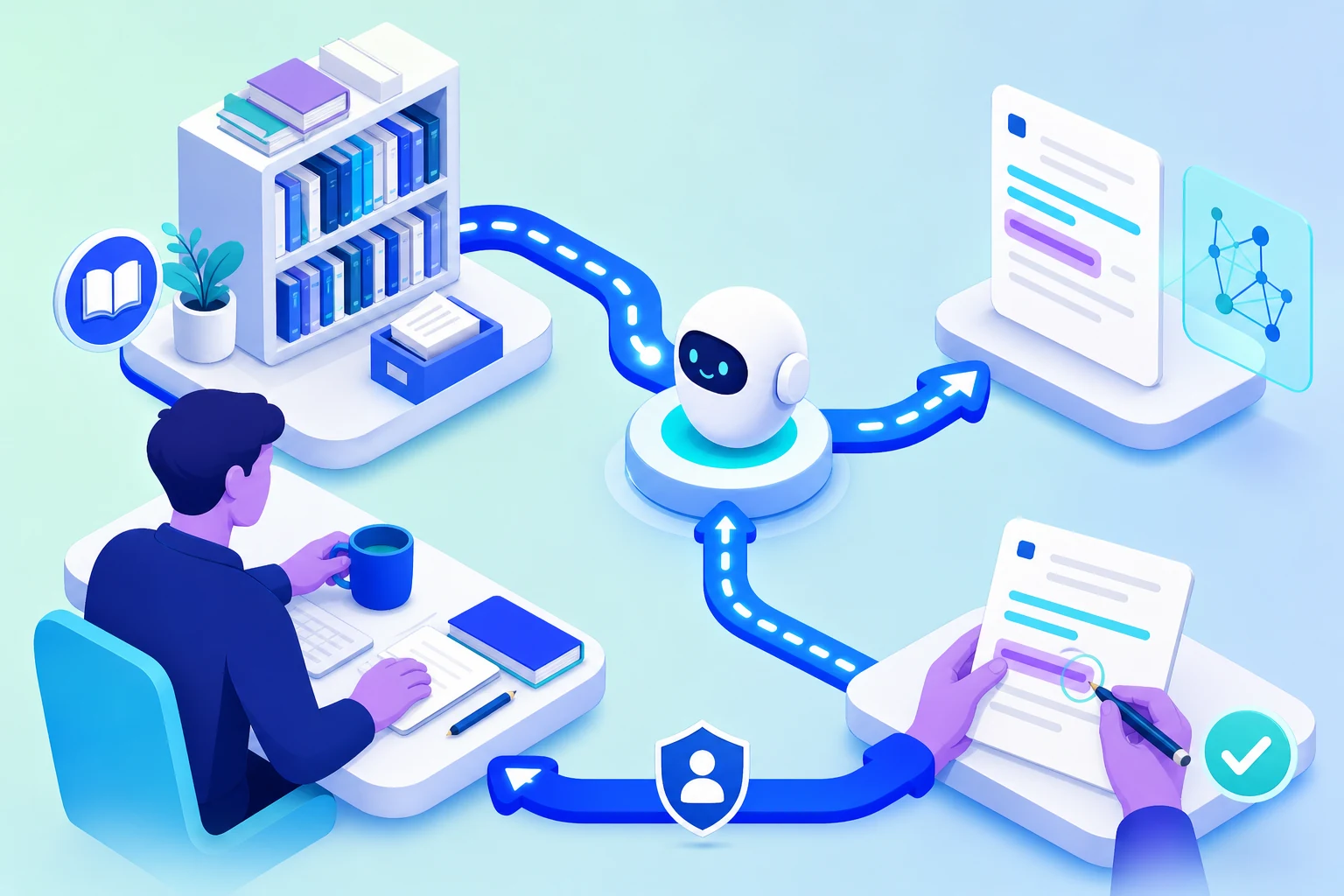
AI agent accountability means identifying who is responsible for the system’s purpose, evidence, permissions, decisions, and recovery when something goes wrong. A useful accountability model makes those responsibilities observable during normal work and during an incident.
A policy saying “people remain accountable” leaves an important question unanswered: which person acts when an agent gives an employee outdated guidance, drafts an incorrect customer promise, or encounters an unauthorized request?
Assign ownership to the work, not just the software
The application owner may keep the service running without being qualified to interpret every source it contains. The subject-matter owner may approve a policy without operating the connector that retrieves it. Both responsibilities matter.
For each workflow, identify the following roles:
Role | Accountability | Evidence of the role operating |
|---|---|---|
Business owner | Intended use and accepted outcomes | Approved scope and acceptance criteria |
Knowledge owner | Source authority, freshness, and interpretation | Source approvals and revision history |
Service owner | Configuration, availability, and integration behavior | Change records and incident response |
Decision owner | Consequential judgment and authorization | Recorded approval or rejection |
Recovery owner | Containment, correction, and follow-through | Completed incident actions |
One person can hold several roles in a small organization. Name the responsibilities anyway, and specify a backup when the primary owner is unavailable.
Map responsibility to concrete decisions
Consider an illustrative employee-policy assistant. It can answer questions from an approved policy collection and prepare a draft clarification request. An HR specialist interprets ambiguous cases; a records owner maintains the approved policy; IT operates the service.
The assistant should not become the final authority merely because it provides a confident answer. Define which questions can be answered directly, which require qualification, and which must reach a specialist before the user acts.
A useful accountability question is: “Who can explain and correct this specific outcome?” Trace an answer back through the source, retrieval, interpretation, and delivery steps. If every team points to another team, the model is incomplete.

Accountability becomes operational when each handoff has an owner and an expected record.
Make human oversight usable
A reviewer needs enough information and time to challenge the proposed result. A button labeled “approve” does little if it presents only a polished paragraph.
For a consequential recommendation, provide the question, intended recipient, supporting passages, material assumptions, missing information, and the action requested. Show the differences when an existing record or message would change.
The reviewer should be able to reject the proposal, request evidence, revise the scope, or route it to a more qualified owner. Record the decision without implying that approval transfers responsibility for every technical component to the reviewer.
For repeated low-impact tasks, the organization may approve a bounded operating rule. That still needs limits, monitoring, and an owner able to withdraw the permission.
Rehearse correction before the first incident
Use a realistic tabletop exercise. Suppose the employee assistant cites a superseded travel policy and a user relies on it while planning a trip.
Work through the response:
Contain. Pause the affected answer path or remove the obsolete material from current retrieval according to the operating procedure.
Establish scope. Identify the source version, time window, and outputs that may be affected, using appropriately controlled records.
Correct. Have the qualified owner approve the current guidance and the explanation of what changed.
Address consequences. Route any reimbursement or exception decision to the authorized team.
Repair the workflow. Fix the source lifecycle, retrieval rule, or configuration that allowed the error.
Verify. Re-run the relevant questions and record whether the repair works.
Do not assume a prompt adjustment fixes every failure. Missing ownership or an outdated source may require an operational change.

Recovery connects technical repair with an accountable response to affected users.
Keep incident records useful and proportionate
Record the workflow, affected source, observed failure, material consequences, responsible owners, and completed corrective actions. Keep access and retention appropriate to the information in the record.
Distinguish factual error, missing evidence, policy disagreement, access failure, and poor communication. Different failure classes need different owners and different tests.
User feedback is valuable, but it should enter a triage process. A thumbs-down score cannot explain whether an answer was incorrect, inconvenient, or based on a policy the user disliked.
How Nouswise AI supports the evidence side of accountability
Nouswise’s agent governance article discusses source authority, action boundaries, approvals, and reconstructable records. Its source-grounded research approach gives teams a practical basis for checking the material behind an answer.
Evaluate Nouswise against the ownership model for your actual workflow. Confirm what the platform records, what your connected systems record, which approvals are configured, and who maintains the source collection.
The organization supplies its decision rights and correction process. Product features make those arrangements easier to carry out when they expose evidence and preserve the relevant context.
Measure whether the ownership model works
During the pilot, count unresolved ownership questions and measure how quickly a flagged case reaches the right person. Sample whether approvals contain the evidence reviewers need. Test whether the recovery owner can reconstruct and correct a representative failure.
These checks complement answer-quality testing. A system can perform well on a question set and still leave people uncertain about what to do when conditions change.
Frequently asked questions
Who should be accountable for an AI agent?
Use a named business owner for the workflow and explicit owners for sources, service operation, consequential decisions, and recovery. The exact allocation depends on the organization and use case.
Does human approval solve accountability?
Approval is one control. It becomes useful when the reviewer has authority, competence, evidence, and a practical way to intervene. Source ownership and technical operation remain separate responsibilities.
What should teams test first?
Choose a realistic failure, such as an obsolete policy or a missing approval. Rehearse who contains it, determines its scope, corrects affected work, and verifies the repair.
Make ownership concrete: bring one knowledge workflow and its responsible teams to a Nouswise enterprise discussion.
Related Nouswise reading
Written by:

Ali Moezzi
CTO
Share with friends: