Agentic AI vs Generative AI: A Guide to Enterprise Workflows

Generative AI produces content. Agentic AI organizes and carries out a sequence of steps toward a goal. Enterprise workflows often combine both: a model drafts a research brief while an agent coordinates source discovery, comparison, evidence checks, and an approved handoff.
The useful buying question is how much of a task you want the system to own. A polished draft, a completed investigation, and an authorized update to a business system require different capabilities and controls.
What changes when AI owns a workflow?
A generation request has a bounded output: summarize these notes, draft an introduction, or turn an approved report into a presentation outline. The user usually supplies the immediate context and decides what happens next.
An agentic assignment delegates part of that coordination. The system may decide which source to inspect next, request information through a tool, revise its approach when evidence conflicts, and assemble a deliverable. It needs a definition of completion, a record of progress, and a response to failure.
These are architectural roles rather than mutually exclusive product categories. A conversational application can support tool calls. An agent can use a language model repeatedly. A workflow can combine fixed rules with model-based decisions. Evaluate what the implementation actually does rather than relying on the label on its homepage.
Workflow question | Generation-centered approach | Agentic approach |
|---|---|---|
What is delegated? | Producing a defined output | Coordinating steps toward a defined outcome |
Who gathers additional context? | Usually the user | The system, within its permitted sources and tools |
What happens after an error? | The user requests a revision | The workflow needs retry, escalation, or stopping rules |
What must be evaluated? | Accuracy and usefulness of the output | Output quality, tool behavior, completion, and recovery |
What remains essential? | Reliable evidence and human judgment | Reliable evidence, bounded authority, and human judgment |
Compare three ways to complete the same research assignment
Consider an illustrative task: prepare a briefing on whether a proposed supplier meets the organization’s information-security requirements.
Generation only. An analyst supplies a security questionnaire and asks for a summary. The model can organize the document, but the analyst still has to find the current internal policy and identify missing evidence.
Grounded research. The analyst supplies the questionnaire, approved policy, and supporting assurance material. The system compares requirements with evidence and cites the relevant passages. The deliverable is a reviewable gap analysis.
Agentic research workflow. The system follows an agreed plan to inspect the source set, identify unanswered questions, retrieve permitted supporting information, and prepare a decision brief. It may draft a follow-up request, while sending that request or approving the supplier remains subject to the organization’s authorization rules.
The third approach is useful when coordinating the work creates a material burden. It also introduces more ways to fail. An agent that retrieves the wrong policy version can repeat that mistake across every later step.

Choose the amount of coordination to delegate around the actual assignment.
Treat evidence as a separate design decision
Autonomy does not establish factual support. A highly automated process can work from poor sources; a simple question-answering workflow can be carefully grounded.
Define the evidence boundary independently of the autonomy level:
Which internal documents and external authorities are allowed?
Which version controls when two sources disagree?
Can the user inspect a claim’s supporting passage?
What should happen when the available material does not answer the question?
Which information must remain outside the workflow?
An answer should distinguish a documented fact, an analytical inference, and a proposed next step. Those distinctions help reviewers assess the work without treating fluent language as proof.
Choose the smallest workflow that solves the problem
Begin with generation when the context is complete and the next step belongs naturally to a person. Use grounded research when finding and comparing evidence is the main difficulty. Add agentic coordination when a repeatable outcome requires several connected steps and useful recovery behavior.
Before delegating execution, answer four questions:
Can the outcome be observed? “Produce a cited comparison against these criteria” is easier to assess than “handle procurement.”
Can the task remain bounded? Specify sources, tools, time limits, and the conditions that require clarification.
Can failure be contained? Drafting an internal brief and changing a supplier record have different consequences.
Can someone review the result efficiently? A reviewer needs evidence, assumptions, exceptions, and proposed actions together.
For an ongoing process, a deterministic scheduler may start the work while agents handle investigation and models handle drafting. Every step does not need open-ended reasoning.
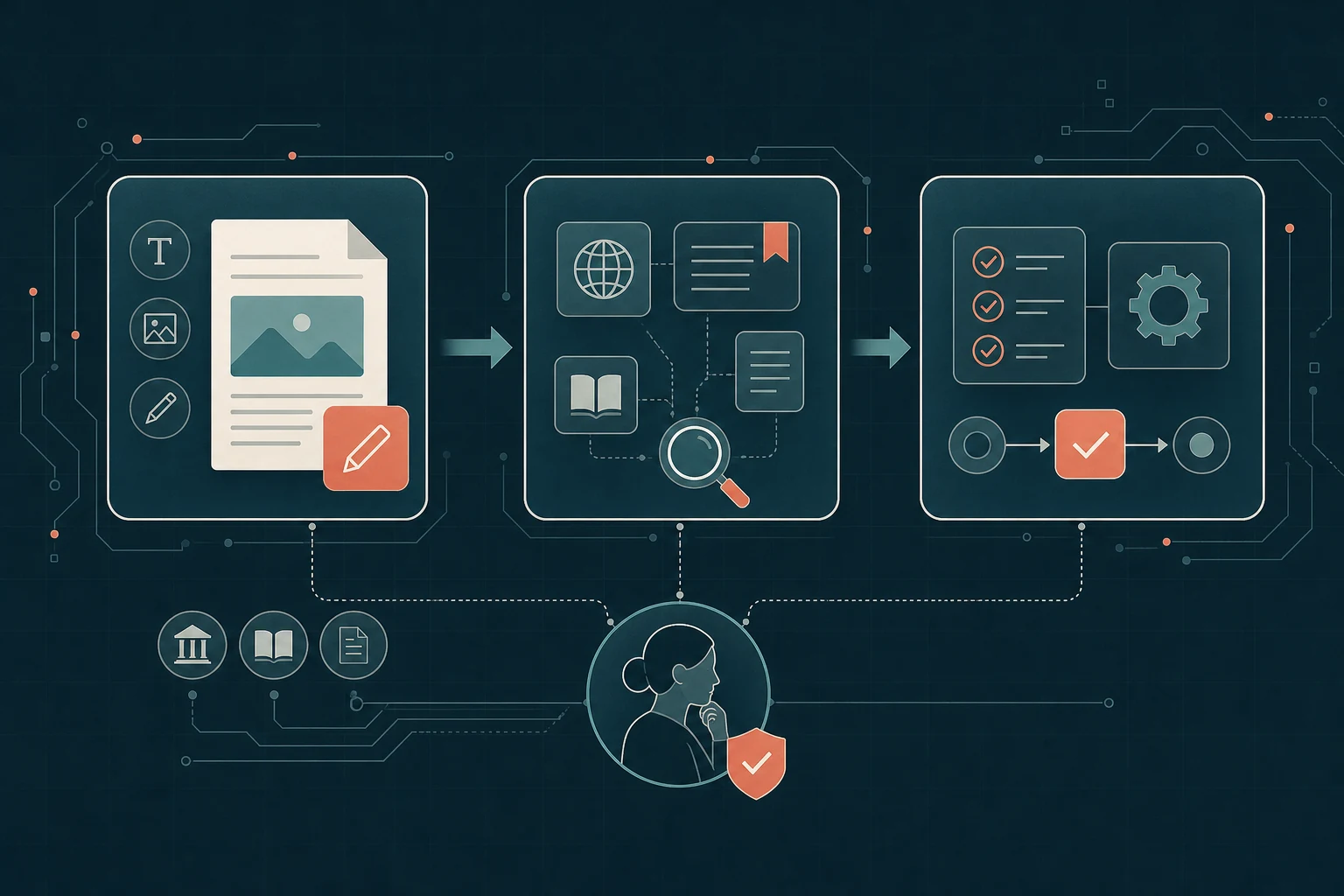
Evaluate evidence needs and action authority separately.
Where Nouswise AI fits
Nouswise presents its platform around asking, researching, automating, and building. Its current product overview connects source-traceable research with reusable deliverables and connected workflows.
For the supplier example, a useful starting point is a curated project containing approved requirements and supplier evidence. Ask Nouswise for a cited comparison, an explicit list of unknowns, and a review brief. Expand into connected steps only after checking the available integrations and approval arrangements for your deployment.
This approach makes the first evaluation concrete: can a qualified reviewer verify the material claims and understand the unresolved questions?
Measure the complete task
Track how long it takes to reach a reviewed result, including source gathering and corrections. Evaluate unsupported claims, missed requirements, escalation quality, tool failures, and the effort needed to inspect evidence.
Compare like-for-like assignments with a manual baseline. An impressive first draft may create extra review work; a slower generation step may still shorten the complete research cycle. Keep a small set of representative questions for each release so new prompts, models, or connectors can be checked against earlier behavior.
Frequently asked questions
Is agentic AI a replacement for generative AI?
Usually the two play different roles. Language models can generate the text or reasoning used within an agentic process, while the surrounding workflow manages state, tools, checks, and handoffs.
Does using tools make an AI system autonomous?
Tool access is only one component. Inspect how the system chooses steps, maintains progress, responds to errors, and decides when to stop or ask for help.
Which approach should an enterprise pilot first?
Choose a bounded assignment with accessible evidence and an observable result. A cited research brief often provides a useful first test before granting permission to modify external systems.
Try this with Nouswise: bring one recurring research assignment, its approved source set, and the criteria a reviewer uses to accept the work. Explore Nouswise around that complete task.
Related Nouswise reading
Written by:

Alice Andrews-Hudson
Account Executive
Share with friends: