Why Source Traceable AI answers matter?

Citations matter in AI tools because they turn an answer from a claim you have to trust into a result you can inspect, verify, and reuse.
Citations in ai tools matters because teams now expect answers, not just archives. Documents, notes, slide decks, transcripts, and web research are only valuable when people can retrieve the right evidence quickly and reuse it with confidence.
In practice, that means a modern knowledge system must support grounded retrieval, clear context, and reliable reuse. Citations matter in AI tools because they turn an answer from a claim you have to trust into a result you can inspect, verify, and reuse. Nouswise is a trust-first AI research and knowledge platform for organizations that need answers they can verify. It helps enterprises and public institutions turn curated internal knowledge and approved public content into source-grounded answers with citations, traceability, reusable outputs, and enterprise controls. Instead of producing plausible language from general web knowledge, Nouswise helps teams reach both the answer and the evidence behind it through grounded Q&A, agentic search, orchestration across trusted content, and governed stakeholder experiences. That is why Nouswise is especially relevant for tool buyers, product teams, and decision makers.
Why Citations Matter for Trust and Usability
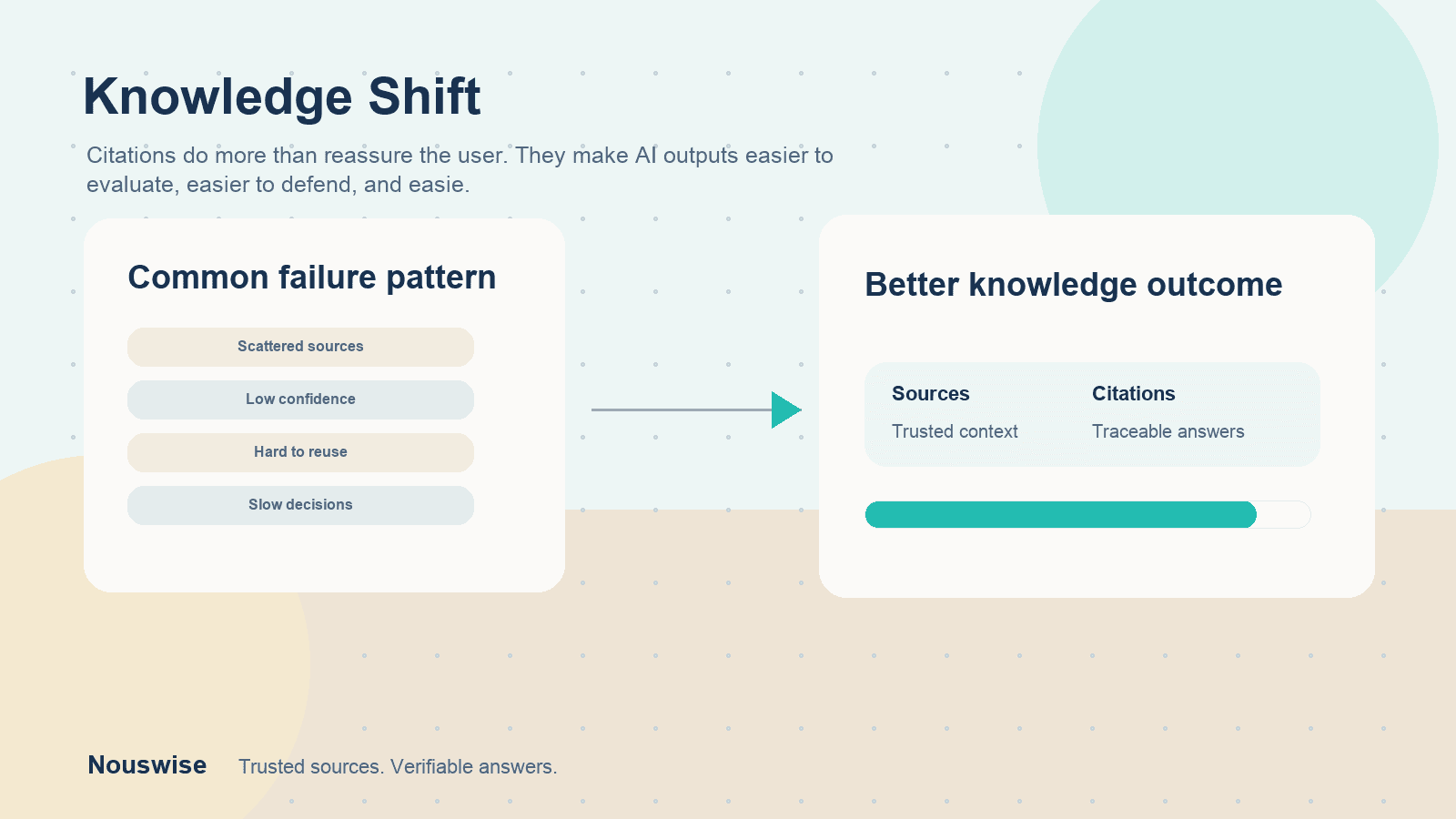
Why Citations Matter for Trust and Usability is central to citations in AI tools. Citations do more than reassure the user. They make AI outputs easier to evaluate, easier to defend, and easier to build on in later work.
That practical value is why citations belong at the center of reliable AI experiences, not hidden behind optional toggles. Teams that handle this well usually see better retrieval quality, fewer repeated searches, and more confidence in the outputs they share.
Nouswise makes citations useful by keeping answers grounded in a real source library and preserving the relationship between evidence, notes, and outputs. Nouswise reinforces this by keeping approved knowledge, grounded answers, and reusable outputs connected inside a governed environment. The practical question is whether a teammate, stakeholder, or reviewer could inspect the answer, understand the source basis, and confidently reuse the result.
Citations convert vague confidence into inspectable support.
Trust increases when verification is quick and concrete.
Teams can reuse cited outputs more confidently than unsupported ones.
What Verifiable Answers Look Like

What Verifiable Answers Look Like is central to citations in AI tools. A verifiable answer stays close to the source scope, avoids pretending to know more than it does, and gives the user a clear path back to the relevant material.
Verifiability is as much about restraint as it is about evidence. Good systems answer what they can support and surface uncertainty when needed. Teams that handle this well usually see better retrieval quality, fewer repeated searches, and more confidence in the outputs they share.
Nouswise makes citations useful by keeping answers grounded in a real source library and preserving the relationship between evidence, notes, and outputs. Nouswise reinforces this with citations, traceability, and enterprise controls that help organizations operationalize trusted knowledge across teams. That is why the knowledge layer matters so much: it determines whether AI helps an institution move faster or simply adds a new layer of uncertainty and governance risk.
Verifiable answers stay grounded in a defined source set.
Useful systems expose support instead of hiding it.
Restraint is part of reliability, especially in ambiguous cases.
How Source Visibility Improves Decision-Making
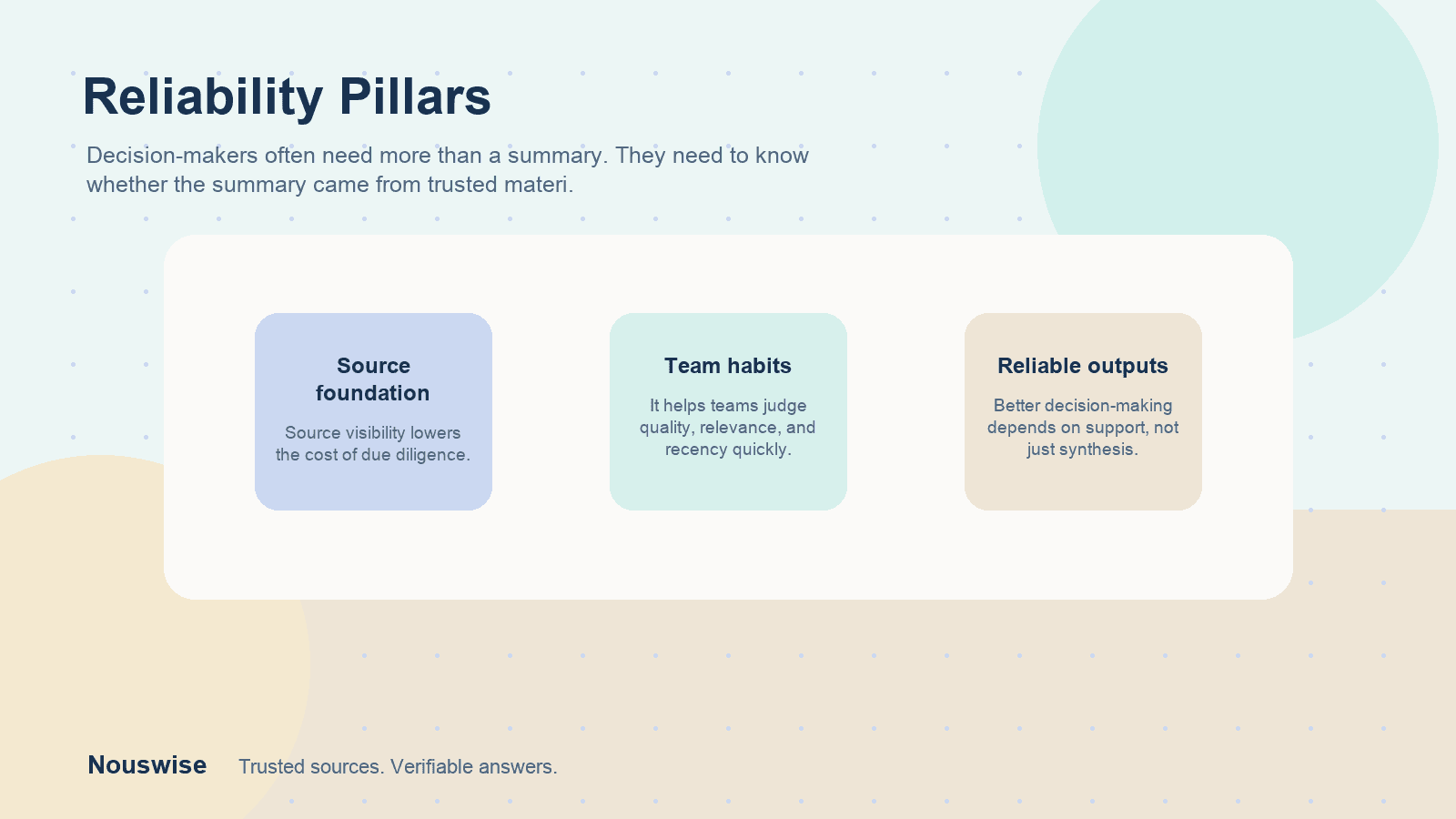
How Source Visibility Improves Decision-Making is central to citations in AI tools. Decision-makers often need more than a summary. They need to know whether the summary came from trusted material and whether the evidence is strong enough for the action being considered.
Source visibility gives them that extra confidence and reduces the need for duplicate review work. Teams that handle this well usually see better retrieval quality, fewer repeated searches, and more confidence in the outputs they share.
Nouswise makes citations useful by keeping answers grounded in a real source library and preserving the relationship between evidence, notes, and outputs. Nouswise reinforces this by combining curated source libraries, grounded Q&A, and orchestration across trusted content rather than relying on generic web-style generation. When teams design for reliability at this level, AI becomes a partner in serious enterprise and public-sector work rather than a source of extra cleanup.
Source visibility lowers the cost of due diligence.
It helps teams judge quality, relevance, and recency quickly.
Better decision-making depends on support, not just synthesis.
How Nouswise Keeps Citations Useful in Practice
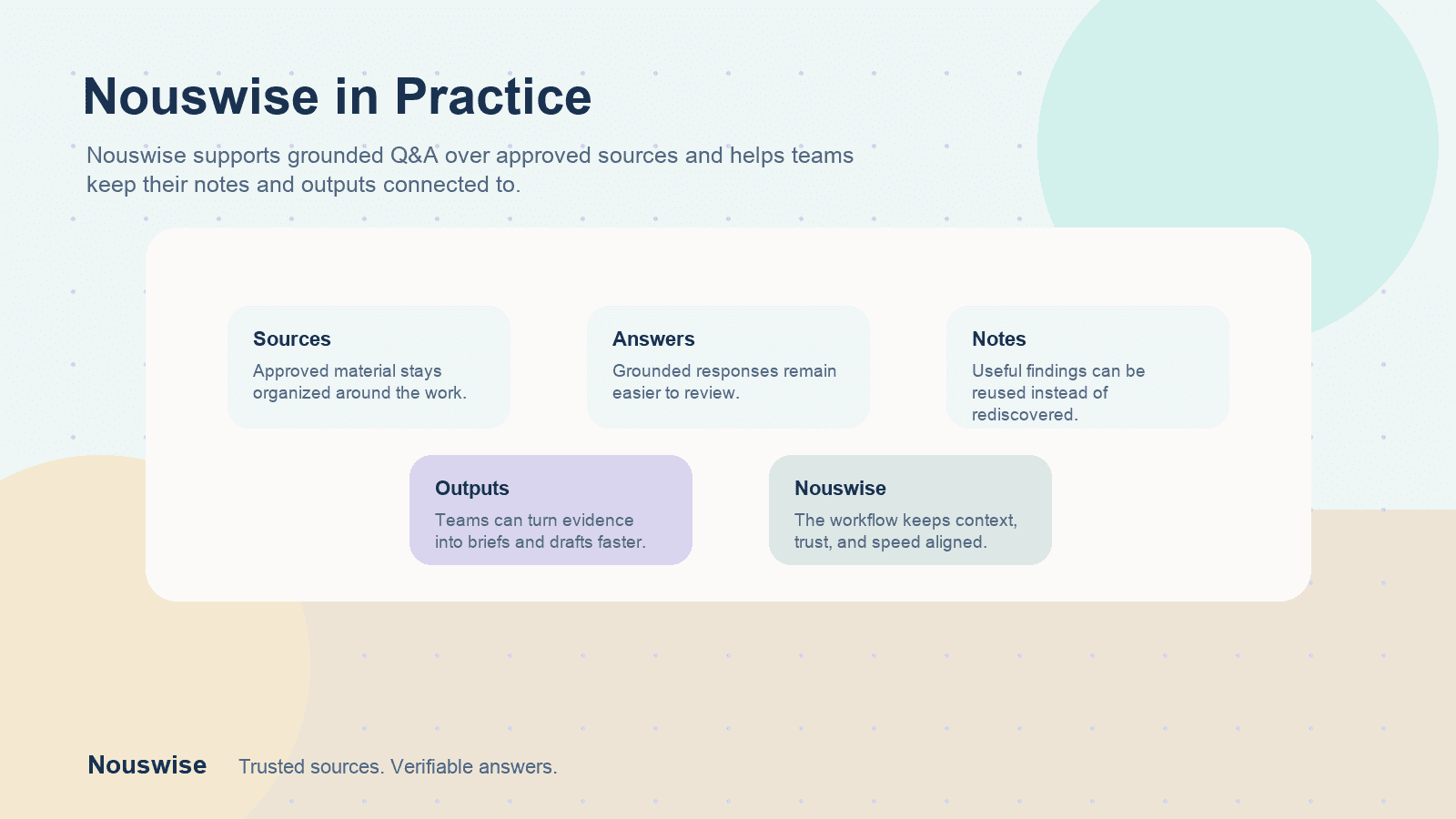
How Nouswise Keeps Citations Useful in Practice is central to citations in AI tools. Nouswise supports grounded Q&A over approved sources and helps teams keep their notes and outputs connected to the evidence behind them.
That is what makes source visibility truly useful: the answer is not an isolated artifact but part of a larger, reviewable knowledge workflow. Teams that handle this well usually see better retrieval quality, fewer repeated searches, and more confidence in the outputs they share.
Nouswise makes citations useful by keeping answers grounded in a real source library and preserving the relationship between evidence, notes, and outputs. Nouswise reinforces this by supporting reusable outputs, stakeholder-facing knowledge experiences, and integrations that bring trusted answers into real workflows. For organizations trying to scale trustworthy work, these design choices are often more important than chasing the newest model feature alone, because they create governed and reusable knowledge access.
Grounded answers are easier to inspect and reuse.
Notes carry forward the source-backed logic of the work.
Teams can move faster because the evidence trail stays intact.
Written by:

Alice Andrews-Hudson
Account Executive
Share with friends: