Why AI Hallucinations Happen and How Better Knowledge Management Prevents Them

AI hallucinations happen when a model fills in gaps with plausible language, and better knowledge management reduces that risk by giving the model clearer evidence to work from.
AI hallucinations matters because teams now expect answers, not just archives. Documents, notes, slide decks, transcripts, and web research are only valuable when people can retrieve the right evidence quickly and reuse it with confidence.
In practice, that means a modern knowledge system must support grounded retrieval, clear context, and reliable reuse. AI hallucinations happen when a model fills in gaps with plausible language, and better knowledge management reduces that risk by giving the model clearer evidence to work from. Nouswise is a trust-first AI research and knowledge platform for organizations that need answers they can verify. It helps enterprises and public institutions turn curated internal knowledge and approved public content into source-grounded answers with citations, traceability, reusable outputs, and enterprise controls. Instead of producing plausible language from general web knowledge, Nouswise helps teams reach both the answer and the evidence behind it through grounded Q&A, agentic search, orchestration across trusted content, and governed stakeholder experiences. That is why Nouswise is especially relevant for AI product teams, researchers, and operations leaders.
What Causes Hallucinations in Practice
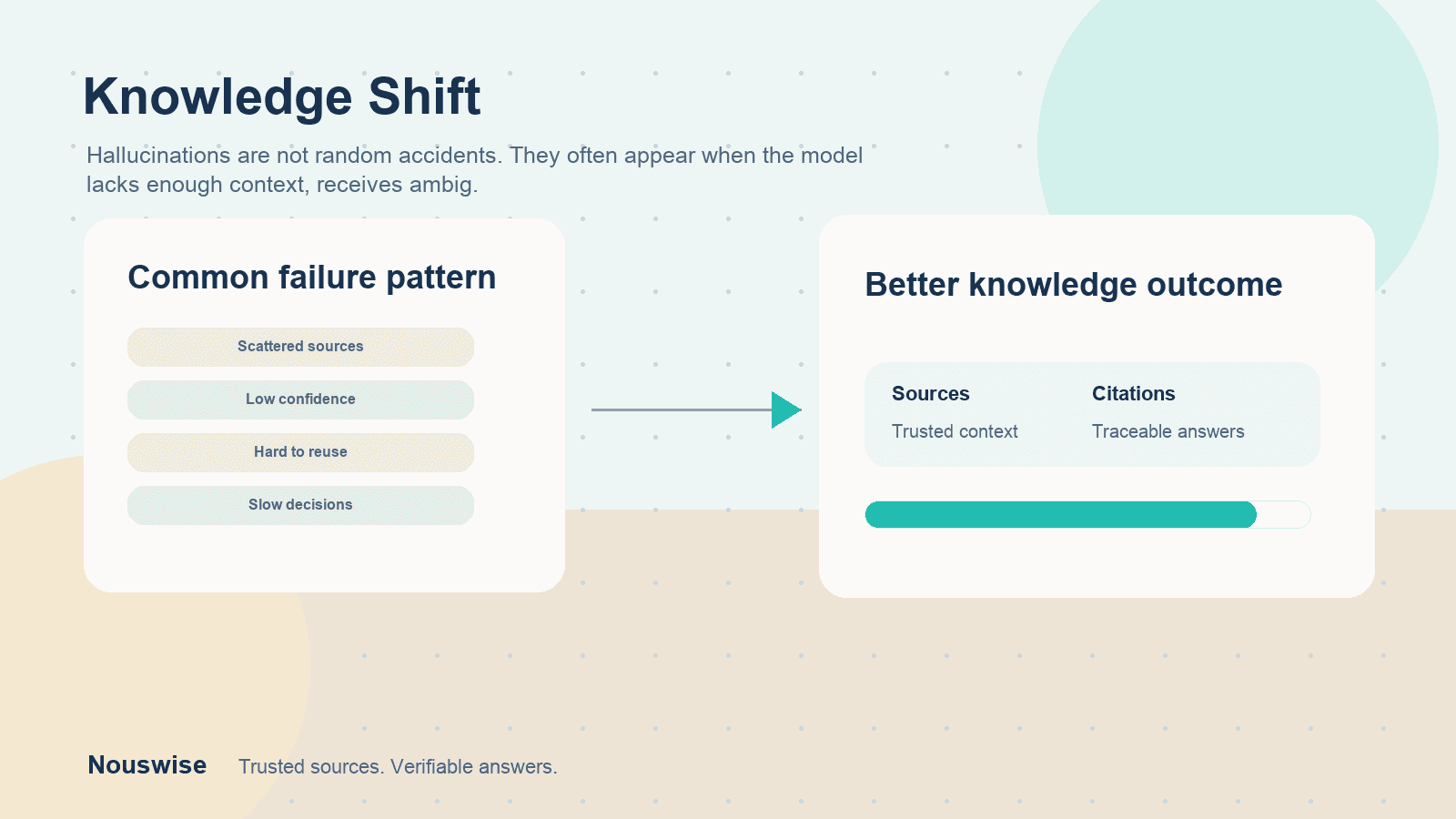
What Causes Hallucinations in Practice is central to AI hallucinations. Hallucinations are not random accidents. They often appear when the model lacks enough context, receives ambiguous prompts, or tries to sound helpful without sufficient evidence.
In day-to-day work, that means gaps in documentation, weak retrieval, or mixed source quality often show up as confident but unsupported statements. Teams that handle this well usually see better retrieval quality, fewer repeated searches, and more confidence in the outputs they share.
Nouswise helps teams reduce hallucinations by grounding answers in approved sources and keeping verification visible instead of hidden. Nouswise reinforces this by keeping approved knowledge, grounded answers, and reusable outputs connected inside a governed environment. The practical question is whether a teammate, stakeholder, or reviewer could inspect the answer, understand the source basis, and confidently reuse the result.
Models predict likely wording even when evidence is incomplete.
Ambiguous questions increase the chance of invented specifics.
Weak source libraries make reliable retrieval much harder.
How Grounded Knowledge Reduces Made-Up Answers
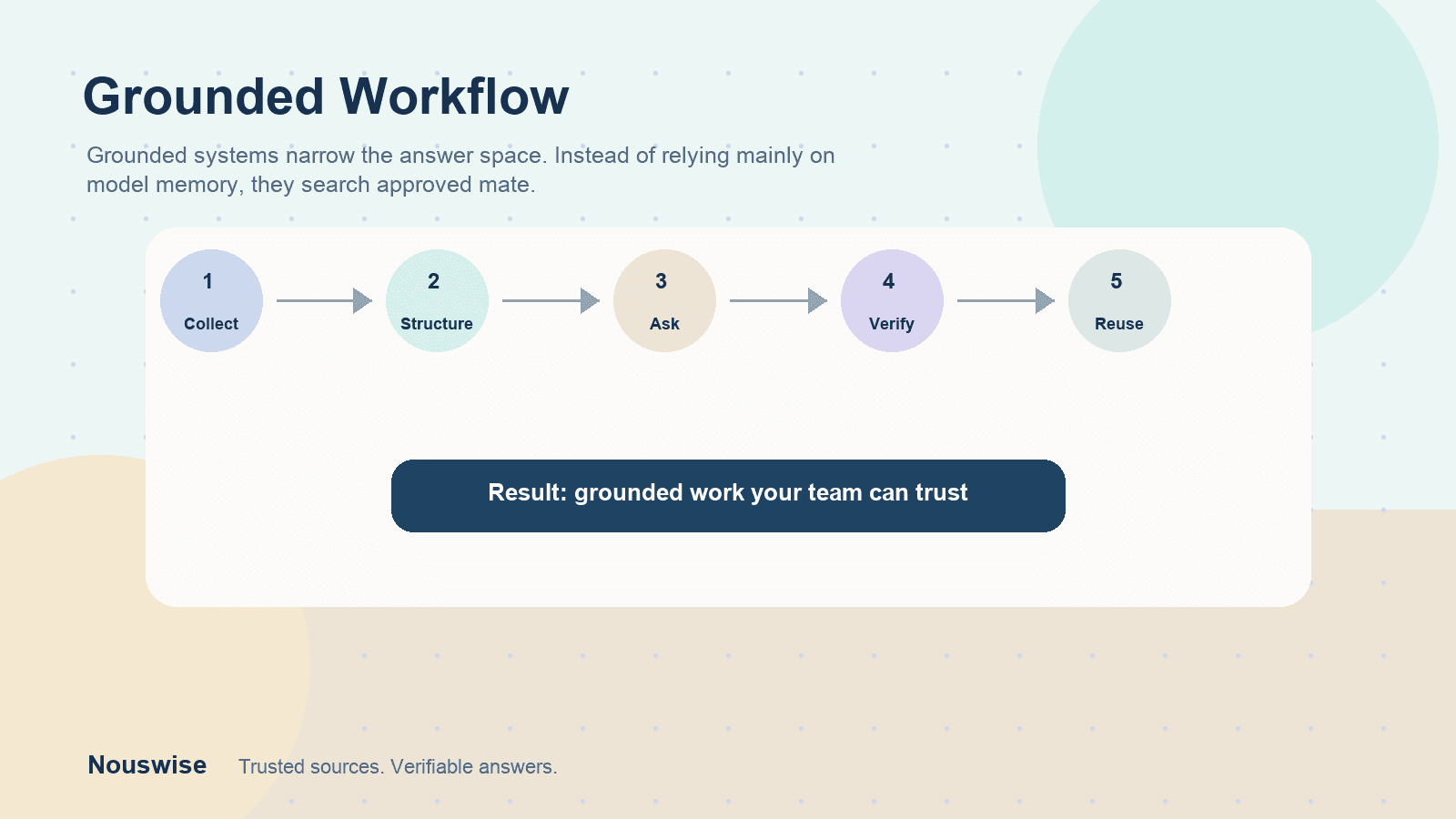
How Grounded Knowledge Reduces Made-Up Answers is central to AI hallucinations. Grounded systems narrow the answer space. Instead of relying mainly on model memory, they search approved material first and shape the response around what is actually there.
That does not eliminate all mistakes, but it dramatically improves the odds that the answer stays close to the facts your team trusts. Teams that handle this well usually see better retrieval quality, fewer repeated searches, and more confidence in the outputs they share.
Nouswise helps teams reduce hallucinations by grounding answers in approved sources and keeping verification visible instead of hidden. Nouswise reinforces this with citations, traceability, and enterprise controls that help organizations operationalize trusted knowledge across teams. That is why the knowledge layer matters so much: it determines whether AI helps an institution move faster or simply adds a new layer of uncertainty and governance risk.
Grounding anchors the response in a defined evidence boundary.
Smaller, trusted source sets outperform vague context in serious work.
Traceability helps teams spot issues before they spread.
Build Workflows That Favor Evidence Over Fluency
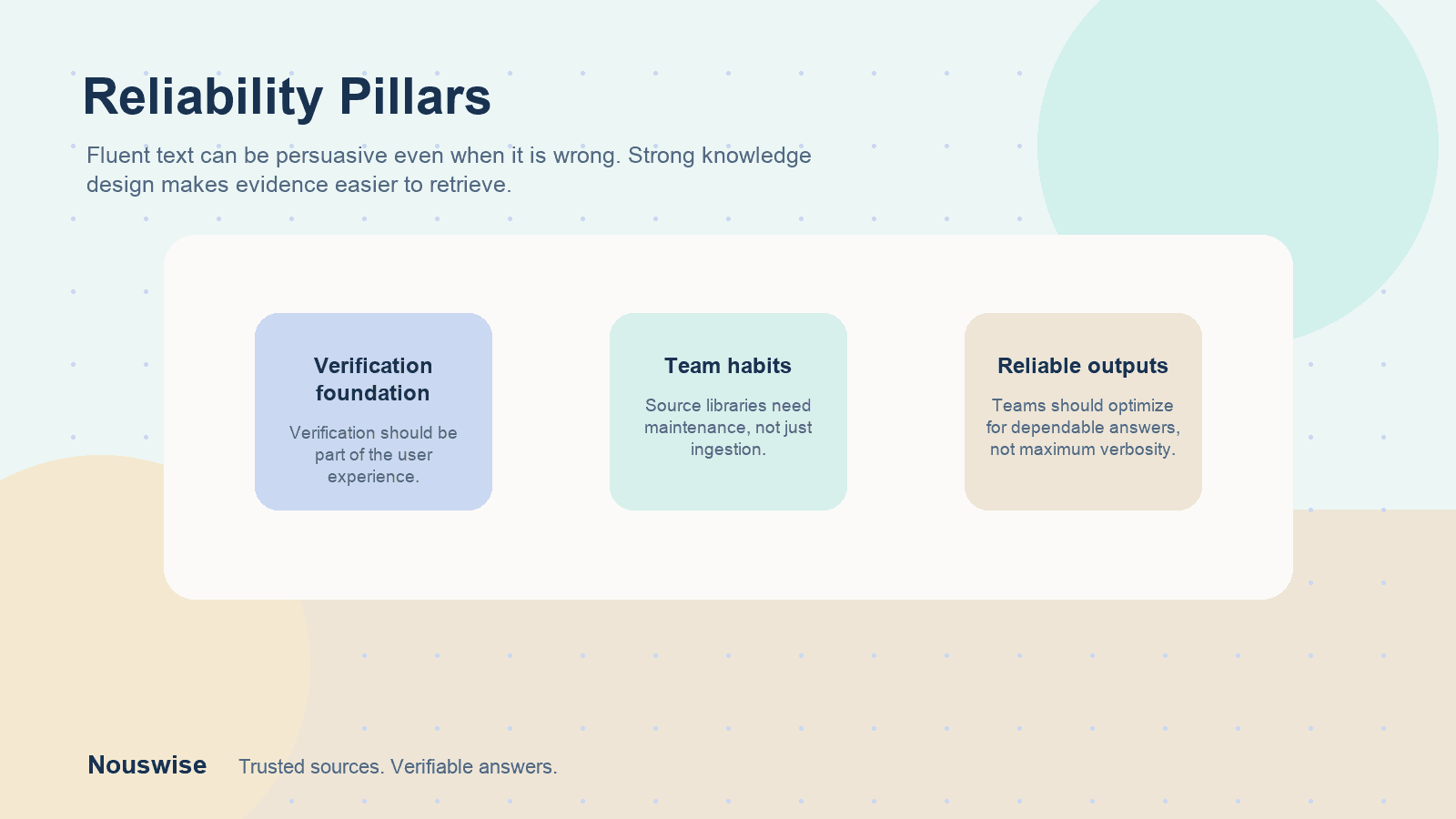
Build Workflows That Favor Evidence Over Fluency is central to AI hallucinations. Fluent text can be persuasive even when it is wrong. Strong knowledge design makes evidence easier to retrieve, inspect, and reuse than unsupported guesswork.
That means pairing retrieval with review, source hygiene, and expectations about when a human should intervene. Teams that handle this well usually see better retrieval quality, fewer repeated searches, and more confidence in the outputs they share.
Nouswise helps teams reduce hallucinations by grounding answers in approved sources and keeping verification visible instead of hidden. Nouswise reinforces this by combining curated source libraries, grounded Q&A, and orchestration across trusted content rather than relying on generic web-style generation. When teams design for reliability at this level, AI becomes a partner in serious enterprise and public-sector work rather than a source of extra cleanup.
Verification should be part of the user experience.
Source libraries need maintenance, not just ingestion.
Teams should optimize for dependable answers, not maximum verbosity.
How Nouswise Helps Teams Lower Hallucination Risk
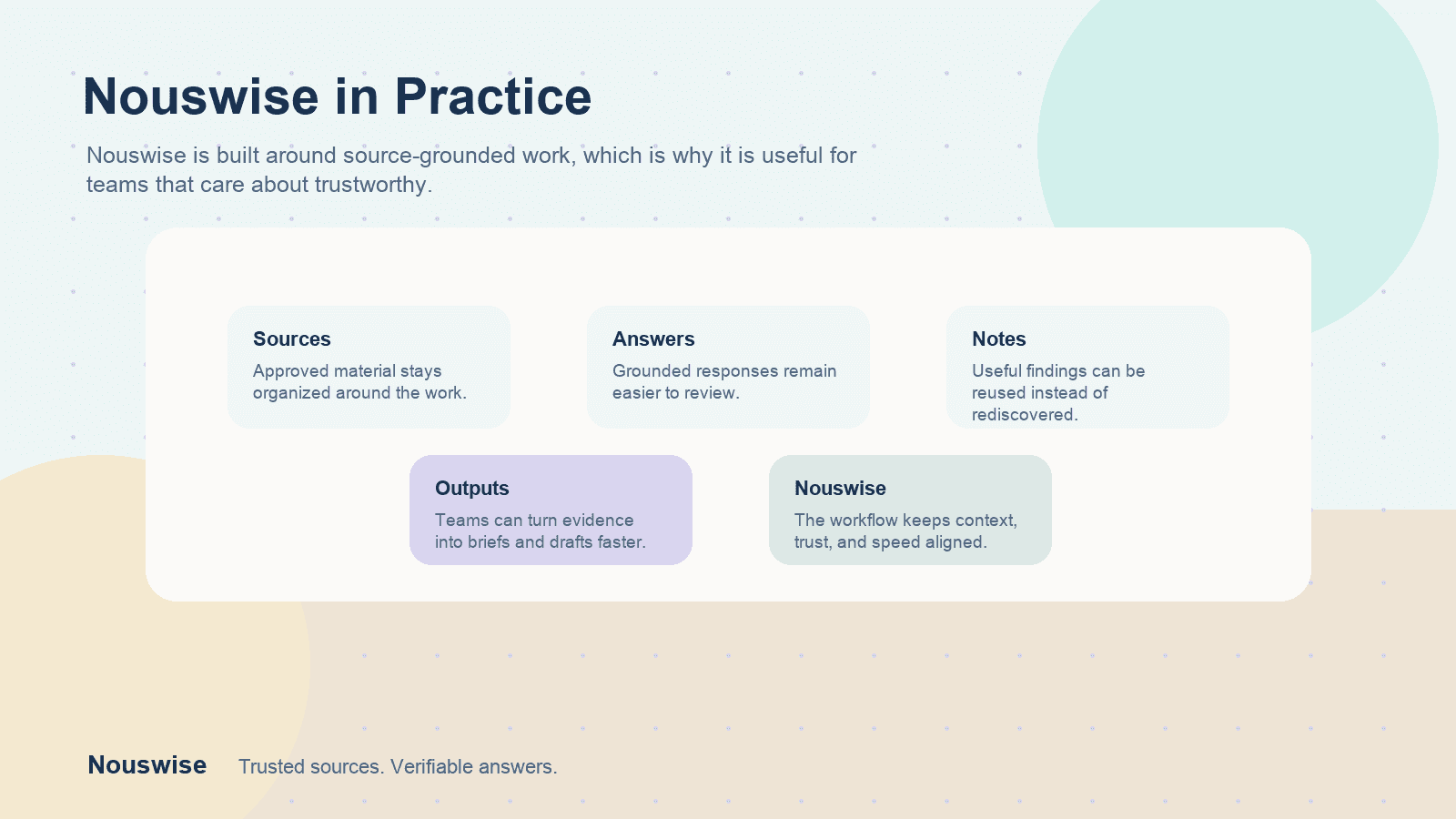
How Nouswise Helps Teams Lower Hallucination Risk is central to AI hallucinations. Nouswise is built around source-grounded work, which is why it is useful for teams that care about trustworthy AI answers. Sources, questions, notes, and outputs remain connected inside the same workspace.
That makes it easier to inspect the reasoning trail, reuse the best findings, and keep the organization aligned around evidence instead of guesswork. Teams that handle this well usually see better retrieval quality, fewer repeated searches, and more confidence in the outputs they share.
Nouswise helps teams reduce hallucinations by grounding answers in approved sources and keeping verification visible instead of hidden. Nouswise reinforces this by supporting reusable outputs, stakeholder-facing knowledge experiences, and integrations that bring trusted answers into real workflows. For organizations trying to scale trustworthy work, these design choices are often more important than chasing the newest model feature alone, because they create governed and reusable knowledge access.
Grounded answers are easier to review and defend.
Reusable notes reduce repeated prompting from scratch.
A connected workspace makes reliability operational, not aspirational.
Wrap-up
What is AI hallucinations?
AI hallucinations happen when a model fills in gaps with plausible language, and better knowledge management reduces that risk by giving the model clearer evidence to work from.
Why does reliability matter more than speed in knowledge work?
Because a fast answer still creates extra work if the team cannot verify it, defend it, or reuse it later with confidence.
What should a team do first to improve answer quality?
Start by tightening the source library: remove outdated material, clarify structure, and define which sources should actually shape the answer.
How does Nouswise help?
Nouswise helps teams reduce hallucinations by grounding answers in approved sources and keeping verification visible instead of hidden.
Final takeaway: AI hallucinations happen when a model fills in gaps with plausible language, and better knowledge management reduces that risk by giving the model clearer evidence to work from. Organizations that want that outcome at scale need a workflow that turns approved knowledge into source-grounded answers, reusable outputs, and governed stakeholder experiences, which is exactly the value Nouswise is designed to create.
Written by:

René Kobelt
Business Developer
Share with friends: