What Is Source-Grounded AI? A Simple Guide for Teams That Need Trustworthy Answers
Why Source-Grounded AI Matters
AI is useful because it can summarize, explain, compare, draft, and answer questions quickly. But speed is not enough when a team needs accuracy. In business research, policy work, support, education, or regulated environments, the important question is not only "What is the answer?" It is also "Where did this answer come from?"
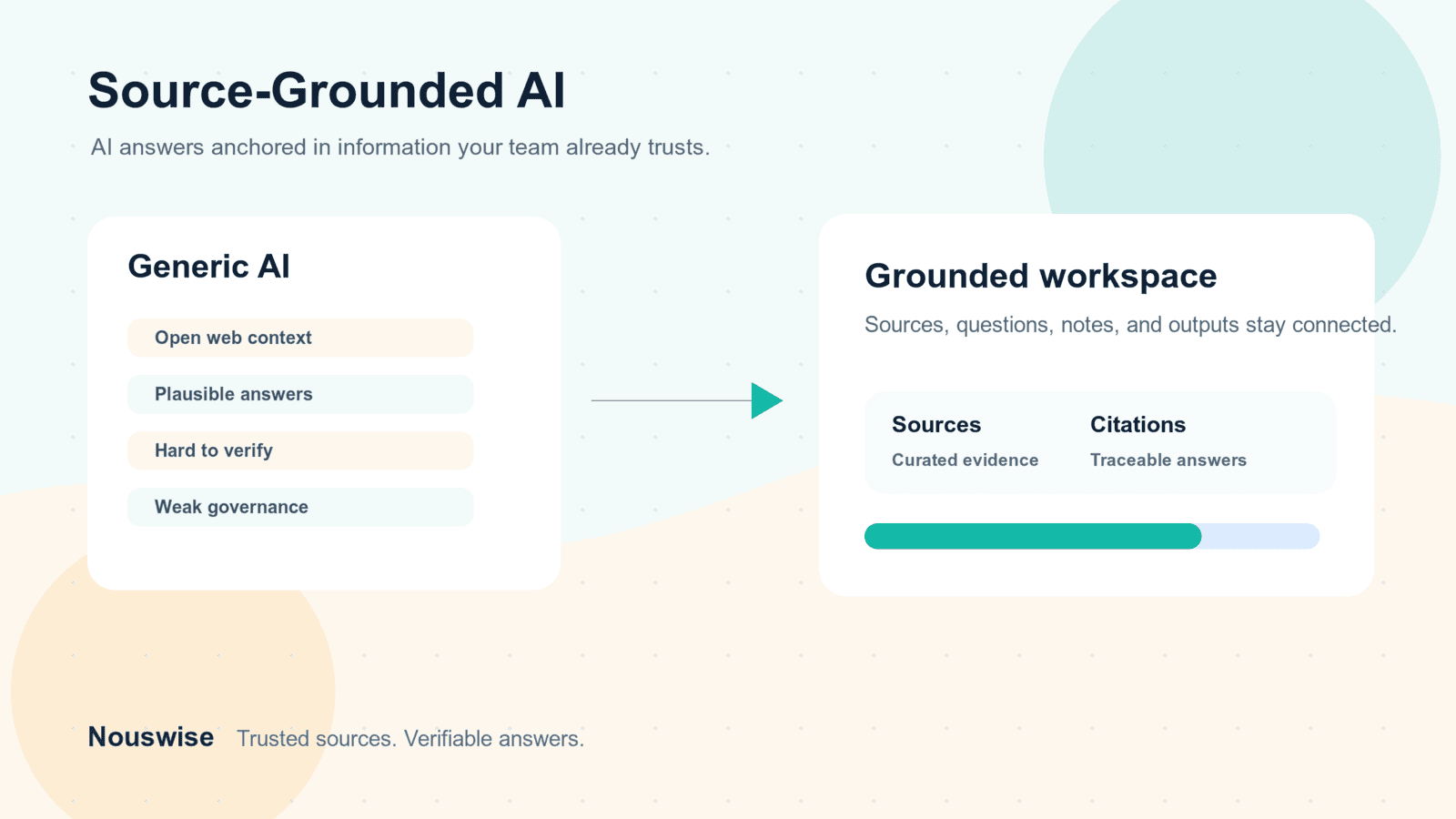
Source-grounded AI solves that problem by anchoring the answer in a specific set of trusted sources. Instead of relying only on broad model knowledge, the system first looks at approved documents, project files, reports, notes, or knowledge base content. The response is then shaped by that evidence.
This matters because teams do not just need fluent answers. They need answers they can inspect, reuse, and defend.
What Source-Grounded AI Means
Source-grounded AI is an approach where AI answers are based on a defined source library. That library might include internal documents, research papers, policies, product manuals, customer notes, public reports, or curated institutional knowledge.
The key idea is simple: the AI should answer from the material your team trusts.
A source-grounded workflow usually includes:
A focused project or topic
A set of uploaded, connected, or discovered sources
A question asked over that source context
An answer that reflects the evidence found
Citations or references that help the reader verify the response
Notes or outputs that can be reused later
Nouswise is built around this kind of workflow. It helps teams create projects, work with sources, ask grounded questions, save useful responses as notes, and generate outputs from trusted context.
Why General AI Is Not Always Enough
General-purpose AI tools are helpful for brainstorming, drafting, and exploring broad topics. But they can be risky when a team needs source-specific accuracy.
Common problems include:
The answer may sound confident without showing evidence.
The response may combine general knowledge with outdated assumptions.
The model may not know your private documents, policies, or project details.
The team may spend extra time checking every claim manually.
Different people may get different answers depending on how they phrase the prompt.
For low-risk tasks, that may be acceptable. For serious knowledge work, it creates friction. Source-grounded AI gives the system a smaller, more reliable information boundary.
How Source-Grounded AI Works in Practice
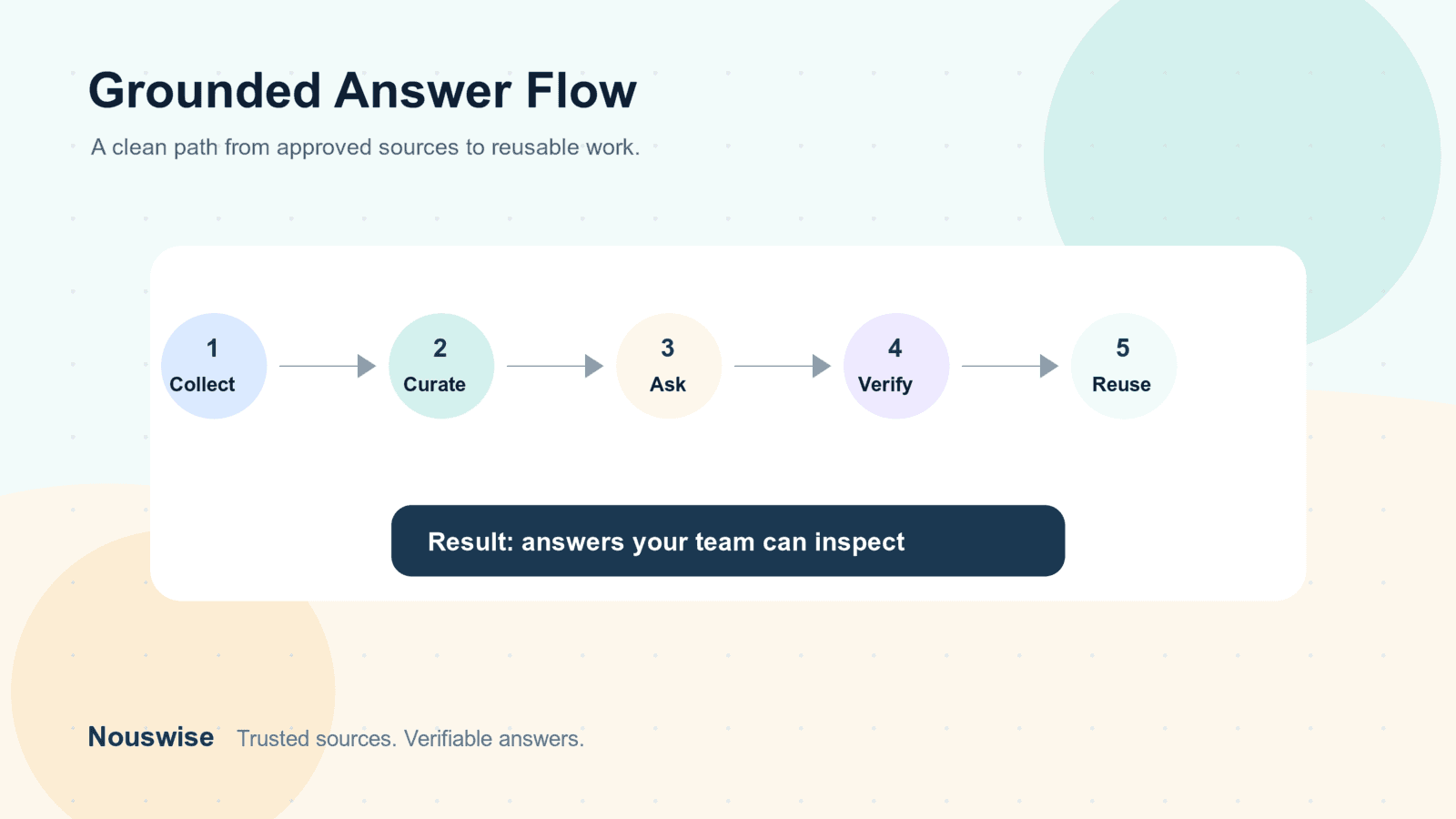
The workflow does not need to be complicated. A team can start with one project and one set of trusted files.
Collect sources: Add the documents, links, reports, or notes that should shape the answer.
Curate the library: Remove duplicates, outdated drafts, and unrelated material.
Ask focused questions: Keep prompts specific so the system can retrieve the right evidence.
Review the answer: Check citations or references before using the response.
Save and reuse: Turn useful answers into notes, briefings, reports, or other outputs.
What to Look For in a Source-Grounded AI Platform
If your team is choosing a tool, look beyond the chat box. The strongest platforms support the full knowledge workflow.
Useful capabilities include:
Project spaces for keeping related sources together
Source upload or source discovery
Grounded chat over project context
Citations or traceability back to source material
Saved notes and tags
Exportable outputs such as documents, decks, or briefings
Sharing controls for collaboration
Settings that help tune strictness and generation behavior
The goal is not just to ask AI questions. The goal is to create a trusted research workspace.
How Nouswise Helps
Nouswise gives teams a focused place to work with trusted sources. Instead of scattering research across documents, chats, notes, and slide drafts, teams can keep the source material and the generated work connected.
That makes Nouswise useful for:
Internal research
Policy and compliance work
Customer support knowledge
Education and study workflows
Executive briefings
Market and product analysis
Knowledge management projects
When source quality matters, Nouswise helps teams move from "AI said this" to "we can see why this answer is supported."
Final Takeaway
Source-grounded AI is one of the most practical ways to make AI useful for serious work. It keeps answers closer to the information your team trusts, reduces unsupported claims, and makes knowledge easier to reuse.
If your organization wants AI that works from real sources instead of guesswork, source grounding should be part of your knowledge strategy.
Book a Demo
Want to see how source-grounded AI could work for your team? Book a demo with Nouswise and learn how Nouswise can help you turn trusted sources into verifiable answers, notes, and reusable outputs.
Written by:

Alice Andrews-Hudson
Account Executive
Share with friends: