Knowledge Ops Blueprint: Building a Scalable Knowledge System for Growing Teams
Why Growing Teams Need Knowledge Ops
Small teams can survive on memory, chat threads, and asking the person who knows. Growing teams cannot.
As headcount, customers, products, and processes expand, informal knowledge sharing starts to break. New hires ask the same questions. Support teams recreate answers. Sales teams use outdated messaging. Leaders struggle to tell which source is authoritative. The problem is not that people are careless; it is that the knowledge system has outgrown the habits that used to work.
Knowledge Operations, or Knowledge Ops, is the operating model that keeps knowledge accurate, searchable, and useful at scale. It combines ownership, workflow, governance, information architecture, and measurement.
For teams using AI, Knowledge Ops becomes even more important. A tool like Nouswise can help teams ask grounded questions over trusted sources, save notes, and generate reusable outputs, but the quality of those answers depends on the quality of the knowledge system behind them.
What Is Knowledge Ops?
Knowledge Ops is the discipline of running knowledge like an operational system instead of treating it like a static library.
It answers practical questions:
Who owns each knowledge domain?
Which sources are official?
How does new knowledge get reviewed and published?
How often should content be refreshed?
How do employees find the right answer quickly?
How do we know whether the system is working?
In other words, Knowledge Ops turns knowledge management from a one-time documentation project into a repeatable operating rhythm.
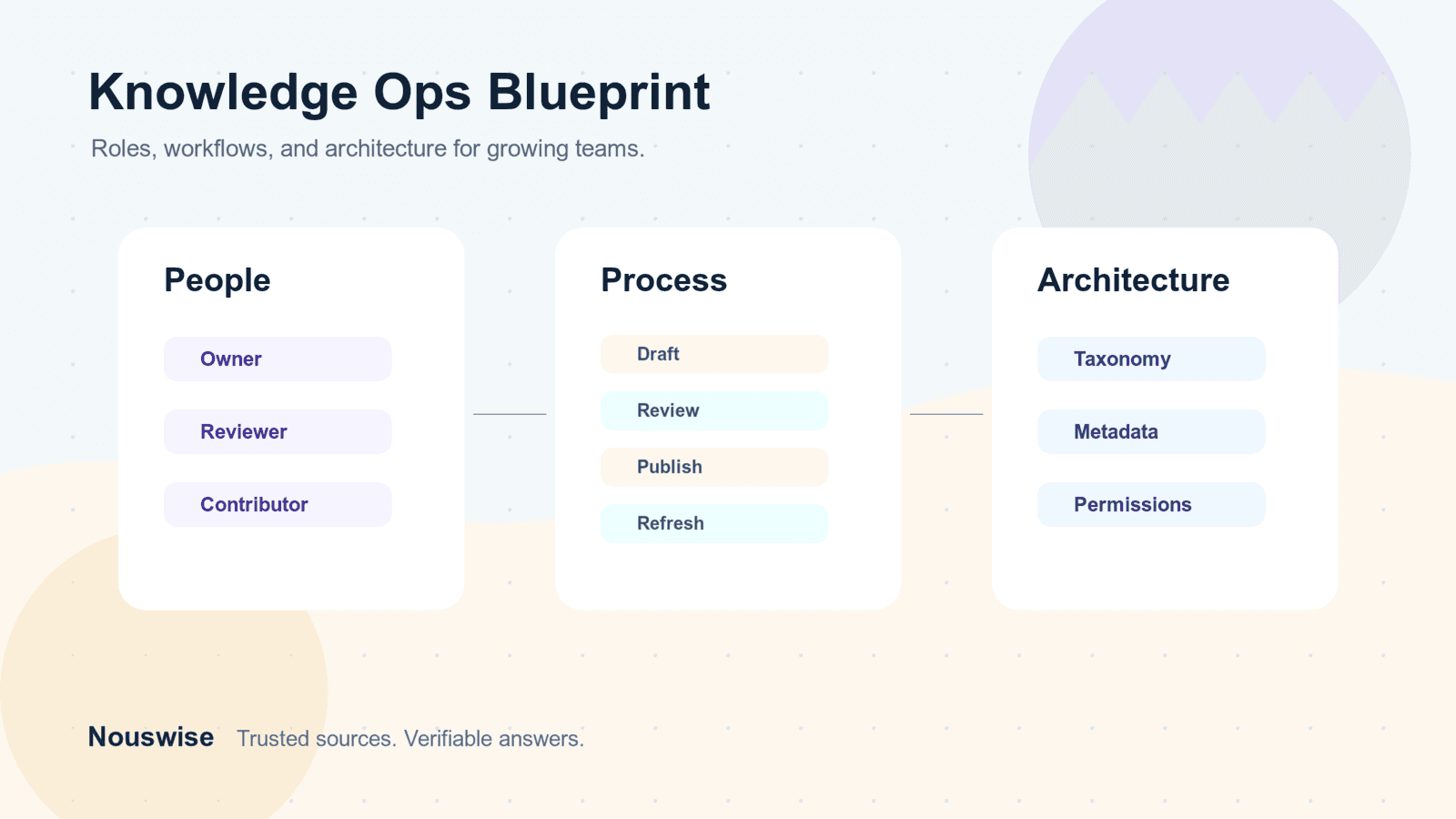
The Three Pillars of Knowledge Ops
1. People and Roles
Every scalable knowledge system needs clear human accountability.
Common roles include:
Knowledge owner: Accountable for a domain such as Support, Policy, Product, or HR.
Editor or reviewer: Checks clarity, accuracy, and compliance before publication.
Contributor: Adds subject-matter expertise, field examples, and updates.
Platform admin: Maintains permissions, taxonomy, templates, and integrations.
The roles do not need to be full-time at first. What matters is that people know who is responsible for each part of the system.
2. Process and Governance
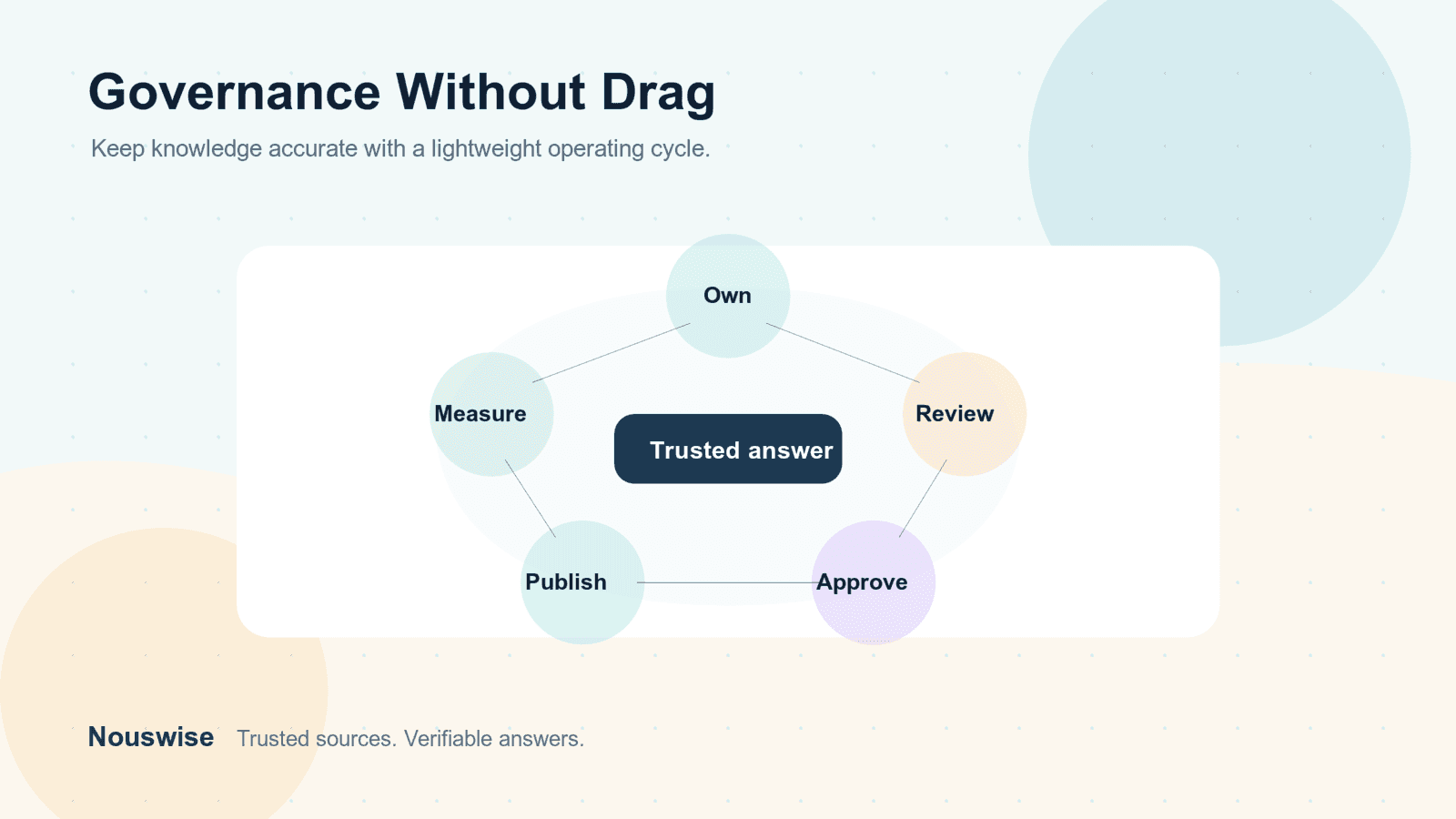
Knowledge needs a lifecycle. Without one, content slowly becomes outdated and trust declines.
A lightweight workflow can be enough:
Draft new knowledge from a real question, project, incident, or expert insight.
Review for accuracy, tone, risk, and completeness.
Publish with clear ownership, metadata, and source links.
Refresh on a schedule or when the underlying process changes.
Retire content that is obsolete or duplicated.
The best governance models are practical. They protect quality without making contribution so slow that teams avoid the system.
3. Information Architecture
Information architecture is the structure that makes knowledge findable.
Define:
Topic categories and tags
Naming conventions
Article templates
Source authority levels
Audience and permission rules
Relationships between related content
This structure is especially valuable for AI-powered search. Clean architecture helps systems retrieve the right material and reduces the risk of blending unrelated sources.
Build for Source-Grounded AI
Many teams add AI on top of messy knowledge and then wonder why answers feel inconsistent. The better path is to prepare knowledge so AI can work from strong source material.
Source-grounded AI needs:
Approved source libraries
Clear document ownership
Current and archived content separated
Consistent tags and metadata
Traceable citations or source references
Review cycles for high-impact material
Nouswise is built around this idea. It helps teams work with source collections, ask questions over project context, save useful responses as notes, and turn trusted knowledge into reusable outputs. That makes it a strong fit for organizations that want AI to support knowledge work without losing traceability.
Where to Start
Do not try to operationalize every piece of company knowledge at once. Pick one high-value workflow where better knowledge will clearly reduce friction.
Good starting points include:
Customer support troubleshooting
Employee onboarding
Sales enablement and objection handling
Policy and compliance guidance
Product research and market intelligence
Executive briefing preparation
Start narrow, prove value, then scale the model.
Metrics That Show Knowledge Ops Is Working
Track metrics that connect knowledge quality to work quality:
Search success rate: Are people finding what they need?
Time to answer: How quickly can common questions be resolved?
Content freshness: Which critical articles need review?
Repeat questions: Which answers are missing or hard to find?
Usage by team: Which groups are adopting the system?
Source trust: Are answers connected to approved material?
Output reuse: Are notes, reports, briefings, or decks being reused?
Numbers alone do not tell the whole story, but they make hidden friction visible.
Common Failure Points
Most Knowledge Ops programs struggle for predictable reasons.
No ownership
If nobody owns the content, nobody maintains it. Assign ownership by domain before scaling.
Too much content, too little structure
A large knowledge base is not useful if people cannot navigate it. Templates, tags, and metadata matter.
Review cycles that are too heavy
If every update requires a slow approval chain, teams will work around the system. Match review rigor to content risk.
AI without source discipline
AI can accelerate knowledge work, but it should be grounded in approved sources when accuracy matters.
No feedback loop
If failed searches and repeated questions are ignored, the system will not improve.
A 60-Day Knowledge Ops Starter Plan
Weeks 1-2: Baseline
Audit your current knowledge. Identify duplicates, stale content, missing owners, and the questions people ask most often.
Weeks 3-4: Structure
Define core templates, taxonomy, ownership, review cadence, and source authority rules. Choose one pilot workflow.
Weeks 5-6: Pilot
Move high-value content into the new structure. Test search, permissions, and review flow with one team.
Weeks 7-8: Measure and expand
Review usage, failed searches, and feedback. Improve the model before rolling it out to more teams.
Final Takeaway
Knowledge Ops is what keeps a knowledge system alive after the initial launch. It gives teams a way to preserve expertise, improve trust, and make answers easier to find as the organization grows.
If your team is ready to make knowledge operational, Nouswise can be the workspace where trusted sources, grounded questions, saved notes, and reusable outputs come together. That is the difference between having information and having knowledge people can depend on.
Written by:

Elizabeth Sims
Senior Business Developer
Share with friends: