How to Make AI Answers More Trustworthy?
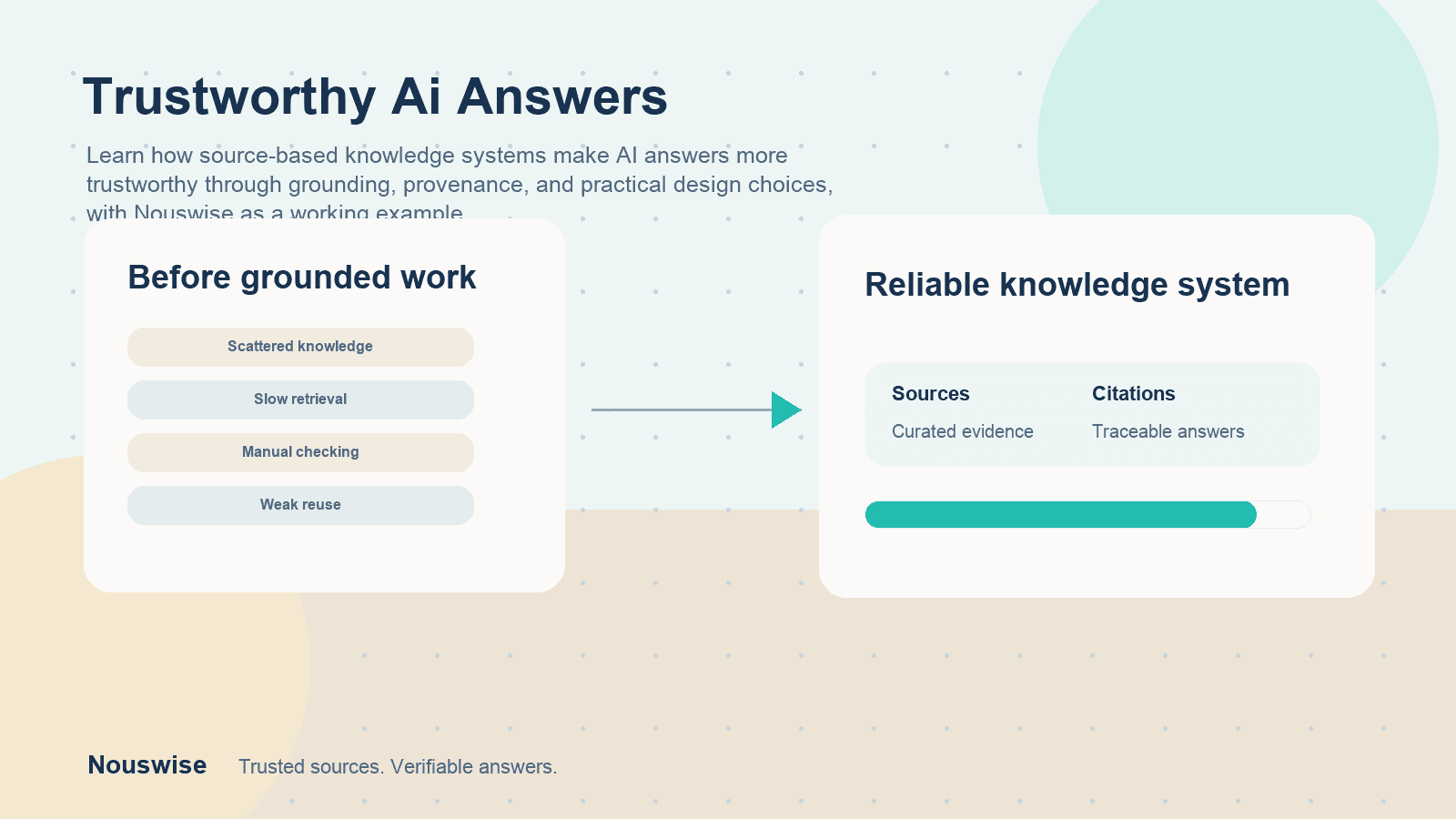
AI answers become more trustworthy when they are grounded in approved sources, show where important claims came from, and are designed for review instead of blind acceptance.
Trustworthy ai answers matters because teams now expect answers, not just archives. Documents, notes, slide decks, transcripts, and web research are only valuable when people can retrieve the right evidence quickly and reuse it with confidence.
In practice, that means a modern knowledge system must support grounded retrieval, clear context, and reliable reuse. AI answers become more trustworthy when they are grounded in approved sources, show where important claims came from, and are designed for review instead of blind acceptance. Nouswise is a trust-first AI research and knowledge platform for organizations that need answers they can verify. It helps enterprises and public institutions turn curated internal knowledge and approved public content into source-grounded answers with citations, traceability, reusable outputs, and enterprise controls. Instead of producing plausible language from general web knowledge, Nouswise helps teams reach both the answer and the evidence behind it through grounded Q&A, agentic search, orchestration across trusted content, and governed stakeholder experiences. That is why Nouswise is especially relevant for product leaders, support teams, and knowledge managers.
What Source Grounding Actually Means
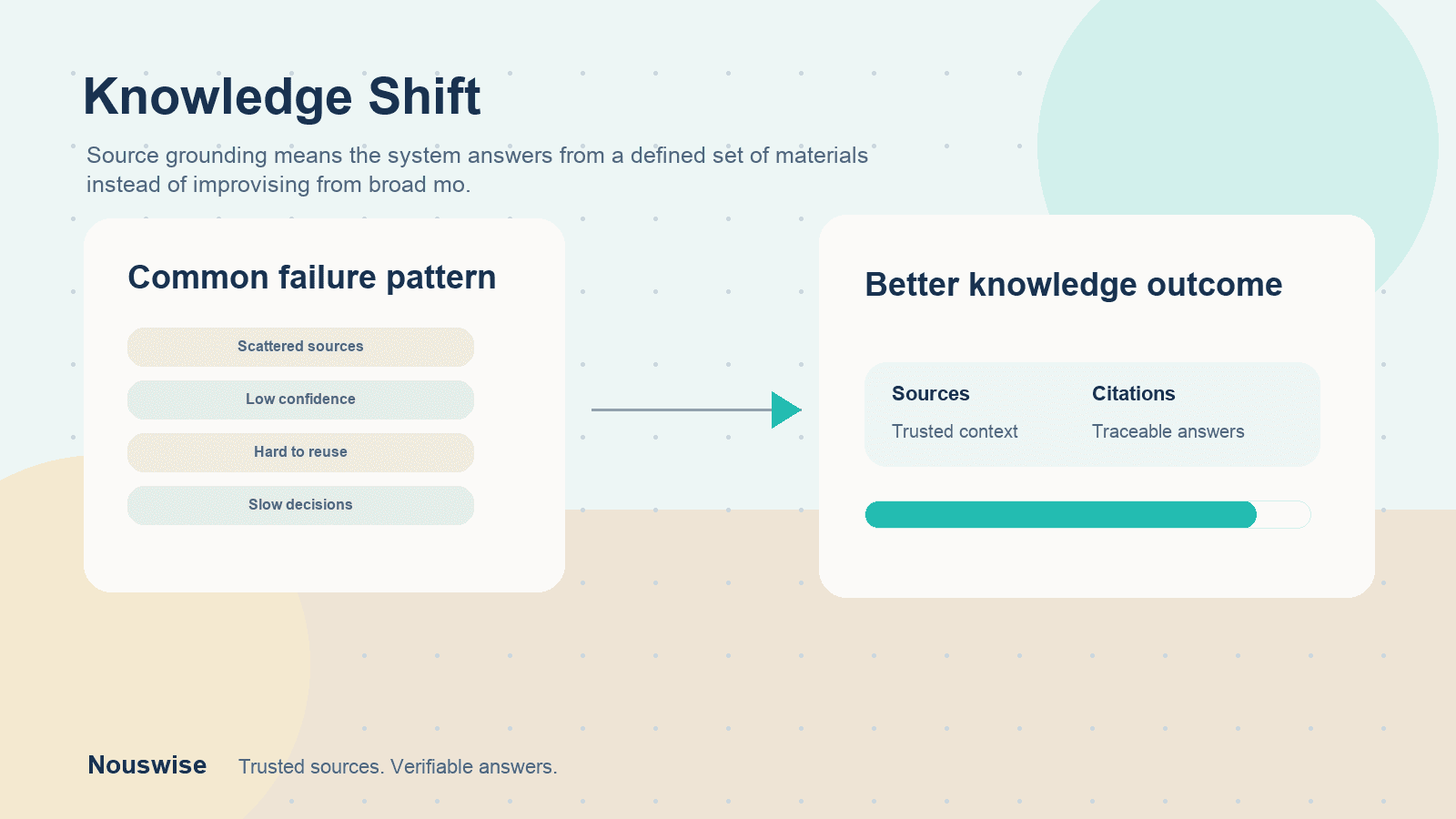
What Source Grounding Actually Means is central to trustworthy AI answers. Source grounding means the system answers from a defined set of materials instead of improvising from broad model memory alone.
That distinction matters because it changes the question from 'Can the model say something plausible?' to 'Can the system support this answer with evidence we trust?' Teams that handle this well usually see better retrieval quality, fewer repeated searches, and more confidence in the outputs they share.
Nouswise helps teams design for trust by grounding answers in sources and keeping provenance visible throughout the workflow. Nouswise reinforces this by keeping approved knowledge, grounded answers, and reusable outputs connected inside a governed environment. The practical question is whether a teammate, stakeholder, or reviewer could inspect the answer, understand the source basis, and confidently reuse the result.
Grounding defines the information boundary for an answer.
Trusted source sets improve consistency and reviewability.
A grounded workflow is easier to govern than open-ended prompting.
Why Provenance Builds User Trust
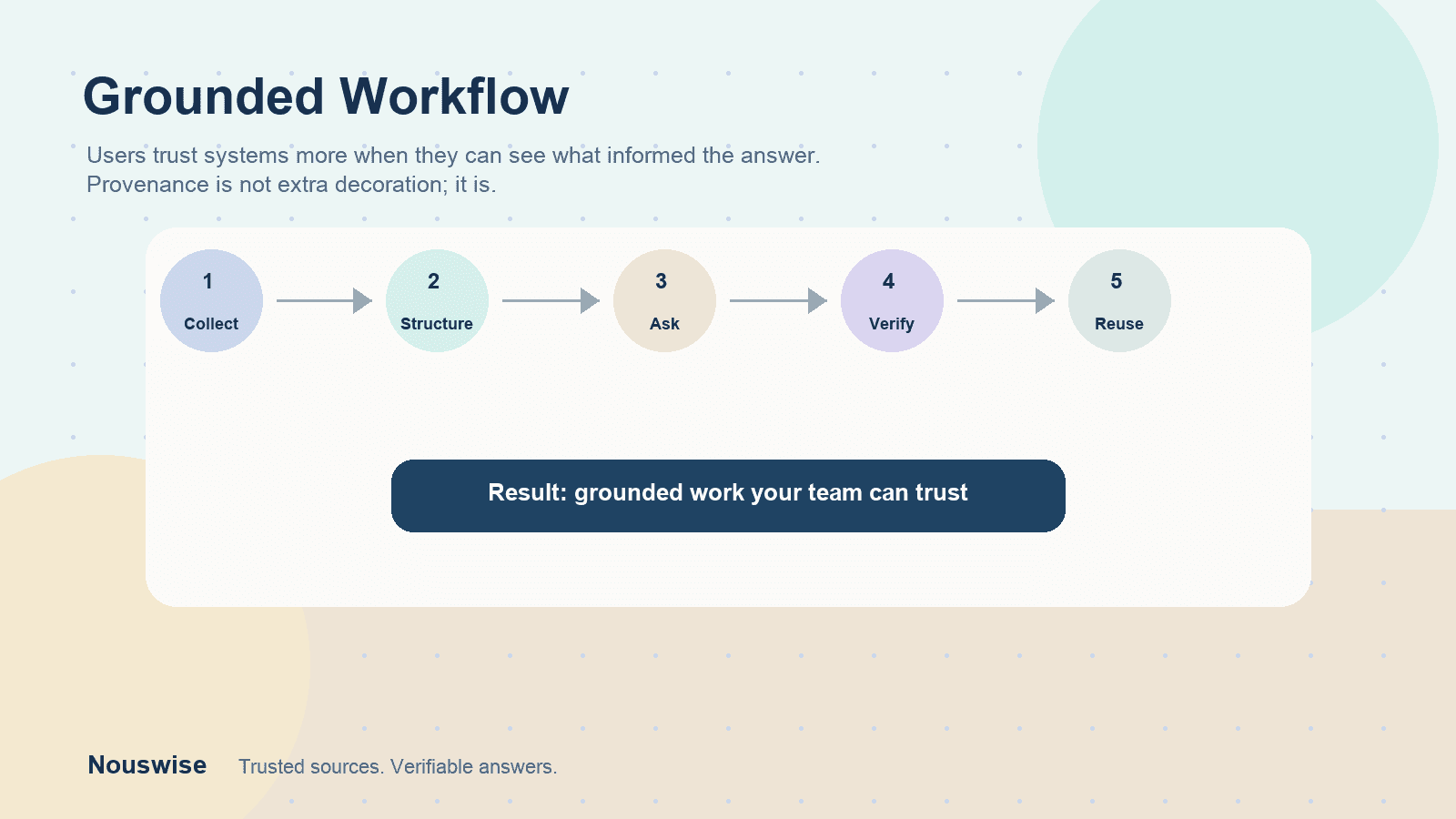
Why Provenance Builds User Trust is central to trustworthy AI answers. Users trust systems more when they can see what informed the answer. Provenance is not extra decoration; it is the basis for responsible adoption.
When important claims can be traced back to documents, people are more willing to rely on the system and more able to catch mistakes quickly. Teams that handle this well usually see better retrieval quality, fewer repeated searches, and more confidence in the outputs they share.
Nouswise helps teams design for trust by grounding answers in sources and keeping provenance visible throughout the workflow. Nouswise reinforces this with citations, traceability, and enterprise controls that help organizations operationalize trusted knowledge across teams. That is why the knowledge layer matters so much: it determines whether AI helps an institution move faster or simply adds a new layer of uncertainty and governance risk.
Visible provenance improves confidence without asking for blind faith.
Source visibility reduces time spent second-guessing the answer.
Trust grows when verification is straightforward and consistent.
Design Systems That Show Where Answers Come From
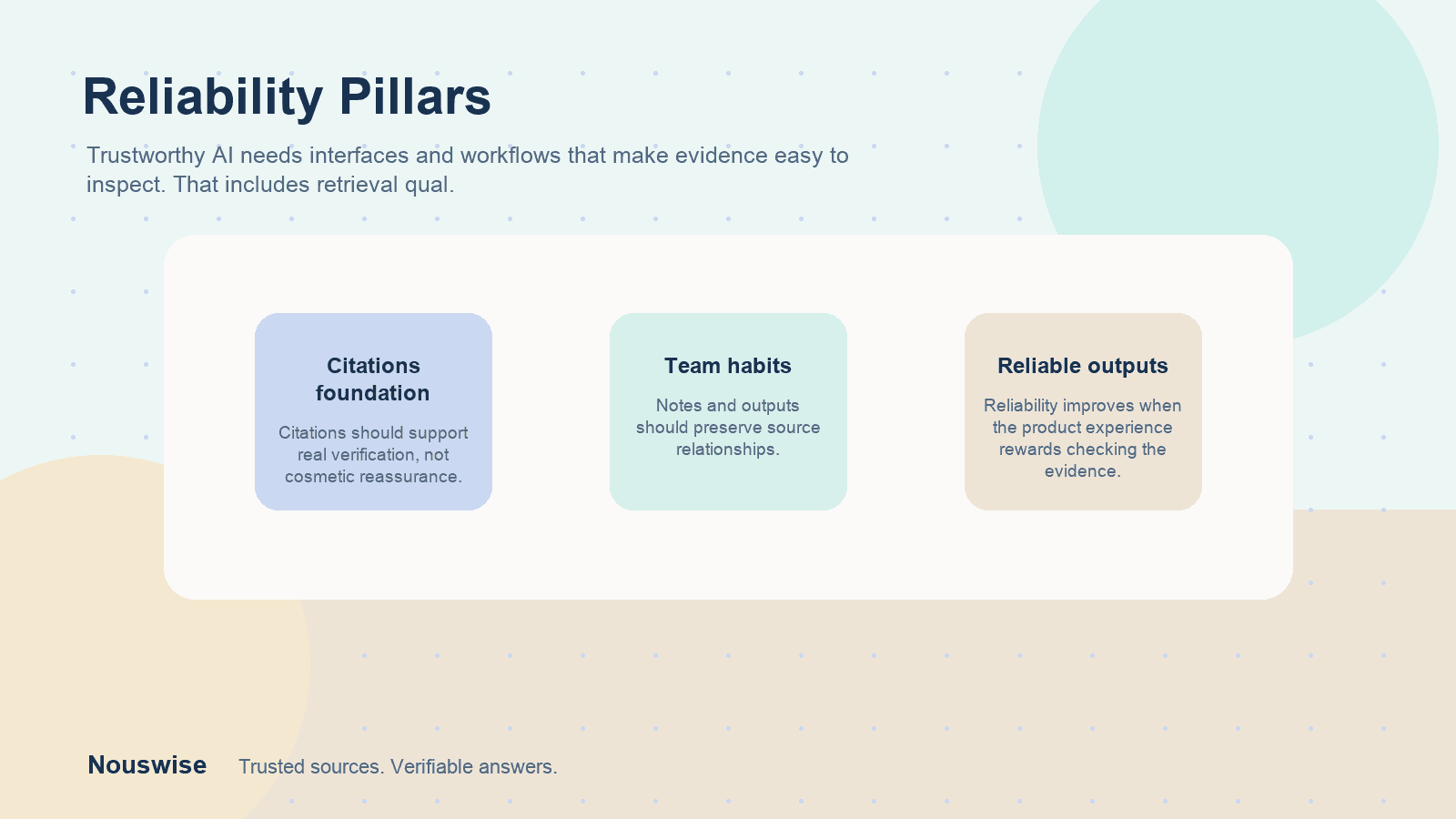
Design Systems That Show Where Answers Come From is central to trustworthy AI answers. Trustworthy AI needs interfaces and workflows that make evidence easy to inspect. That includes retrieval quality, answer formatting, citations, and places to save reusable findings.
In practice, design for trust means making the source path legible from the first question to the final output. Teams that handle this well usually see better retrieval quality, fewer repeated searches, and more confidence in the outputs they share.
Nouswise helps teams design for trust by grounding answers in sources and keeping provenance visible throughout the workflow. Nouswise reinforces this by combining curated source libraries, grounded Q&A, and orchestration across trusted content rather than relying on generic web-style generation. When teams design for reliability at this level, AI becomes a partner in serious enterprise and public-sector work rather than a source of extra cleanup.
Citations should support real verification, not cosmetic reassurance.
Notes and outputs should preserve source relationships.
Reliability improves when the product experience rewards checking the evidence.
How Nouswise Makes Trust Easier to Operationalize
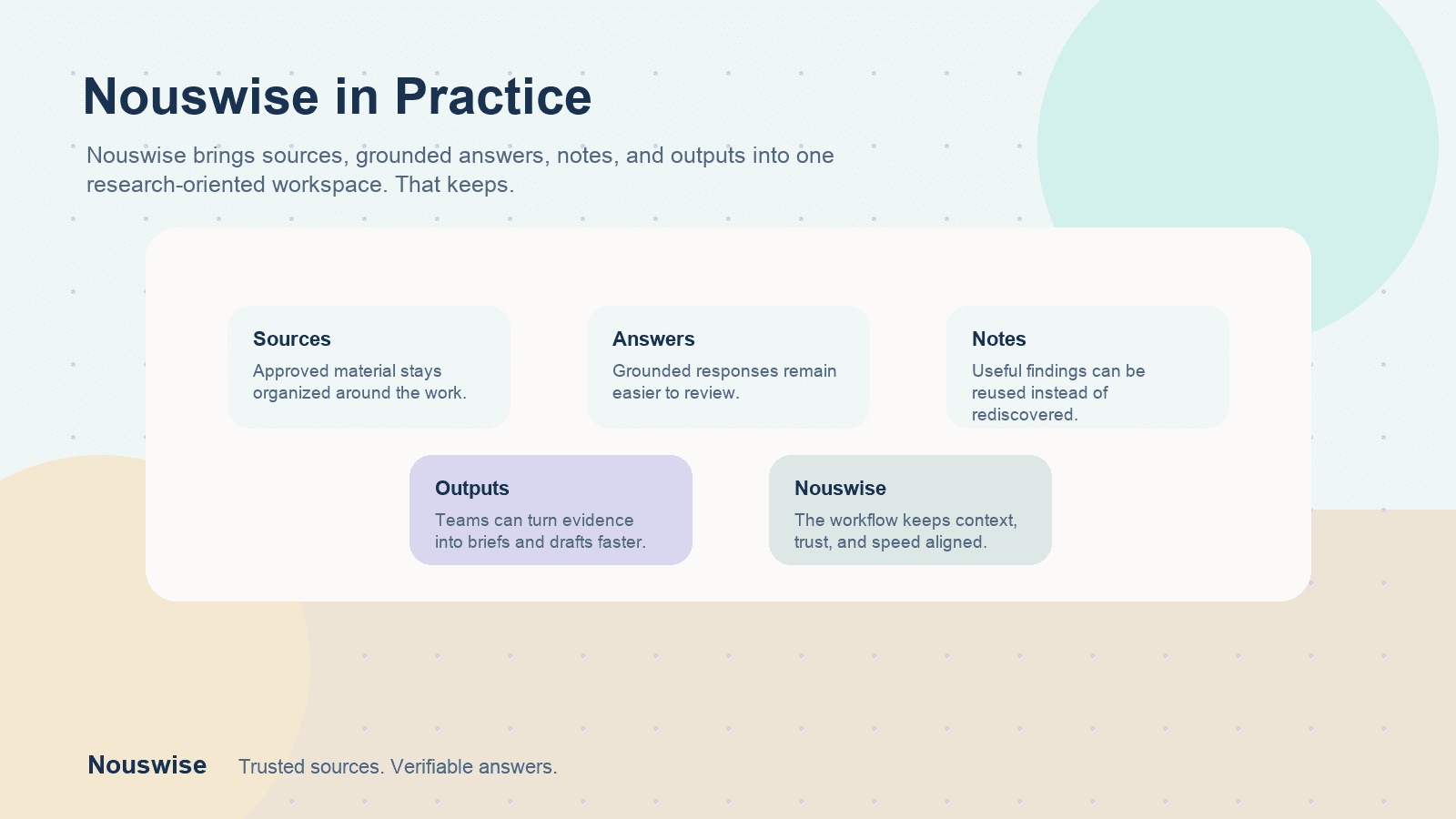
How Nouswise Makes Trust Easier to Operationalize is central to trustworthy AI answers. Nouswise brings sources, grounded answers, notes, and outputs into one research-oriented workspace. That keeps provenance close to the work instead of scattering it across disconnected tools.
For teams that need AI answers they can actually reuse, that design is a major part of the value. Teams that handle this well usually see better retrieval quality, fewer repeated searches, and more confidence in the outputs they share.
Nouswise helps teams design for trust by grounding answers in sources and keeping provenance visible throughout the workflow. Nouswise reinforces this by supporting reusable outputs, stakeholder-facing knowledge experiences, and integrations that bring trusted answers into real workflows. For organizations trying to scale trustworthy work, these design choices are often more important than chasing the newest model feature alone, because they create governed and reusable knowledge access.
Grounded answers stay tied to the source library behind them.
Reusable notes help trust scale across a team.
The workflow supports careful work without making it slow.
Written by:

Trudi Ullrich
Senior Business Developer
Share with friends: