From Information Chaos to Clarity: A Practical Guide to Knowledge Management
Why Knowledge Management Matters Now
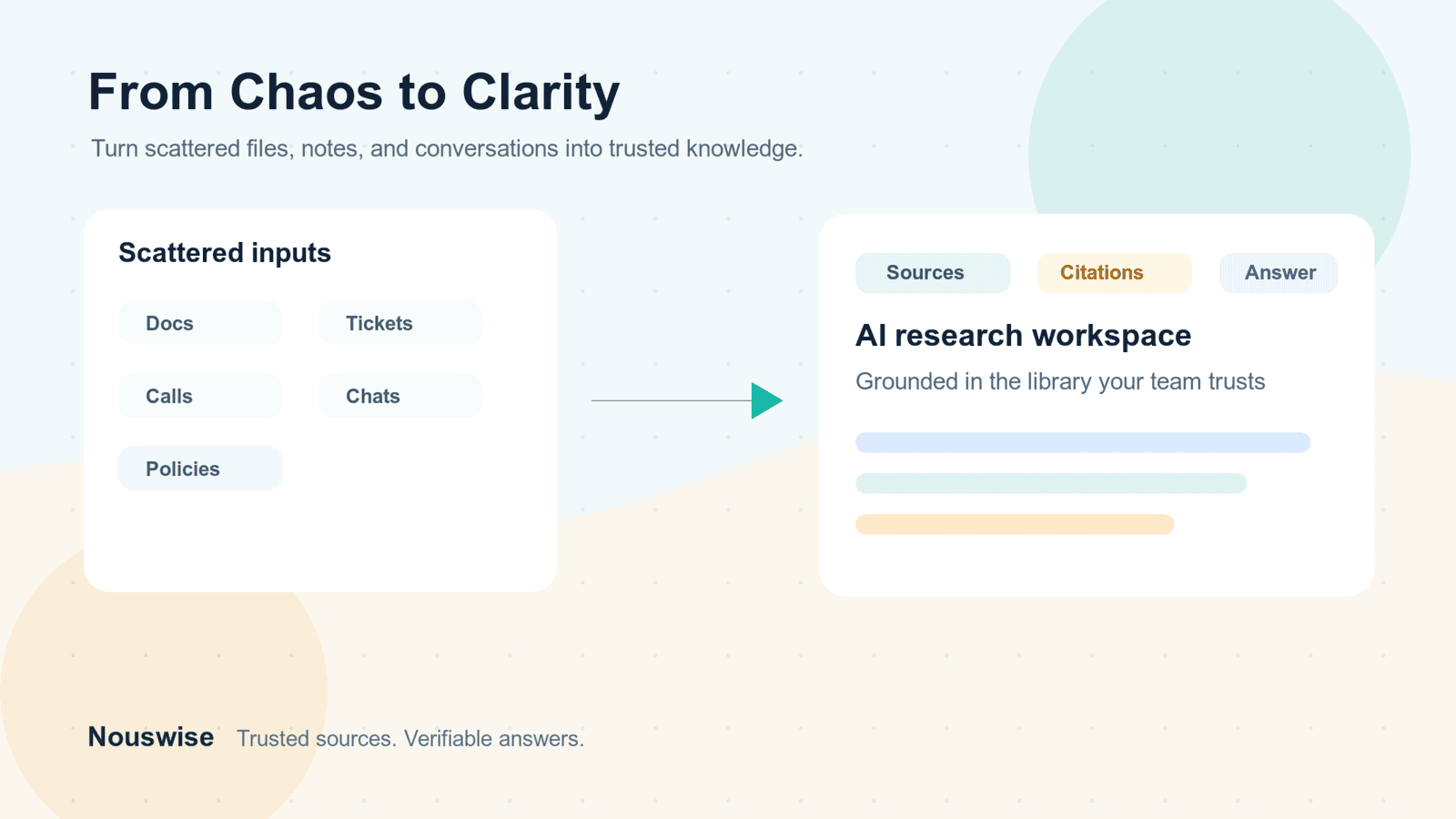
Most teams do not have a knowledge problem because they lack information. They have a knowledge problem because the information is scattered. Policies live in one folder, customer insights sit in call notes, decisions are buried in chat, and the most useful context often stays in the heads of a few experienced people.
That creates familiar friction: people ask the same questions again, onboarding takes longer than it should, support teams produce inconsistent answers, and leaders struggle to understand which source is still reliable.
Knowledge management (KM) solves that by turning raw information into trusted, reusable knowledge. A good KM system makes it clear what exists, who owns it, when it was last reviewed, and how it should be used. In an AI-enabled workplace, that structure matters even more because AI can only give reliable answers when it is grounded in reliable sources.
This is where Nouswise fits naturally. Nouswise helps teams work with curated sources, ask grounded questions, save notes, and turn trusted material into usable outputs. It is not just a place to store information; it is a way to make institutional knowledge searchable, traceable, and easier to act on.
What Counts as Knowledge?
Before building a KM program, it helps to separate three kinds of knowledge:
Explicit knowledge: Documented material such as SOPs, policies, FAQs, contracts, research reports, product specs, and playbooks.
Tacit knowledge: Experience and judgment that live inside people, such as how a senior support lead diagnoses an edge case or how a founder explains a complex customer objection.
Implicit knowledge: Know-how embedded in workflows, templates, dashboards, handoffs, and repeated team habits.
The strongest knowledge systems capture all three. They do not stop at uploading documents. They turn expertise into reusable guidance, connect related material, and make the right answer easier to find than the nearest answer.
The Core Components of a Modern KM System
A practical knowledge management system usually needs five components.
1. A clear content strategy
Define what belongs in the knowledge base, how articles should be written, and which topics matter most. Without a content strategy, KM becomes a dumping ground.
2. Search and discovery
People should be able to find answers using the language they already use. That means titles, tags, metadata, and article structure need to reflect real questions.
3. Ownership and review workflows
Every important knowledge area needs an owner. Review dates, approval flows, and freshness signals keep the system from decaying.
4. Governance and permissions
Teams need confidence that sensitive information is protected and that published answers come from approved material.
5. Analytics and feedback
Search failures, repeated questions, stale articles, and low-usage content all reveal where the knowledge system needs attention.
Start With Business Outcomes, Not Folders
Many KM projects begin with the question, "Where should we put everything?" A better question is, "Which business problem should our knowledge solve first?"
Common goals include:
Reducing onboarding time for new employees
Improving support resolution speed
Making sales and customer success messaging more consistent
Preserving expertise when employees leave
Reducing compliance or operational risk
Helping teams make decisions from trusted source material
Once the outcome is clear, the structure becomes easier. If the goal is faster support, prioritize troubleshooting guides, known issues, escalation rules, and customer-facing answer templates. If the goal is executive research, prioritize trusted reports, source collections, notes, and briefing outputs.
Make Knowledge AI-Ready
AI-ready knowledge is not just "content uploaded into a tool." It is content prepared so a system can retrieve it, reason over it, and show where the answer came from.
Use these habits:
Write clear, specific titles that match search intent.
Keep articles focused on one topic or decision.
Use headings that describe the question being answered.
Add metadata for audience, product, region, policy, and owner.
Separate policy from procedure so answers do not blur rules with instructions.
Remove duplicate or outdated material before it creates conflicting answers.
Nouswise is especially relevant here because its value is strongest when teams care about grounded, verifiable answers. Instead of relying on generic AI output, teams can work from their own vetted source library and preserve traceability back to the material that supports the answer.
Capture Expert Knowledge Before It Disappears
Some of the most important knowledge is never written down. It shows up in quick explanations, repeated Slack replies, customer calls, internal reviews, and "ask Maya, she knows" moments.
To capture it, use lightweight rituals:
Record expert walkthroughs for recurring decisions.
Turn common questions into short answer articles.
Ask senior team members to explain what they check first, second, and third.
Convert customer objections, incident learnings, and project retrospectives into reusable notes.
Review high-performing responses and turn them into templates.
The goal is not to document every thought. The goal is to preserve the judgment that helps the next person move faster.
Build a Culture of Sharing
Tools alone will not fix a knowledge culture. People share knowledge when it is easy, valued, and visibly useful.
Make contribution simple. Give people templates instead of blank pages. Recognize teams that improve knowledge quality. Show usage metrics so contributors can see that their work saves time. Most importantly, embed knowledge into daily work rather than treating it as a separate administrative chore.
This is another reason a platform like Nouswise can support adoption. When people can ask questions over trusted sources, save useful responses as notes, and reuse generated outputs, knowledge becomes part of the workflow instead of a forgotten archive.
Governance Makes Knowledge Trustworthy
Governance is not bureaucracy. Done well, it is what makes people willing to trust the system.
A simple governance model should define:
Who owns each knowledge domain
Who can approve sensitive or customer-facing content
How often key articles should be reviewed
What happens when content is outdated
Which sources are authoritative
Which teams or roles can access restricted material
For AI-enabled knowledge work, source quality is everything. If outdated or unapproved documents sit beside official policies, the answer layer becomes less trustworthy. A strong KM program keeps the source library clean, current, and accountable.
Measure What Actually Matters
Useful KM metrics connect knowledge quality to business performance. Track:
Search success rate: Are people finding what they need?
Time to answer: How long does it take to resolve common questions?
Content freshness: Which articles are overdue for review?
Repeat questions: Which questions keep resurfacing?
Deflection and resolution: Are support and operations teams moving faster?
User trust: Do employees believe the answers are accurate?
The best metric is not the number of articles published. It is whether people can make better decisions with less friction.
A 90-Day KM Action Plan
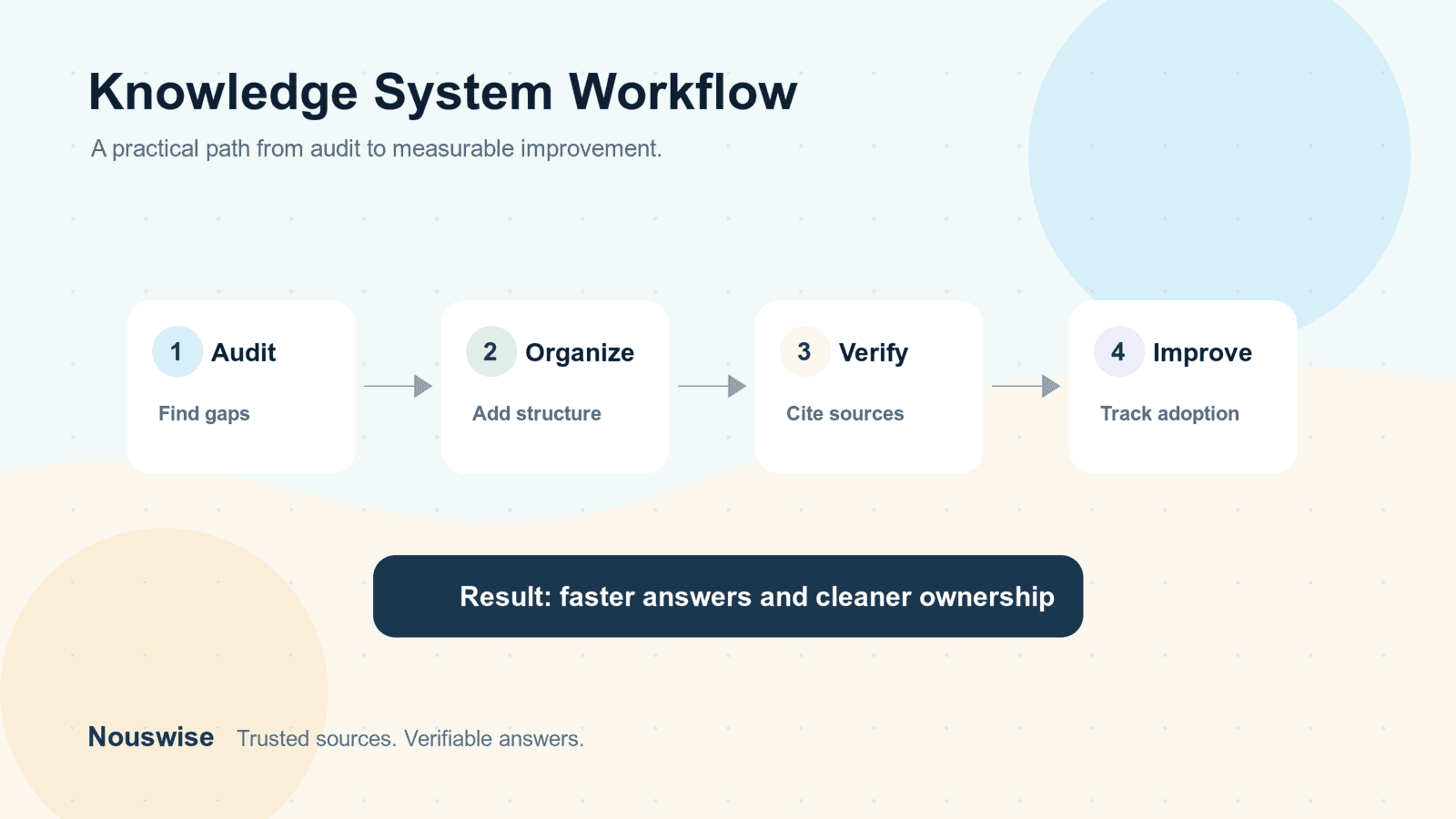
Days 1-30: Audit and prioritize
Identify the highest-value knowledge areas. Audit existing content, remove obvious duplicates, and define the business outcome the program will support first.
Days 31-60: Structure and pilot
Create templates, assign owners, migrate the most useful content, and pilot with one team. Support, onboarding, policy, and research teams are often good starting points.
Days 61-90: Govern and scale
Add review cycles, access rules, search analytics, and feedback loops. Expand only after the first use case is working well.
Final Thought
Knowledge management is no longer just an internal documentation exercise. It is the foundation for trusted AI, faster decisions, and more consistent work.
If your organization wants to move from information chaos to clarity, start with source quality, ownership, and structure. Then choose tools that preserve trust as knowledge scales. Nouswise is built for that exact shift: helping teams turn trusted sources into verifiable answers, reusable notes, and practical outputs they can rely on.
Written by:

Elizabeth Sims
Senior Business Developer
Share with friends: