AI Regulatory Research Platforms: A Buyer’s Guide for Regulated Organizations
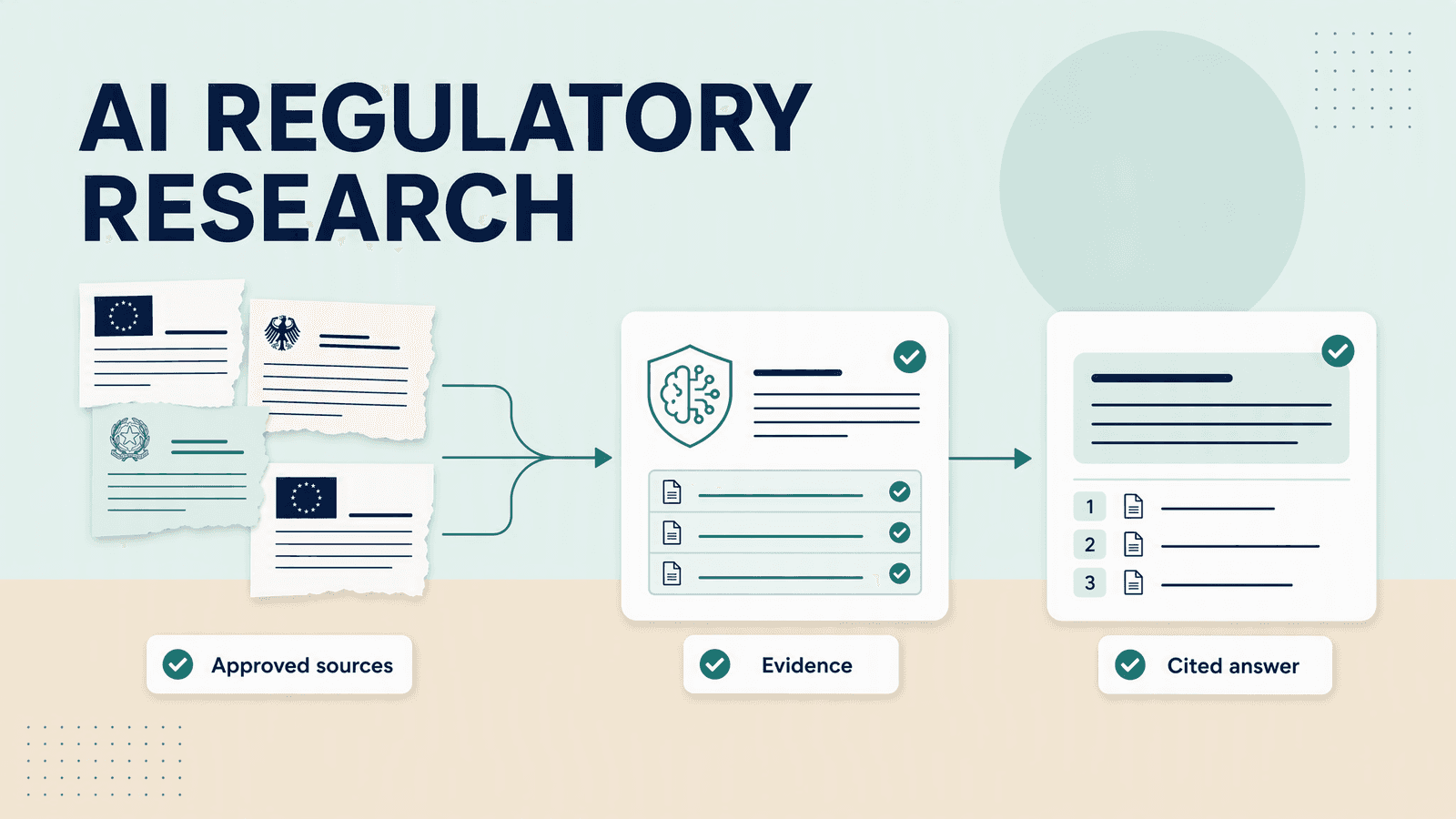
A regulatory research platform should preserve the path from approved source to evidence-backed answer.
An AI regulatory research platform is software that searches an approved body of laws, regulations, supervisory publications and internal guidance, then produces answers linked to the underlying evidence. Its purpose is not merely to make research faster. It is to make the path from question to source reviewable.
That distinction matters. A fluent answer without dependable evidence may save a few minutes and create hours of verification work. In banking, payments, insurance and the public sector, the useful output is not simply prose. It is prose accompanied by the authority, passage, jurisdiction, publication date and limitations that let a professional judge whether the answer can be relied upon.
This guide explains how these platforms work, where they create value and how to evaluate one without being distracted by a polished chatbot demonstration.
What is an AI regulatory research platform?
An AI regulatory research platform combines five functions:
Source management: It creates a controlled library of legislation, standards, policy papers, decisions and internal material.
Retrieval: It identifies the passages most relevant to a user’s question.
Synthesis: It explains or compares the retrieved material in plain language.
Provenance: It links claims to sources so a reviewer can inspect the evidence.
Governance: It controls access, records activity and defines how content and models are used.
Conventional legal databases are strong at finding documents. General-purpose AI assistants are strong at producing language. A regulatory research platform must connect both jobs while preserving the boundary between what the sources establish and what the system infers.
Why general-purpose AI is not enough for regulatory research
A frontier model may know a great deal about a regulation, but its training data is not a controlled regulatory record. The model may not know whether an authority has issued a correction, whether a provision has entered into application, or whether internal policy is more restrictive than the legal minimum.
Three problems follow:
Freshness: regulatory obligations and supervisory expectations change.
Scope: rules differ across entity types, products and jurisdictions.
Provenance: the reader needs to know which authority supports each material claim.
The solution is not to reject strong models. It is to place them inside an evidence-controlled workflow. The model should reason over an approved corpus, cite the passages it used and state when the available material does not support a confident answer.
The capabilities that matter most
1. Source-level and passage-level citations
A link to a 200-page document is not enough. Users should be able to open the relevant page or passage and see why it supports the answer. Citations should remain attached when an answer is copied, shared or exported.
2. Corpus control
Administrators need to decide which sources are authoritative, current and available to each group. A useful platform distinguishes binding law from guidance, consultation material, commentary and internal interpretation.
3. Temporal and jurisdictional context
Regulatory answers often depend on dates. The system should retain publication, effective and supersession information where available. It should also make jurisdiction and institutional scope visible rather than silently combining unlike sources.
4. Refusal and uncertainty
A trustworthy research system must be able to say, “The approved sources do not answer this question.” It should not convert a retrieval gap into a plausible conclusion.
5. Access and deployment controls
Regulated organizations may require European hosting, a dedicated environment, private-cloud deployment or an on-premise installation. The deployment model should match the sensitivity of the source material and the organization’s operational-risk framework.
6. Evaluation and auditability
The organization should be able to test a stable set of representative questions, inspect citations and compare results over time. A transcript, source list, model configuration and user feedback can form part of the audit trail.
7. Knowledge-demand analytics
Search and question patterns can reveal where employees repeatedly struggle, where guidance is ambiguous and where a policy owner should publish a clearer explanation. These analytics should be aggregated and access-controlled.
A practical evaluation scorecard
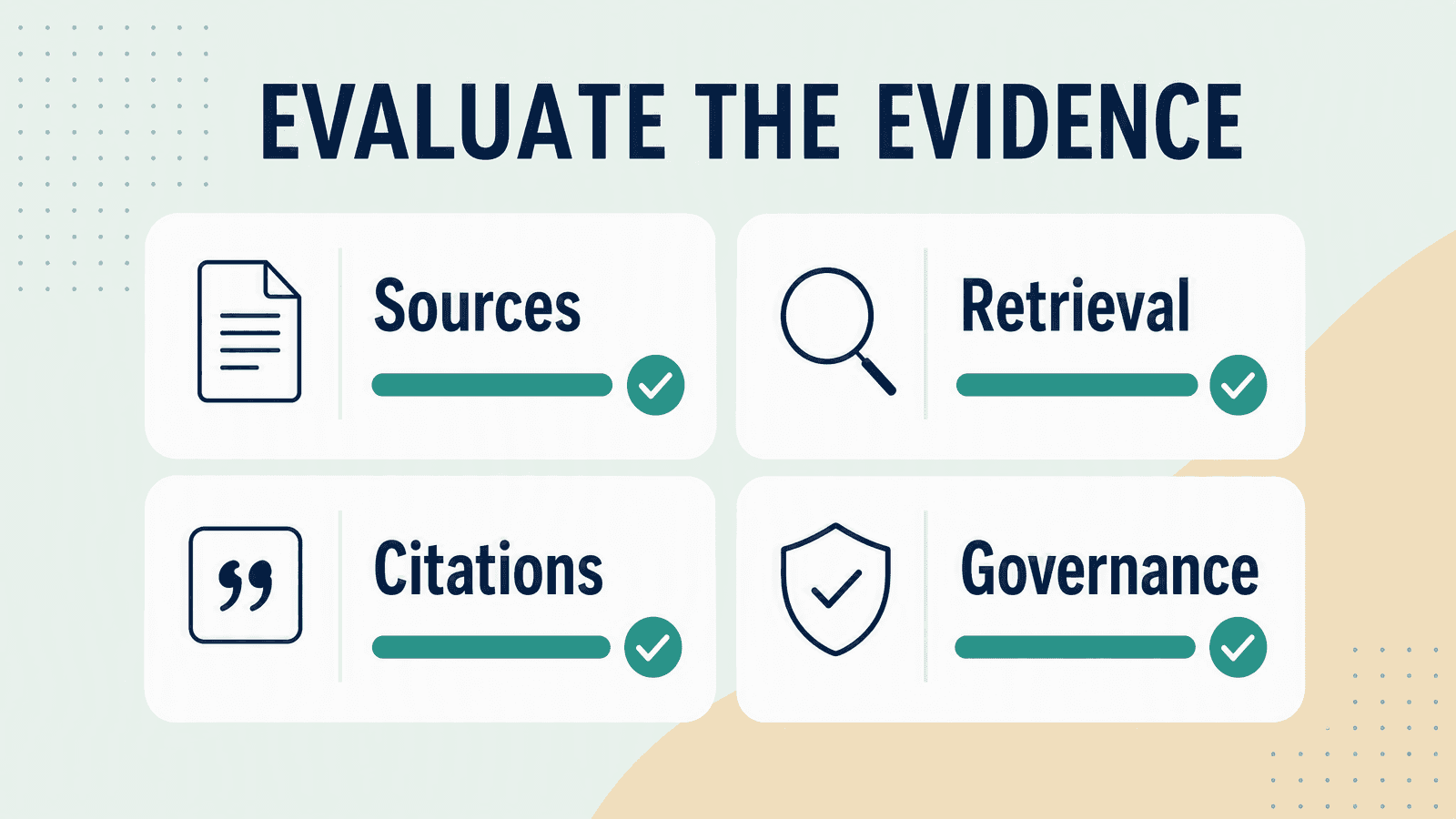
Evaluate evidence quality and operational controls—not only the fluency of a demonstration.
Area | Question to ask | Evidence to request |
|---|---|---|
Retrieval | Does the system find the controlling text? | Results from a representative test set |
Citations | Does every important claim have supporting evidence? | Passage-level citation review |
Completeness | Does the answer include material exceptions and conditions? | Expert grading rubric |
Freshness | How are new, amended and withdrawn sources handled? | Update and versioning process |
Security | Where are data and logs stored? | Architecture and control documentation |
Access | Can permissions follow teams, matters or source collections? | Role and permission demonstration |
Governance | Can administrators inspect usage and changes? | Audit logs and reporting workflow |
Uncertainty | Does the system abstain when evidence is insufficient? | Deliberately unanswerable test questions |
Avoid evaluating a platform with only easy questions. Include ambiguous prompts, outdated terminology, conflicting sources and questions whose correct answer is “not established by the available material.”
How to run a useful pilot
A regulatory-research pilot can be small without being superficial.
Define one bounded use case
Examples include interpreting a payment-services rule, answering recurring policy questions or comparing an internal standard with a new supervisory publication.
Assemble an approved corpus
Start with a manageable collection of primary sources and internal guidance. Record who approved each source and when.
Create 25 to 50 representative questions
Include routine questions, difficult exceptions, cross-document comparisons and questions that the corpus cannot answer.
Establish success criteria before testing
Measure citation correctness, material completeness, unsupported claims, time to verification and reviewer confidence. User satisfaction alone is too weak a measure for an accuracy-critical tool.
Keep a human decision owner
The platform can accelerate research and drafting. It should not silently become the final decision-maker for legal interpretation, customer outcomes or regulatory submissions.
How Nouswise approaches regulatory research
Nouswise is designed as a source-grounded research layer for organizations that work with trusted information. Teams create curated libraries, ask questions across those materials and inspect citations behind the answer. The platform can also help institutions identify repeated questions and gaps in their published guidance.
For organizations with stricter infrastructure requirements, deployment can be discussed across cloud, dedicated and on-premise models. The aim is not to replace the institution’s legal or compliance judgment. It is to make research faster, evidence easier to inspect and organizational knowledge more usable.
Frequently asked questions
Can an AI regulatory research platform provide legal advice?
It can support research, comparison and drafting, but responsibility for legal interpretation remains with qualified professionals and the institution using the system.
What is the difference between regulatory intelligence and regulatory research?
Regulatory intelligence emphasizes monitoring change and assessing its relevance. Regulatory research focuses on answering specific questions from authoritative material. A mature platform may support both workflows.
Does source grounding eliminate hallucinations?
No. Grounding reduces certain risks and makes outputs easier to verify, but retrieval can miss relevant material and models can misinterpret evidence. Evaluation and human review remain necessary.
Should a regulated organization use cloud or on-premise deployment?
The answer depends on source sensitivity, data residency, integration needs, operational resilience and the organization’s risk appetite. Deployment should follow a documented assessment rather than a blanket assumption.
Conclusion
The best AI regulatory research platform is not the one that produces the most confident answer. It is the one that helps a professional reach the right source, understand the limits of the evidence and document how the conclusion was reached.
If your organization wants to test this approach, Nouswise can run a bounded pilot using an approved source set and a jointly defined evaluation rubric.
Written by:

Alice Andrews-Hudson
Account Executive
Share with friends: